Results by title
101 books match the query 'Planning' and 5 start with l
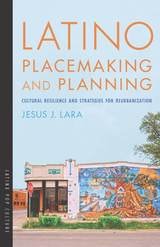
Latino Placemaking and Planning
Cultural Resilience and Strategies for ReurbanizationJesus J. Lara
University of Arizona Press, 2018
Latino Placemaking and Planning offers a pathway to define, analyze, and evaluate the role that placemaking can have with respect to Latino communities in the context of contemporary urban planning, policy, and design practices. Using strategically selected case studies, Jesus J. Lara examines how Latinos contribute to the phenomenon of urban revitalization through the (re)appropriation of physical space for their own use and the consequent transformation of what were previously economically downtrodden areas into vibrant commercial and residential centers.
The book examines the formation of urban cultures and reurbanization strategies from the perspective of Latino urbanism and is divided into four key sections, which address (1) emerging new urban geographies; (2) the power of place and neighborhood selection; (3) Latino urbanism case studies; and (4) lessons and recommendations for “reurbanizing” the city. Latino Placemaking and Planning illustrates the importance of placemaking for Latino communities and provides accessible strategies for planners, students, and activists to sustainable urban revitalization.
Law and Economy in Planning
By Walter Firey
University of Texas Press, 1965
From the beginnings of human association, social planning has been an accepted method for effecting improvements in community, regional, and national life. In Law and Economy in Planning, Walter Firey has made a start in the development of an intellectual framework that will give meaning to the craft of planning and establish a relationship between practice and first principles.
In this study he investigates basic elements of this framework existing in two normative orders: the state, in which a collectivity has the obligation to enforce obedience; and the market, in which the individual has the right to be rational. These normative orders, whose laws are formulated in the disciplines of jurisprudence and economics, have a common concern with the utilization of scarce means to given ends.
These orders, the state and the market, are formulated by the art of planning and have a common relationship to the natural order, which cannot be planned, but only predicted, and which is explained by the science of planning. To bridge the gap between the natural order and the normative order is the function of a philosophy of planning, for which an intellectual framework—of necessity interdisciplinary—is essential.
This study is the culmination of several years of research in the fields of planning and social theory. During the course of this research Firey came to appreciate more and more keenly the need for an interdisciplinary formulation of the planning process and, with this, the need for a philosophical foundation for interdisciplinary work. A year’s fellowship at the Center for Advanced Study in the Behavioral Sciences at Stanford gave him the opportunity to develop his ideas bearing on this subject and to put them in writing.

Libraries Designed for Kids
Nolan Lushington
American Library Association, 2008
Library Camps and Unconferences
American Library Association, 2010
Library Next
Seven Action Steps for ReinventionCatherine Murray-Rust
American Library Association, 2021
After a career of more than 40 years, Murray-Rust, former Dean of Libraries at Georgia Tech and a self-proclaimed library disrupter, sees our profession’s central challenge as simply this: how to turn the library outward in order to make a difference in the lives of individuals and the community. In this book she encourages readers to look an uncertain library future square in the eye. She shares stories from her transformational years at Georgia Tech Libraries which present both inspiration and practical advice on how to stand up for values while changing the ways we act upon them. Organized around seven action steps for change, this book offers takeaways and activities you can adapt to your work style and organizational culture. You will learn from such stories and lessons as
- the three different kinds of information you need for measuring impact;
- using new frameworks, outside fragmented, risk-adverse library structures, to get the work done;
- the limitations of trying to manage your way through major cultural change;
- embedding in the community to develop visions and strategies for improvement;
- painful and challenging times that set Murray-Rust on a path of self-learning;
- how an uncomfortable assignment led to a sought-after seat at the table for a university-wide capital construction project;
- the bold promise that got the library onto the high-priority list for renovation;
- visiting a Toyota plant to learn how to encourage employee engagement and creativity; and
- learning to listen with the "turning outward" philosophy of Harwood Institute.