Results by title
314 books match the query 'Plants' and 7 start with l
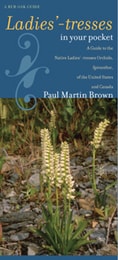
Ladies'-tresses in Your Pocket
A Guide to the Native Ladies'-tresses Orchids, Spiranthes, of the United States and CanadaPaul Martin Brown
University of Iowa Press, 2008
Brown provides general distributional information, time of flowering, and habitat requirements for each species as well as a complete list of hybrids and the many different growth and color forms that can make identifying orchids so intriguing. He includes information on 256 species, 3 additional varieties, and 7 hybrids.
Wild ladies’-tresses occur from British Columbia, with the hooded ladies’-tresses, Spiranthes romanzoffiana, to Florida, with Eaton’s-ladies’-tresses, S. eatonii. The newest species to science, Spiranthes stellata, the starry ladies’-tresses, is featured. Most of these species are easy to identify based upon their general appearance, range, and time of flowering. Answer three simple questions—when, where, and how does it grow? Then compare the living plant with the striking photos in these backpack-friendly laminated guides and consult the keys that Brown has created. Following these steps should enable both professional and amateur naturalists to achieve the satisfaction of identifying specific orchids in their native environment.
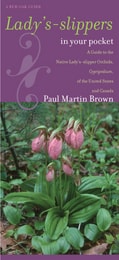
Lady's-slippers in Your Pocket
A Guide to the Native Lady's-slipper Orchids, Cypripedium, of the United States and CanadaPaul Martin Brown
University of Iowa Press, 2008
Brown provides general distributional information, time of flowering, and habitat requirements for each species as well as a complete list of hybrids and the many different growth and color forms that can make identifying orchids so intriguing. For the lady’s-slippers he includes information on 12 species, 2 additional varieties, and 6 hybrids.
Wild lady’s-slippers grow from Alaska, with the spotted lady’s-slipper, Cypripedium guttatum, to Texas, with the ivory-lipped lady’s-slipper, C. kentuckiense. Most of these species are easy to identify based upon their general appearance, range, and time of flowering. Answer three simple questions—when, where, and how does it grow? Then compare the living plant with the striking photos in these backpack-friendly laminated guides and consult the keys that Brown has created. Following these steps should enable both professional and amateur naturalists to achieve the satisfaction of identifying specific orchids in their native environment.
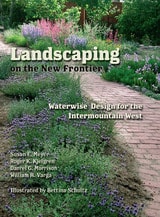
Landscaping on the New Frontier
Waterwise Design for the Intermountain WestSusan E. Meyer, Roger K. Kjelgren, Darrel G. Morrison, and William A. Varga
Utah State University Press, 2009
In this book you will learn how to use natural landscapes to inspire your own designed landscape around your business or home and yard. Included are design principles, practical ideas, and strong examples of what some homeowners have already done to convert traditional "bluegrass" landscapes into ones that are more expressive of theWest. Landscaping on the new Frontier also offers an approach to irrigation that minimizes the use of supplemental water yet ensures the survival of plants during unusually dry periods. You will learn how to combine ecological principles with design principles to create beautiful home landscapes that require only minimal resources to maintain.
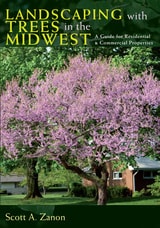
Landscaping with Trees in the Midwest
A Guide for Residential and Commercial PropertiesScott A. Zanon
Ohio University Press, 2014
Trees not only add beauty and value to property but also enhance the physical environment by providing shade, reflecting heat, and blocking wind. Choosing the right trees for the right location and conditions, however, is not always easy: each species has its own requirements for sunlight, water, drainage, and protection.
Landscaping with Trees in the Midwest: A Guide for Residential and Commercial Properties describes sixty-five desirable tree species, their characteristics, and their uses. More than 325 color photographs illustrate the appearance of each species through the seasons—including height, shape, bark, flowers, and fall colors—as well as other factors that influence selection and siting in order to help the landscape professional or homeowner make informed choices.
This guidebook also considers trees as a factor in overall environmental health and gives special consideration to the effects of the emerald ash borer, which continues to wreak havoc in wooded areas of the Midwest, offering replacement alternatives for vulnerable areas. In addition to the text and photos, the book includes a table of growth rates and sizes, a map of hardiness zones, and other valuable reference tools.
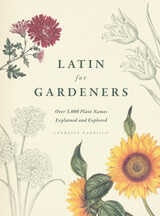
Latin for Gardeners
Over 3,000 Plant Names Explained and ExploredLorraine Harrison
University of Chicago Press, 2012
Since Latin became the standard language for plant naming in the eighteenth century, it has been intrinsically linked with botany. And while mastery of the classical language may not be a prerequisite for tending perennials, all gardeners stand to benefit from learning a bit of Latin and its conventions in the field. Without it, they might buy a Hellebores foetidus and be unprepared for its fetid smell, or a Potentilla reptans with the expectation that it will stand straight as a sentinel rather than creep along the ground.
An essential addition to the gardener’s library, this colorful, fully illustrated book details the history of naming plants, provides an overview of Latin naming conventions, and offers guidelines for pronunciation. Readers will learn to identify Latin terms that indicate the provenance of a given plant and provide clues to its color, shape, fragrance, taste, behavior, functions, and more.
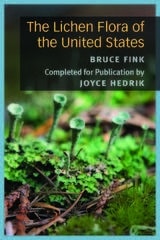
Lichen Flora of the United States
Bruce Fink
University of Michigan Press, 1935
The manual presents a general discussion of the morphology and reproduction of the group. There are descriptions of 1,578 species, varieties, and forms, belonging to 178 genera and 46 families. Keys to the families, genera, and species, 47 plates illustrating 63 species, and an index complete the volume.
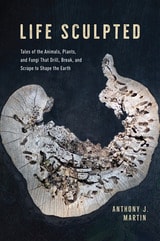
Life Sculpted
Tales of the Animals, Plants, and Fungi That Drill, Break, and Scrape to Shape the EarthAnthony J. Martin
University of Chicago Press, 2023
Meet the menagerie of lifeforms that dig, crunch, bore, and otherwise reshape our planet.
Did you know elephants dig ballroom-sized caves alongside volcanoes? Or that parrotfish chew coral reefs and poop sandy beaches? Or that our planet once hosted a five-ton dinosaur-crunching alligator cousin? In fact, almost since its fascinating start, life was boring. Billions of years ago bacteria, algae, and fungi began breaking down rocks in oceans, a role they still perform today. About a half-billion years ago, animal ancestors began drilling, scraping, gnawing, or breaking rocky seascapes. In turn, their descendants crunched through the materials of life itself—shells, wood, and bones. Today, such “bioeroders” continue to shape our planet—from the bacteria that devour our teeth to the mighty moon snail, always hunting for food, as evidenced by tiny snail-made boreholes in clams and other moon snails.
There is no better guide to these lifeforms than Anthony J. Martin, a popular science author, paleontologist, and co-discoverer of the first known burrowing dinosaur. Following the crumbs of lichens, sponges, worms, clams, snails, octopi, barnacles, sea urchins, termites, beetles, fishes, dinosaurs, crocodilians, birds, elephants, and (of course) humans, Life Sculpted reveals how bioerosion expanded with the tree of life, becoming an essential part of how ecosystems function while reshaping the face of our planet. With vast knowledge and no small amount of whimsy, Martin uses paleontology, biology, and geology to reveal the awesome power of life’s chewing force. He provokes us to think deeply about the past and present of bioerosion, while also considering how knowledge of this history might aid us in mitigating and adapting to climate change in the future. Yes, Martin concedes, sometimes life can be hard—but life also makes everything less hard every day.