Results by title
213 books match the query 'Political parties' and 7 start with l
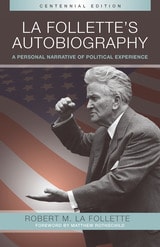
La Follette’s Autobiography
A Personal Narrative of Political ExperiencesRobert M. La Follette; Foreword by Matthew Rothschild
University of Wisconsin Press, 2013
Leadership Organizations in the House of Representatives
Party Participation and Partisan PoliticsScott R. Meinke
University of Michigan Press, 2016
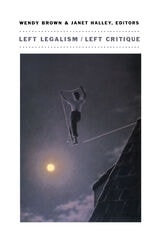
Left Legalism/Left Critique
Wendy Brown and Janet Halley, eds.
Duke University Press, 2002
Brown and Halley have assembled essays from diverse contributors—law professors, philosophers, political theorists, and literary critics—united chiefly by their willingness to think critically from the left about left legal projects. The essays themselves vary by topic, by theoretical approach, and by conclusion. While some contributors attempt to rework particular left legal projects, others insist upon abandoning or replacing those projects. Still others leave open the question of what is to be done as they devote their critical attention to understanding what we are doing. Above all, Left Legalism/Left Critique is a rare contemporary argument and model for the intellectually exhilarating and politically enriching dimensions of left critique—dimensions that persist even, and perhaps especially, when critique is unsure of the intellectual and political possibilities it may produce.
Contributors: Lauren Berlant, Wendy Brown, Judith Butler, Drucilla Cornell, Richard T. Ford, Katherine M. Franke, Janet Halley, Mark Kelman, David Kennedy, Duncan Kennedy, Gillian Lester, Michael Warner
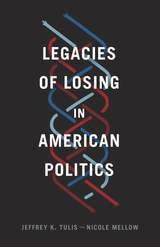
Legacies of Losing in American Politics
Jeffrey K. Tulis and Nicole Mellow
University of Chicago Press, 2017
With Legacies of Losing in American Politics, Jeffrey K. Tulis and Nicole Mellow rethink three pivotal moments in American political history: the founding, when anti-Federalists failed to stop the ratification of the Constitution; the aftermath of the Civil War, when President Andrew Johnson’s plan for restoring the South to the Union was defeated; and the 1964 presidential campaign, when Barry Goldwater’s challenge to the New Deal order was soundly defeated by Lyndon B. Johnson. In each of these cases, the very mechanisms that caused the initial failures facilitated their eventual success. After the dust of the immediate political defeat settled, these seemingly discredited ideas and programs disrupted political convention by prevailing, often subverting, and occasionally enhancing constitutional fidelity. Tulis and Mellow present a nuanced story of winning and losing and offer a new understanding of American political development as the interweaving of opposing ideas.
Lincoln and the Abolitionists
Stanley Harrold
Southern Illinois University Press, 2018
Abraham Lincoln has often been called the “Great Emancipator.” But he was not among those Americans who, decades before the Civil War, favored immediate emancipation of all slaves inside the United States. Those who did were the abolitionists—the men and women who sought freedom and equal rights for all African Americans. Stanley Harrold traces how, despite Lincoln’s political distance from abolitionists, they influenced his evolving political orientation before and during the Civil War.
While explaining how the abolitionist movement evolved, Harrold also clarifies Lincoln’s connections with and his separation from this often fiery group. For most of his life Lincoln regarded abolitionists as dangerous fanatics. Like many northerners during his time, Lincoln sought compromise with the white South regarding slavery, opposed abolitionist radicalism, and doubted that free black people could have a positive role in America. Yet, during the 1840s and 1850s, conservative northern Democrats as well as slaveholders branded Lincoln an abolitionist because of his sympathy toward black people and opposition to the expansion of slavery.
Lincoln’s election to the presidency and the onslaught of the Civil War led to a transformation of his relationship with abolitionists. Lincoln’s original priority as president had been to preserve the Union, not to destroy slavery. Nevertheless many factors—including contacts with abolitionists—led Lincoln to favor ending slavery. After Lincoln issued the Emancipation Proclamation in 1863 and raised black troops, many, though not all, abolitionists came to view him more favorably.
Providing insight into the stressful, evolving relationship between Lincoln and the abolitionists, and also into the complexities of northern politics, society, and culture during the Civil War era, this concise volume illuminates a central concern in Lincoln’s life and presidency.
Lines in the Sand
Congressional Redistricting in Texas and the Downfall of Tom DeLayBy Steve Bickerstaff
University of Texas Press, 2007
The events of 2003 in Texas were important to the political history of this country. Congressman Tom DeLay led a Republican effort to gerrymander the state's thirty-two congressional districts to defeat all ten of the Anglo Democratic incumbents and to elect more Republicans; Democratic state lawmakers fled the state in an effort to defeat the plan. The Lone Star State uproar attracted attention worldwide. The Republicans won this showdown, gaining six additional seats from Texas and protecting the one endangered Republican incumbent. Some of the methods used by DeLay to achieve this result, however, led to his criminal indictment and ultimately to his downfall.
With its eye-opening research, readable style, and insightful commentary, Lines in the Sand provides a front-line account of what happened in 2003, often through the personal stories of members of both parties and of the minority activist groups caught in a political vortex. Law professor Steve Bickerstaff provides much-needed historical perspective and also probes the aftermath of the 2003 redistricting, including the criminal prosecutions of DeLay and his associates and the events that led to DeLay's eventual resignation from the U.S. House of Representatives. As a result, Bickerstaff graphically shows a dark underside of American politics—the ruthless use of public institutional power for partisan gain.
Losing to Win
Why Congressional Majorities Play Politics Instead of Make LawsJeremy Gelman
University of Michigan Press, 2020
Losing to Win answers these questions through a novel theory of agenda-setting. Unlike other research that studies bills that become law, Jeremy Gelman begins from the opposite perspective. He studies why majority parties knowingly take up dead-on-arrival (DOA) bills, the ideas everyone knows are going to lose. In doing so, he argues that congressional parties’ decisions to play politics instead of compromising, and the topics on which they choose to bicker, are strategic and predictable. Gelman finds that legislative dysfunction arises from a mutually beneficial relationship between a majority party in Congress, which is trying to win unified government, and its allied interest groups, which are trying to enact their policies. He also challenges the conventional wisdom that DOA legislation is political theater. By tracking bills over time, Gelman shows that some former dead-on-arrival ideas eventually become law. In this way, ideas viewed as too extreme or partisan today can produce long-lasting future policy changes.
Through his analysis, Gelman provides an original explanation for why both parties pursue the partisan bickering that voters find so frustrating. He moves beyond conventional arguments that our discordant politics are merely the result of political polarization. Instead, he closely examines the specific circumstances that give rise to legislative dysfunction. The result is a fresh, straightforward perspective on the question we have all asked at some point, “Why can’t Democrats and Republicans stop fighting and just get something done?”