Results by title
191 books match the query 'Politics and literature' and 11 start with l
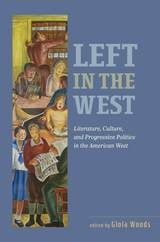
Left in the West
Literature, Culture, and Progressive Politics in the American WestGioia Woods
University of Nevada Press, 2018
From the early 19th century to the present, a remarkably complex and varied body of literary and cultural production has emerged out of progressive social movements. While the literary left in the West shared many interests with other regional expressions—labor, class, anti-fascism, and anti-imperialism, the influence of Manifest Destiny—the distinct history of settler colonialism in western territories caused western leftists to develop concerns unique to the region.
Chapters in the volume provide an impressive range of analysis, covering artists and movements from suffragist writers to bohemian Californian photographers, from civil rights activists to popular folk musicians, from Latinx memoirists to Native American experimental writers, to name just a few.
The unique consideration of the West as a socio-political region establishes a framework for political critique that moves beyond class consequences, anti-fascism, and civil liberties, and into distinct Western concerns such as Native American sovereignty, environmental exploitation, and the legacies of settler colonialism. What emerges is a deeper understanding of the region and its unique people, places, and concerns.
Liberalism and the Culture of Security
The Nineteenth-Century Rhetoric of ReformKatherine Henry
University of Alabama Press, 2011
Rethinking the language of liberty, protection, and citizenship in nineteenth-century America.
Figures of protection and security are everywhere in American public discourse, from the protection of privacy or civil liberties to the protection of marriage or the unborn, and from social security to homeland security. Liberalism and the Culture of Security traces a crucial paradox in historical and contemporary notions of citizenship: in a liberal democratic culture that imagines its citizens as self-reliant, autonomous, and inviolable, the truth is that claims for citizenship—particularly for marginalized groups such as women and slaves—have just as often been made in the name of vulnerability and helplessness.
Katherine Henry traces this turn back to the eighteenth-century opposition of liberty and tyranny, which imagined our liberties as being in danger of violation by the forces of tyranny and thus in need of protection. She examines four particular instances of this rhetorical pattern. The first chapters show how women’s rights and antislavery activists in the antebellum era exploited the contradictions that arose from the liberal promise of a protected citizenry: first by focusing primarily on arguments over slavery in the 1850s that invoke the Declaration of Independence, including Harriet Beecher Stowe’s fiction and Frederick Douglass’s “Fourth of July” speech; and next by examining Angelina Grimké’s brief but intense antislavery speaking career in the 1830s.
New conditions after the Civil War and Emancipation changed the way arguments about civic inclusion and exclusion could be advanced. Henry considers the issue of African American citizenship in the 1880s and 1890s, focusing on the mainstream white Southern debate over segregation and the specter of a tyrannical federal government, and then turning to Frances E. W. Harper’s fictional account of African American citizenship in Iola Leroy. Finally, Henry examines Henry James’s 1886 novel The Bostonians, in which arguments over the appropriate role of women and the proper place of the South in post–Civil War America are played out as a contest between Olive Chancellor and Basil ransom for control over the voice of the eloquent girl Verena Tarrant.
Line Break
Poetry as Social PracticeJames Scully
Northwestern University Press, 2005
Lineages of the Literary Left
Essays in Honor of Alan M. WaldHoward Brick, Robbie Lieberman, and Paula Rabinowitz, Editors
Michigan Publishing Services, 2015

Literary Politics in the Soviet Ukraine, 1917-1934
George S. N. Luckyj
Duke University Press, 1990
The new edition reissues Luckyj’s critical work in light of current political developments and reflects the revision of previous findings. Luckyj originally drew on published Soviet sources and the important unpublished papers of a Soviet Ukrainian writer who defected to the West to describe how the brief literary revival in the Soviet Ukraine in the 1920s was abruptly halted by Communist Party controls. The present volume features a new preface, an additional chapter covering recent Soviet attitudes toward the literature of the 1920s and 1930s, and an updated bibliography.
Literature and Politics in the Central American Revolutions
By John Beverley and Marc Zimmerman
University of Texas Press, 1990
“This book began in what seemed like a counterfactual intuition . . . that what had been happening in Nicaraguan poetry was essential to the victory of the Nicaraguan Revolution,” write John Beverley and Marc Zimmerman. “In our own postmodern North American culture, we are long past thinking of literature as mattering much at all in the ‘real’ world, so how could this be?” This study sets out to answer that question by showing how literature has been an agent of the revolutionary process in Nicaragua, El Salvador, and Guatemala.
The book begins by discussing theory about the relationship between literature, ideology, and politics, and charts the development of a regional system of political poetry beginning in the late nineteenth century and culminating in late twentieth-century writers. In this context, Ernesto Cardenal of Nicaragua, Roque Dalton of El Salvador, and Otto René Castillo of Guatemala are among the poets who receive detailed attention.
Literature and Resistance in Guatemala
Textual Modes and Cultural Politics from El Señor Presidente to Rigoberta MenchúMarc Zimmerman
Ohio University Press, 1994
Literature in Exile
John Glad, ed.
Duke University Press, 1990
The volume includes writers whose origins lie in Central Europe, South Africa, Israel, Cuba, Chile, Somalia, and Turkey. Through their testimony of the creative process in exile, we gain insight into the forces which affect the creative process as a whole.
Contributors. William Gass, Yury Miloslavsky, Jan Vladislav, Jiri Grusa, Guillermo Cabrera Infante, Horst Bienek, Edward Limonov, Nedim Gursel, Nuruddin Farah, Jaroslav Vejvoda, Anton Shammas, Joseph Brodsky, Wojciech Karpinski, Thomas Venclova, Yuri Druzhnikov
Little House, Long Shadow
Laura Ingalls Wilder's Impact on American CultureAnita Clair Fellman
University of Missouri Press, 2008
Beyond their status as classic children’s stories, Laura Ingalls Wilder’s Little House books play a significant role in American culture that most people cannot begin to appreciate. Millions of children have sampled the books in school; played out the roles of Laura and Mary; or visited Wilder homesites with their parents, who may be fans themselves. Yet, as Anita Clair Fellman shows, there is even more to this magical series with its clear emotional appeal: a covert political message that made many readers comfortable with the resurgence of conservatism in the Reagan years and beyond.
In Little House, Long Shadow, a leading Wilder scholar offers a fresh interpretation of the Little House books that examines how this beloved body of children’s literature found its way into many facets of our culture and consciousness—even influencing the responsiveness of Americans to particular political views. Because both Wilder and her daughter, Rose Wilder Lane, opposed the New Deal programs being implemented during the period in which they wrote, their books reflect their use of family history as an argument against the state’s protection of individuals from economic uncertainty. Their writing emphasized the isolation of the Ingalls family and the family’s resilience in the face of crises and consistently equated self-sufficiency with family acceptance, security, and warmth.
Fellman argues that the popularity of these books—abetted by Lane’s overtly libertarian views—helped lay the groundwork for a negative response to big government and a positive view of political individualism, contributing to the acceptance of contemporary conservatism while perpetuating a mythic West. Beyond tracing the emergence of this influence in the relationship between Wilder and her daughter, Fellman explores the continuing presence of the books—and their message—in modern cultural institutions from classrooms to tourism, newspaper editorials to Internet message boards.
Little House, Long Shadow shows how ostensibly apolitical artifacts of popular culture can help explain shifts in political assumptions. It is a pioneering look at the dissemination of books in our culture that expands the discussion of recent political transformations—and suggests that sources other than political rhetoric have contributed to Americans’ renewed appreciation of individualist ideals.
Love and Politics in the Contemporary Spanish American Novel
By Aníbal González
University of Texas Press, 2010
The Latin American Literary Boom was marked by complex novels steeped in magical realism and questions of nationalism, often with themes of surreal violence. In recent years, however, those revolutionary projects of the sixties and seventies have given way to quite a different narrative vision and ideology. Dubbed the new sentimentalism, this trend is now keenly elucidated in Love and Politics in the Contemporary Spanish American Novel.
Offering a rich account of the rise of this new mode, as well as its political and cultural implications, Aníbal González delivers a close reading of novels by Miguel Barnet, Elena Poniatowska, Isabel Allende, Alfredo Bryce Echenique, Gabriel García Márquez, Antonio Skármeta, Luis Rafael Sánchez, and others. González proposes that new sentimental novels are inspired principally by a desire to heal the division, rancor, and fear produced by decades of social and political upheaval. Valuing pop culture above the avant-garde, such works also tend to celebrate agape—the love of one's neighbor—while denouncing the negative effects of passion (eros). Illuminating these and other aspects of post-Boom prose, Love and Politics in the Contemporary Spanish American Novel takes a fresh look at contemporary works.
Lydia Sigourney
Critical Essays and Cultural ViewsMary Louise Kete
University of Massachusetts Press, 2018
During her lifetime, Lydia Sigourney was acclaimed as nineteenth-century America's most popular woman poet and published widely as a historian, travel writer, essayist, and educator. While serious critical attention to her work languished following her death and into the twentieth century, a growing number of critics and writers have reexamined Sigourney and her large body of writing and have given her a central place in the “new canon.”
This first collection of original essays devoted to the poet's work puts many of the best scholars on Sigourney together in one place and in conversation with one another. The volume includes critical essays examining her literary texts as well as essays that unpack Sigourney's participation in the cultural movements of her day. Holding powerful opinions about the role of women in society, Sigourney was not afraid to advocate against government policies that, in her view, undermined the promise of America, even as she was held up as a paragon of American womanhood and middle-class rectitude. The resulting portrait promises to engage readers who wish to know more about Sigourney's writing, her career, and the causes that inspired her.
Along with the volume editors, contributors include Ann Beebe, Paula Bernat Bennett, Janet Dean, Sean Epstein-Corbin, Annie Finch, Gary Kelly, Paul Lauter, Amy J. Lueck, Ricardo Miguel-Alfonso, Jennifer Putzi, Angela Sorby, Joan Wry, and Sandra Zagarell.