Results by title
102 books match the query 'Poor' and 2 start with l
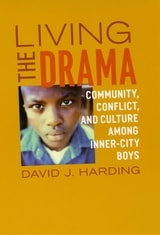
Living the Drama
Community, Conflict, and Culture among Inner-City BoysDavid J. Harding
University of Chicago Press, 2010
For the middle class and the affluent, local ties seem to matter less and less these days, but in the inner city, your life can be irrevocably shaped by what block you live on. Living the Drama takes a close look at three neighborhoods in Boston to analyze the many complex ways that the context of community shapes the daily lives and long-term prospects of inner-city boys.
David J. Harding studied sixty adolescent boys growing up in two very poor areas and one working-class area. In the first two, violence and neighborhood identification are inextricably linked as rivalries divide the city into spaces safe, neutral, or dangerous. Consequently, Harding discovers, social relationships are determined by residential space. Older boys who can navigate the dangers of the streets serve as role models, and friendships between peers grow out of mutual protection. The impact of community goes beyond the realm of same-sex bonding, Harding reveals, affecting the boys’ experiences in school and with the opposite sex. A unique glimpse into the world of urban adolescent boys, Living the Drama paints a detailed, insightful portrait of life in the inner city.
David J. Harding studied sixty adolescent boys growing up in two very poor areas and one working-class area. In the first two, violence and neighborhood identification are inextricably linked as rivalries divide the city into spaces safe, neutral, or dangerous. Consequently, Harding discovers, social relationships are determined by residential space. Older boys who can navigate the dangers of the streets serve as role models, and friendships between peers grow out of mutual protection. The impact of community goes beyond the realm of same-sex bonding, Harding reveals, affecting the boys’ experiences in school and with the opposite sex. A unique glimpse into the world of urban adolescent boys, Living the Drama paints a detailed, insightful portrait of life in the inner city.
[more]
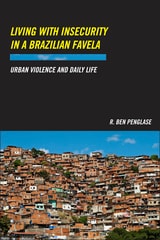
Living with Insecurity in a Brazilian Favela
Urban Violence and Daily LifePenglase, R. Ben
Rutgers University Press, 2015
The residents of Caxambu, a squatter neighborhood in Rio de Janeiro, live in a state of insecurity as they face urban violence. Living with Insecurity in a Brazilian Favela examines how inequality, racism, drug trafficking, police brutality, and gang activities affect the daily lives of the people of Caxambu. Some Brazilians see these communities, known as favelas, as centers of drug trafficking that exist beyond the control of the state and threaten the rest of the city. For other Brazilians, favelas are symbols of economic inequality and racial exclusion. Ben Penglase’s ethnography goes beyond these perspectives to look at how the people of Caxambu themselves experience violence.
Although the favela is often seen as a war zone, the residents are linked to each other through bonds of kinship and friendship. In addition, residents often take pride in homes and public spaces that they have built and used over generations. Penglase notes that despite poverty, their lives are not completely defined by illegal violence or deprivation. He argues that urban violence and a larger context of inequality create a social world that is deeply contradictory and ambivalent. The unpredictability and instability of daily experiences result in disagreements and tensions, but the residents also experience their neighborhood as a place of social intimacy. As a result, the social world of the neighborhood is both a place of danger and safety.
[more]