Results by title
52 books match the query 'Postcolonialism in literature' and 3 start with l

Left Turns in Brown Study
Sandra Ruiz
Duke University Press, 2024
In Left Turns in Brown Study Sandra Ruiz offers a poetic-theoretical inquiry into the interlacing forms of study and mourning. Drawing on Black and Brown activism and theory, Ruiz interweaves poetry, memoir, lyrical essay, and vignettes to examine study as an emancipatory practice. Proposing “brown study” as key for understanding how Brownness harbors loss and suffering along with the possibility for more abundant ways of living, Ruiz invites readers to turn left into the sounds, phrases, and principles of anticolonial ways of reading, writing, citing, and listening. In doing so, Ruiz engages with a panoply of hauntings, ghosts, and spectral presences, from deceased teachers, illiterate ancestors, and those lost to unnatural disasters to all those victims of institutional and colonial violence. Study is shared movement and Brownness lives in citation. Conceptual, poetic, and unconventional, this book is crucial for all those who theorize minoritarian literary aesthetics and think through utopia, queer possibility, and the entwinement of forms.
[more]
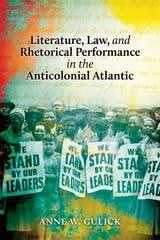
Literature, Law, and Rhetorical Performance in the Anticolonial Atlantic
Anne W. Gulick
The Ohio State University Press, 2016
The era of national liberation and decolonization may have come and gone, but postcolonialism remains a largely elusive ideal in the early twenty-first century. In Literature, Law, and Rhetorical Performance in the Anticolonial Atlantic, Anne W. Gulick uncovers a dynamic literary history of African and Caribbean critical engagements with First World law. This transatlantic archive attests to the continuing vitality of anticolonialism as a model for intellectual inquiry and political performance. Gulick argues that experimentation with declarative forms is a vital rhetorical strategy in the anticolonial Atlantic—one through which writers have asked: Who gets to “write” the law, and under what circumstances?
Responses to this question take shape across the black Atlantic from Haiti to South Africa, in texts ranging from Haiti’s Declaration of Independence and work by C. L. R. James to South Africa’s Freedom Charter, Aimé Césaire’s poem Notebook of a Return to the Native Land, and Ngugi wa Thiong’o’s A Grain of Wheat. These texts constitute a robust transatlantic tradition of challenging colonial and imperial authority through rhetorical performance. Drawing on the cosmopolitan aspirations and emancipatory energies of the political declaration, this tradition aims to radically reinvent the possibilities for law and political belonging in the postcolonial future.
Responses to this question take shape across the black Atlantic from Haiti to South Africa, in texts ranging from Haiti’s Declaration of Independence and work by C. L. R. James to South Africa’s Freedom Charter, Aimé Césaire’s poem Notebook of a Return to the Native Land, and Ngugi wa Thiong’o’s A Grain of Wheat. These texts constitute a robust transatlantic tradition of challenging colonial and imperial authority through rhetorical performance. Drawing on the cosmopolitan aspirations and emancipatory energies of the political declaration, this tradition aims to radically reinvent the possibilities for law and political belonging in the postcolonial future.
[more]
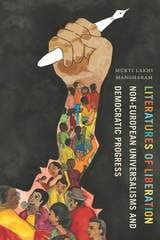
Literatures of Liberation
Non-European Universalisms and Democratic ProgressMukti Lakhi Mangharam
The Ohio State University Press, 2017
The postcolonial spread of democratic ideals such as freedom and equality has taken place all over the world despite the widespread cultural differences that would seem to inhibit such change. In her new book, Literatures of Liberation: Non-European Universalisms and Democratic Progress, Mukti Lakhi Mangharam questions how these “universalisms” came to be and suggests that these elements were not solely the result of Europe-based Enlightenment ideals. Instead, they also arose in context-specific forms throughout the world (particularly in the Global South), relatively independently from Enlightenment concepts. These translatable yet distinct cognitive frameworks, or “contextual universalisms,” as she argues, were central to the spread of modern democratic principles in response to the relentless expansion of capital.
In this way, she posits that these universalisms reconceptualize democratic ideals not as Western imports into precolonial societies but as regional phenomena tied to local relations of power and resistance. In charting these alternative democratic trajectories, Mangharam examines oft-overlooked regional and vernacular literary forms and provides a fresh approach to current theorizations of postcolonial and world literatures.
In this way, she posits that these universalisms reconceptualize democratic ideals not as Western imports into precolonial societies but as regional phenomena tied to local relations of power and resistance. In charting these alternative democratic trajectories, Mangharam examines oft-overlooked regional and vernacular literary forms and provides a fresh approach to current theorizations of postcolonial and world literatures.
[more]