Results by title
56 books match the query 'Press' and 2 start with l

Last Rights
Revisiting *Four Theories of the Press*Edited by John C. Nerone
University of Illinois Press, 1995
Though subjected to years of criticism, Four Theories of the Press remains a core text in communications. Its influence on the field, impact on generations of journalists, and ability to spark debate on why the press acts as it does continue to make it an oft-quoted source and classroom staple.
In Last Rights, eight communications scholars critique and expand on the classic text. The authors argue that Four Theories spoke to and for a world beset by a cold war ended long ago. At the same time, they praise the book for offering an alternative view of the press and society and as a useful tool for helping scholars and citizens alike grapple with contradictions in classical liberalism. They also raise important questions about the Internet and other major changes in communications systems and society since the original publication of Four Theories.
Contributors: William E. Berry, Sandra Braman, Clifford Christians, Thomas G. Guback, Steven J. Helle, Louis W. Liebovich, John C. Nerone, and Kim B. Rotzoll
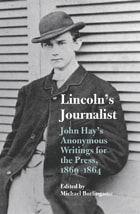
Lincoln's Journalist
John Hay's Anonymous Writings for the Press, 1860 - 1864Edited by Michael Burlingame
Southern Illinois University Press, 2006
Michael Burlingame presents anonymous and pseudonymous newspaper articles written by Lincoln's assistant personal secretary, John Hay, between 1860 and 1864. In the White House, Hay became the ultimate insider, the man who had the president's ear. "Only an extremely small number of persons ever saw Abraham Lincoln both day and night in public as well as private settings from 1860 to 1864," notes Wayne C. Temple, chief deputy director, Illinois State Archives. "And only one of them had the literary flair of John Milton Hay."
Burlingame takes great pains to establish authorship of the items reproduced here. He convincingly demonstrates that the essays and letters written for the Providence Journal, the Springfield Illinois State Journal, and the St. Louis Missouri Democrat under the pseudonym "Ecarte" are the work of Hay. And he finds much circumstantial and stylistic evidence that Hay wrote as "our special correspondent" for the Washington World and for the St. Louis Missouri Republican. Easily identifiable, Hay's style was "marked by long sentences, baroque syntactical architecture, immense vocabulary, verbal pyrotechnics, cocksure tone (combining acid contempt and extravagant praise), offbeat adverbs, and scornful adjectives."