Results by title
262 books match the query 'Public health' and 5 start with l
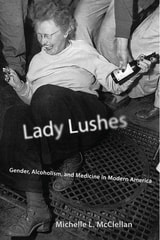
Lady Lushes
Gender, Alcoholism, and Medicine in Modern AmericaMcClellan, Michelle L
Rutgers University Press, 2017
According to the popular press in the mid twentieth century, American women, in a misguided attempt to act like men in work and leisure, were drinking more. “Lady Lushes” were becoming a widespread social phenomenon. From the glamorous hard-drinking flapper of the 1920s to the disgraced and alcoholic wife and mother played by Lee Remick in the 1962 film “Days of Wine and Roses,” alcohol consumption by American women has been seen as both a prerogative and as a threat to health, happiness, and the social order.
In Lady Lushes, medical historian Michelle L. McClellan traces the story of the female alcoholic from the late-nineteenth through the twentieth century. She draws on a range of sources to demonstrate the persistence of the belief that alcohol use is antithetical to an idealized feminine role, particularly one that glorifies motherhood. Lady Lushes offers a fresh perspective on the importance of gender role ideology in the formation of medical knowledge and authority.
In Lady Lushes, medical historian Michelle L. McClellan traces the story of the female alcoholic from the late-nineteenth through the twentieth century. She draws on a range of sources to demonstrate the persistence of the belief that alcohol use is antithetical to an idealized feminine role, particularly one that glorifies motherhood. Lady Lushes offers a fresh perspective on the importance of gender role ideology in the formation of medical knowledge and authority.
[more]
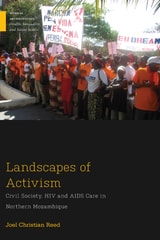
Landscapes of Activism
Civil Society, HIV and AIDS Care in Northern MozambiqueReed, Joel Christian
Rutgers University Press, 2018
AIDS activists are often romanticized as extremely noble and selfless. However, the relationships among HIV support group members highlighted in Landscapes of Activism are hardly utopian or ideal. At first, the group has everything it needs, a thriving membership, and support from major donors. Soon, the group undergoes an identity crisis over money and power, eventually fading from the scene. As government and development institutions embraced activist demands—decentralizing AIDS care through policies of health systems strengthening—civil society was increasingly rendered obsolete. Charting this transition—from subjects, to citizens, and back again—reveals the inefficacy of protest, and the importance of community resilience. The product of in-depth ethnography and focused anthropological inquiry, this is the first book on AIDS activists in Mozambique. AIDS activism’s strange decline in southern Africa, rather than a reflection of citizen apathy, is the direct result of targeted state and donor intervention.
[more]
Last Best Gifts
Altruism and the Market for Human Blood and OrgansKieran Healy
University of Chicago Press, 2006
More than any other altruistic gesture, blood and organ donation exemplifies the true spirit of self-sacrifice. Donors literally give of themselves for no reward so that the life of an individual—often anonymous—may be spared. But as the demand for blood and organs has grown, the value of a system that depends solely on gifts has been called into question, and the possibility has surfaced that donors might be supplemented or replaced by paid suppliers.
Last Best Gifts offers a fresh perspective on this ethical dilemma by examining the social organization of blood and organ donation in Europe and the United States. Gifts of blood and organs are not given everywhere in the same way or to the same extent—contrasts that allow Kieran Healy to uncover the pivotal role that institutions play in fashioning the contexts for donations. Procurement organizations, he shows, sustain altruism by providing opportunities to give and by producing public accounts of what giving means. In the end, Healy suggests, successful systems rest on the fairness of the exchange, rather than the purity of a donor’s altruism or the size of a financial incentive.
Last Best Gifts offers a fresh perspective on this ethical dilemma by examining the social organization of blood and organ donation in Europe and the United States. Gifts of blood and organs are not given everywhere in the same way or to the same extent—contrasts that allow Kieran Healy to uncover the pivotal role that institutions play in fashioning the contexts for donations. Procurement organizations, he shows, sustain altruism by providing opportunities to give and by producing public accounts of what giving means. In the end, Healy suggests, successful systems rest on the fairness of the exchange, rather than the purity of a donor’s altruism or the size of a financial incentive.
[more]
Launching Global Health
The Caribbean Odyssey of the Rockefeller FoundationSteven Palmer
University of Michigan Press, 2010
From the Rockefeller Foundation to the Bill and Melinda Gates Foundation, U.S. philanthropies have played a leading role in the evolution of international health. Launching Global Health examines one of the earliest of these initiatives abroad, the Rockefeller Foundation's International Health Board. The flagship agency made its first call in British Guiana in 1914 to experiment with its new "American method" for the treatment of hookworm disease. Within months it was involved in ambitious hookworm programs in six Central American and Caribbean sites, its directors self-consciously choosing to test run the prototype for their global project in the nearest and clearest domain of American imperial influence. These efforts continued until 1930, when most of the International Health Board hookworm campaigns had evolved into public health projects of a different nature. Launching Global Health is the first book to explore the inaugural Rockefeller Foundation campaigns in depth and to treat them as an ensemble---as a laboratory for discovering and testing the elements of a global health system for the twentieth century. Orienting the study according to the priorities and perspectives of the social and cultural history of medicine and marrying the results with social science and institutional approaches, Steven Palmer rediscovers elements and dynamics in the original history of global health that were either discarded or that have continued to operate beneath the radar of scholarship. In particular, Palmer examines the extraordinary encounters that took place between the Rockefeller proselytizers of biomedicine and public health and the diverse populations whom they were attempting to help. Launching Global Health devotes special attention to the health narratives and practices of laboring people of different ethnicities and how they clashed and blended with the stories and rituals being promoted by the Rockefeller Foundation, ultimately showing the locally assembled health teams of microscopists, inspectors, and dispensers to have been active agents in the shaping of encounters between imperial and popular medicine. A volume in the series Conversations in Medicine and Society.
[more]
Living and Dying in São Paulo
Immigrants, Health, and the Built Environment in BrazilJeffrey Lesser
Duke University Press, 2025
There is a saying in Brazil: “Mosquitoes are democratic: they bite the rich and the poor alike.” Why then is bad health---from violence to respiratory disease, from malaria to dengue---dispersed unevenly across different social and national groups? In Living and Dying in São Paulo, Jeffrey Lesser focuses on the Bom Retiro neighborhood to explore such questions by examining the competing visions of well-being in Brazil among racialized immigrants and policymakers and health officials. He analyzes the fraught relationship between Bom Retiro residents and the state and health care agencies that have overseen community sanitation efforts since the mid-nineteenth century, drawing out the connected systems of the built environment, public health laws and practices, and citizenship. Lesser employs the concept of “residues” to outline how continuing historical material, legislative, and social legacies structure contemporary daily life and health outcomes in the neighborhood. In so doing, Lesser creates a dialogue between the past and the present, showing how the relationship between culture and disease is both layered and interconnected.
[more]