Results by title
376 books match the query 'Racism' and 11 start with l
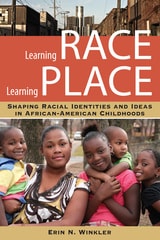
Learning Race, Learning Place
Shaping Racial Identities and Ideas in African American ChildhoodsWinkler, Erin N
Rutgers University Press, 2012
In an American society both increasingly diverse and increasingly segregated, the signals children receive about race are more confusing than ever. In this context, how do children negotiate and make meaning of multiple and conflicting messages to develop their own ideas about race? Learning Race, Learning Place engages this question using in-depth interviews with an economically diverse group of African American children and their mothers.
Through these rich narratives, Erin N. Winkler seeks to reorient the way we look at how children develop their ideas about race through the introduction of a new framework—comprehensive racial learning—that shows the importance of considering this process from children’s points of view and listening to their interpretations of their experiences, which are often quite different from what the adults around them expect or intend. At the children’s prompting, Winkler examines the roles of multiple actors and influences, including gender, skin tone, colorblind rhetoric, peers, family, media, school, and, especially, place. She brings to the fore the complex and understudied power of place, positing that while children’s racial identities and experiences are shaped by a national construction of race, they are also specific to a particular place that exerts both direct and indirect influence on their racial identities and ideas.
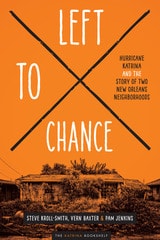
Left to Chance
Hurricane Katrina and the Story of Two New Orleans NeighborhoodsBy Steve Kroll-Smith, Vern Baxter, and Pam Jenkins
University of Texas Press, 2015
How do survivors recover from the worst urban flood in American history, a disaster that destroyed nearly the entire physical landscape of a city, as well as the mental and emotional maps that people use to navigate their everyday lives? This question has haunted the survivors of Hurricane Katrina and informed the response to the subsequent flooding of New Orleans across many years.
Left to Chance takes us into two African American neighborhoods—working-class Hollygrove and middle-class Pontchartrain Park—to learn how their residents have experienced “Miss Katrina” and the long road back to normal life. The authors spent several years gathering firsthand accounts of the flooding, the rushed evacuations that turned into weeks- and months-long exile, and the often confusing and exhausting process of rebuilding damaged homes in a city whose local government had all but failed. As the residents’ stories make vividly clear, government and social science concepts such as “disaster management,” “restoring normality,” and “recovery” have little meaning for people whose worlds were washed away in the flood. For the neighbors in Hollygrove and Pontchartrain Park, life in the aftermath of Katrina has been a passage from all that was familiar and routine to an ominous world filled with raw existential uncertainty. Recovery and rebuilding become processes imbued with mysteries, accidental encounters, and hasty adaptations, while victories and defeats are left to chance.
Liberation and Education
Perspectives on Black Educational ThoughtRonald E. Chennault
Rutgers University Press, 2026
Liberation and Education brings together a collection of essays about Black educators’ and organizations’ quests to cultivate and employ educational strategies for the liberation of Black people. The contributions examine the enduring nature of Black people’s thinking about education prior to and through enslavement to the present. It documents a variety of critical accounts of how Black people have developed ways to free themselves mentally from the legacies of slavery, the view of Black inferiority, and historical and systemic racism.
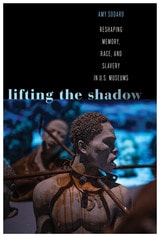
Lifting the Shadow
Reshaping Memory, Race, and Slavery in U.S. MuseumsAmy Sodaro
Rutgers University Press, 2025
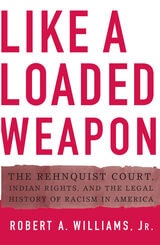
Like a Loaded Weapon
The Rehnquist Court, Indian Rights, and the Legal History of Racism in AmericaRobert Williams Jr.
University of Minnesota Press, 2005
Beginning with Chief Justice John Marshall’s foundational opinions in the early nineteenth century and continuing today in the judgments of the Rehnquist Court, Williams shows how undeniably racist language and precedent are still used in Indian law to justify the denial of important rights of property, self-government, and cultural survival to Indians. Building on the insights of Malcolm X, Thurgood Marshall, and Frantz Fanon, Williams argues that racist language has been employed by the courts to legalize a uniquely American form of racial dictatorship over Indian tribes by the U.S. government.
Williams concludes with a revolutionary proposal for reimagining the rights of American Indians in international law, as well as strategies for compelling the current Supreme Court to confront the racist origins of Indian law and for challenging bigoted ways of talking, thinking, and writing about American Indians.
Robert A. Williams Jr. is professor of law and American Indian studies at the James E. Rogers College of Law, University of Arizona. A member of the Lumbee Indian Tribe, he is author of The American Indian in Western Legal Thought: The Discourses of Conquest and coauthor of Federal Indian Law.
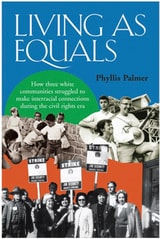
Living as Equals
How Three White Communities Struggled to Make Interracial Connections During the Civil Rights EraPhyllis Palmer
Vanderbilt University Press, 2008
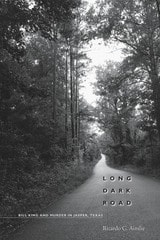
Long Dark Road
Bill King and Murder in Jasper, TexasBy Ricardo C. Ainslie
University of Texas Press, 2004
On a long dark road in deep East Texas, James Byrd Jr. was dragged to his death behind a pickup truck one summer night in 1998. The brutal modern-day lynching stunned people across America and left everyone at a loss to explain how such a heinous crime could possibly happen in our more racially enlightened times. Many eventually found an answer in the fact that two of the three men convicted of the murder had ties to the white supremacist Confederate Knights of America. In the ex-convict ringleader, Bill King, whose body was covered in racist and satanic tattoos, people saw the ultimate monster, someone so inhuman that his crime could be easily explained as the act of a racist psychopath. Few, if any, asked or cared what long dark road of life experiences had turned Bill King into someone capable of committing such a crime.
In this gripping account of the murder and its aftermath, Ricardo Ainslie builds an unprecedented psychological profile of Bill King that provides the fullest possible explanation of how a man who was not raised in a racist family, who had African American friends in childhood, could end up on death row for viciously killing a black man. Ainslie draws on exclusive in-prison interviews with King, as well as with Shawn Berry (another of the perpetrators), King's father, Jasper residents, and law enforcement and judicial officials, to lay bare the psychological and social forces—as well as mere chance—that converged in a murder on that June night. Ainslie delves into the whole of King's life to discover how his unstable family relationships and emotional vulnerability made him especially susceptible to the white supremacist ideology he adopted while in jail for lesser crimes.
With its depth of insight, Long Dark Road not only answers the question of why such a racially motivated murder happened in our time, but it also offers a frightening, cautionary tale of the urgent need to intervene in troubled young lives and to reform our violent, racist-breeding prisons. As Ainslie chillingly concludes, far from being an inhuman monster whom we can simply dismiss, "Bill King may be more like the rest of us than we care to believe."
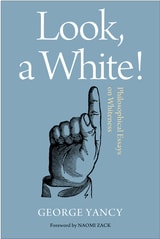
Look, A White!
Philosophical Essays on WhitenessGeorge Yancy
Temple University Press, 2012
Look, a White! returns the problem of whiteness to white people. Prompted by Eric Holder's charge, that as Americans, we are cowards when it comes to discussing the issue of race, noted philosopher George Yancy's essays map out a structure of whiteness.
He considers whiteness within the context of racial embodiment, film, pedagogy, colonialism, its "danger," and its position within the work of specific writers. Identifying the embedded and opaque ways white power and privilege operate, Yancy argues that the Black countergaze can function as a "gift" to whites in terms of seeing their own whiteness more effectively.
Throughout Look, a White! Yancy pays special attention to the impact of whiteness on individuals, as well as on how the structures of whiteness limit the capacity of social actors to completely untangle the way whiteness operates, thus preventing the erasure of racism in social life.
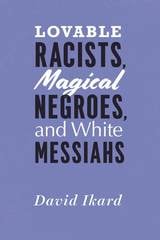
Lovable Racists, Magical Negroes, and White Messiahs
David Ikard
University of Chicago Press, 2017
In the book, Ikard explodes the fiction of a postracial society while awakening us to the sobering reality that we must continue to fight for racial equality or risk losing the hard-fought gains of the Civil Rights movement. Through his close reading of novels, films, journalism, and political campaigns, he analyzes willful white blindness and attendant master narratives of white redemption—arguing powerfully that he who controls the master narrative controls the perception of reality. The book sounds the alarm about seemingly innocuous tropes of white redemption that abound in our society and generate the notion that blacks are perpetually indebted to whites for liberating, civilizing, and enlightening them. In Lovable Racists, Magical Negroes, and White Messiahs, Ikard expertly and unflinchingly gives us a necessary critical historical intervention.
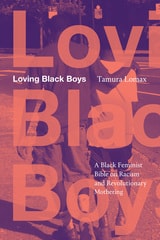
Loving Black Boys
A Black Feminist Bible on Racism and Revolutionary MotheringTamura Lomax
Duke University Press, 2026
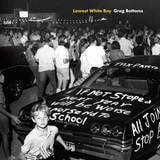
Lowest White Boy
Greg Bottoms
West Virginia University Press, 2019
An innovative, hybrid work of literary nonfiction, Lowest White Boy takes its title from Lyndon Johnson’s observation during the civil rights era: “If you can convince the lowest white man he’s better than the best colored man, he won’t notice you’re picking his pocket.”
Greg Bottoms writes about growing up white and working class in Tidewater, Virginia, during school desegregation in the 1970s. He offers brief stories that accumulate to reveal the everyday experience of living inside complex, systematic racism that is often invisible to economically and politically disenfranchised white southerners—people who have benefitted from racism in material ways while being damaged by it, he suggests, psychologically and spiritually. Placing personal memories against a backdrop of documentary photography, social history, and cultural critique, Lowest White Boy explores normalized racial animus and reactionary white identity politics, particularly as these are collected and processed in the mind of a child.