61 books match the query 'Readers' and 4 start with l
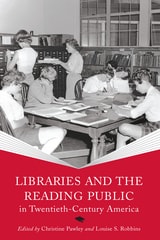
cover of Libraries and the Reading Public in Twentieth-Century America

Libraries and the Reading Public in Twentieth-Century America

Edited by Christine Pawley and Louise S. Robbins

University of Wisconsin Press, 2013
For well over one hundred years, libraries open to the public have played a crucial part in fostering in Americans the skills and habits of reading and writing, by routinely providing access to standard forms of print: informational genres such as newspapers, pamphlets, textbooks, and other reference books, and literary genres including poetry, plays, and novels. Public libraries continue to have an extraordinary impact; in the early twenty-first century, the American Library Association reports that there are more public library branches than McDonald's restaurants in the United States. Much has been written about libraries from professional and managerial points of view, but less so from the perspectives of those most intimately involved—patrons and librarians.
 
Drawing on circulation records, patron reviews, and other archived materials, Libraries and the Reading Public in Twentieth-Century America underscores the evolving roles that libraries have played in the lives of American readers. Each essay in this collection examines a historical circumstance related to reading in libraries. The essays are organized in sections on methods of researching the history of reading in libraries; immigrants and localities; censorship issues; and the role of libraries in providing access to alternative, nonmainstream publications. The volume shows public libraries as living spaces where individuals and groups with diverse backgrounds, needs, and desires encountered and used a great variety of texts, images, and other media throughout the twentieth century.
[more]
cover of Literacy as Involvement: The Acts of Writers, Readers, and Texts

Literacy as Involvement

The Acts of Writers, Readers, and Texts

Deborah Brandt

Southern Illinois University Press, 1990

In Literacy as Involvement, Deborah Brandt examines the cultural and social roots of the acts of reading and writing. The book asks, for example, whether literacy is a natural growth of or a radical shift from orality. It questions the contrary views that literacy is either the learning of the conventions of language or is better understood as heightened social ability. Finally, it raises the possibility that knowing how to read and write is actually understanding how we respond during the acts of reading and writing.

This examination of literacy as process is also offered as a critique of prevailing theories of literacy advanced by such scholars as Walter J. Ong, S.J., David Olson, and E. D. Hirsch. They depict literacy as a textual experience that is socially and linguistically detached. Brandt critically examines the underlying assumptions from research on writing processes and argues that they call for a major reformation of prevailing conceptions of literacy. Specifically, she analyzes several expository texts from a process perspective to establish the interaction of reader and writer in even the most seemingly formal and detached writing. In her conclusion, Brandt brings together the major findings of her study to address pressing literacy issues, including the problem of illiteracy in our schools.
[more]
cover of Loving Faster than Light: Romance and Readers in Einstein's Universe

Loving Faster than Light

Romance and Readers in Einstein's Universe

Katy Price

University of Chicago Press, 2012
In November 1919, newspapers around the world alerted readers to a sensational new theory of the universe: Albert Einstein’s theory of relativity. Coming at a time of social, political, and economic upheaval, Einstein’s theory quickly became a rich cultural resource with many uses beyond physical theory. Media coverage of relativity in Britain took on qualities of pastiche and parody, as serious attempts to evaluate Einstein’s theory jostled with jokes and satires linking relativity to everything from railway budgets to religion. The image of a befuddled newspaper reader attempting to explain Einstein’s theory to his companions became a set piece in the popular press.
           
Loving Faster than Light focuses on the popular reception of relativity in Britain, demonstrating how abstract science came to be entangled with class politics, new media technology, changing sex relations, crime, cricket, and cinematography in the British imagination during the 1920s. Blending literary analysis with insights from the history of science, Katy Price reveals how cultural meanings for Einstein’s relativity were negotiated in newspapers with differing political agendas, popular science magazines, pulp fiction adventure and romance stories, detective plots, and esoteric love poetry. Loving Faster than Light is an essential read for anyone interested in popular science, the intersection of science and literature, and the social and cultural history of physics.
[more]
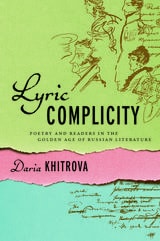
cover of Lyric Complicity: Poetry and Readers in the Golden Age of Russian Literature

Lyric Complicity

Poetry and Readers in the Golden Age of Russian Literature

Daria Khitrova

University of Wisconsin Press, 2019

For many nineteenth-century Russians, poetry was woven into everyday life—in conversation and correspondence, scrapbook albums, and parlor entertainments. Blending close literary analysis with social and cultural history, Daria Khitrova shows how poetry lovers of the period all became nodes in a vast network of literary appreciation and constructed meaning. Poetry during the Golden Age was not a one-way avenue from author to reader. Rather, it was participatory, interactive, and performative.
Lyric Complicity helps modern readers recover Russian poetry’s former uses and functions—life situations that moved people to quote or perform a specific passage from a poem or a forgotten occasion that created unforgettable verse.
[more]