Results by title
53 books match the query 'Reconstruction (U.S. history, 1865-1877)' and 2 start with l
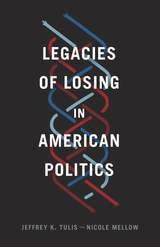
Legacies of Losing in American Politics
Jeffrey K. Tulis and Nicole Mellow
University of Chicago Press, 2017
With Legacies of Losing in American Politics, Jeffrey K. Tulis and Nicole Mellow rethink three pivotal moments in American political history: the founding, when anti-Federalists failed to stop the ratification of the Constitution; the aftermath of the Civil War, when President Andrew Johnson’s plan for restoring the South to the Union was defeated; and the 1964 presidential campaign, when Barry Goldwater’s challenge to the New Deal order was soundly defeated by Lyndon B. Johnson. In each of these cases, the very mechanisms that caused the initial failures facilitated their eventual success. After the dust of the immediate political defeat settled, these seemingly discredited ideas and programs disrupted political convention by prevailing, often subverting, and occasionally enhancing constitutional fidelity. Tulis and Mellow present a nuanced story of winning and losing and offer a new understanding of American political development as the interweaving of opposing ideas.
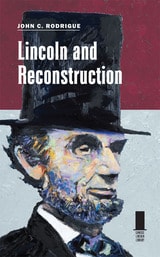
Lincoln and Reconstruction
John C. Rodrigue
Southern Illinois University Press, 2013
Although Abraham Lincoln dominates the literature on the American Civil War, he remains less commonly associated with reconstruction. Previous scholarly works touch on Lincoln and reconstruction, but they tend either to speculate on what Lincoln might have done after the war had he not been assassinated or to approach his reconstruction plans merely as a means of winning the war. In this thought-provoking study, John C. Rodrigue offers a succinct but significant survey of Lincoln’s wartime reconstruction initiatives while providing a fresh interpretation of the president’s plans for postwar America.
Revealing that Lincoln concerned himself with reconstruction from the earliest days of his presidency, Rodrigue details how Lincoln’s initiatives unfolded, especially in the southern states where they were attempted. He explores Lincoln’s approach to various issues relevant to reconstruction, including slavery, race, citizenship, and democracy; his dealings with Congressional Republicans, especially the Radicals; his support for and eventual abandonment of colonization; his dealings with the border states; his handling of the calls for negotiations with the Confederacy as a way of reconstructing the Union; and his move toward emancipation and its implications for his approach to reconstruction.
As the Civil War progressed, Rodrigue shows, Lincoln’s definition of reconstruction transformed from the mere restoration of the seceded states to a more fundamental social, economic, and political reordering of southern society and of the Union itself. Based on Lincoln’s own words and writings as well as an extensive array of secondary literature, Rodrigue traces the evolution of Lincoln’s thinking on reconstruction, providing new insight into a downplayed aspect of his presidency.