Results by title
167 books match the query 'Reform' and 4 start with l
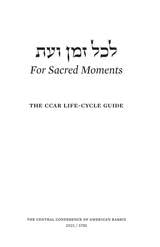
L'chol Z'man v'Eit
For Sacred Moments Book + 2021 Supplement: The CCAR Life-Cycle GuideRabbi Donald Goor and Rabbi April Davis
Central Conference of American Rabbis, 2021
This is a PDF version of the manual. You will receive a link to download a PDF that directly integrates the supplement material and the material found in the original manual.
Now with a new supplement, the CCAR clergy manual contains a wealth of prayers, readings, rituals, and ceremonies, expanding the original to encompass many new situations. Designed for the current moment, its prayers and blessings respond to the evolving role of Reform clergy and the changing life experiences of our congregants. Among these liturgical responses are blessings for moving, starting school, and taking a new name; prayers to support community members dealing with infertility, premature birth, abortion, addiction, eating disorders, assault, and suicide; and an extensive collection of readings to guide communities through times of challenge and pain such as natural disasters, shootings, and antisemitic incidents.
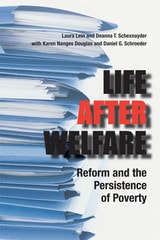
Life After Welfare
Reform and the Persistence of PovertyBy Laura Lein and Deanna T. Schexnayder; with Karen Manges Douglas and Daniel G. Schroeder
University of Texas Press, 2007
A Choice Outstanding Academic Book
In the decade since President Clinton signed the Personal Responsibility and Work Opportunity Reconciliation Act of 1996 into law—amidst promises that it would "end welfare as we know it"—did the reforms ending entitlements and moving toward time limits and work requirements lift Texas families once living on welfare out of poverty, or merely strike their names from the administrative rolls?
Under welfare reform, Texas continued with low monthly payments and demanding eligibility criteria. Many families who could receive welfare in other states do not qualify in Texas, and virtually any part-time job makes a family ineligible. In Texas, most families who leave welfare remain in or near poverty, and many are likely to return to the welfare rolls in the future.
This compelling work, which follows 179 families after leaving welfare, is set against a backdrop of multiple types of data and econometric modeling. The authors' multi-method approach draws on administrative data from nine programs serving low-income families and a statewide survey of families who have left welfare. Survey data on health problems, transportation needs, and child-care issues shed light on the patterns of employment and welfare use seen in the administrative data. In their lives after welfare, the families chronicled here experience poverty even when employed; a multiplicity of barriers to employment that work to exacerbate one another; and a failing safety net of basic human services as they attempt to sustain low-wage employment.

Lights in the Forest
Rabbis Respond to Twelve Essential Jewish QuestionsRabbi Paul Citrin
Central Conference of American Rabbis, 2014
Perfect for self-study, group study, adult learning, and conversion, the collection strives to encourage further study and ongoing discussion through presenting Judaism's intellectual and spiritual tools as means for leading a life full of purpose and commitment.
Questions addressed by the anthology can found below:
-Questions about God
-Questions about Our Humanity
-Questions about the Jewish People

Louis Sébastien Mercier
Revolution and Reform in Eighteenth-Century ParisMichael J. Mulryan
Bucknell University Press, 2023