Results by title
237 books match the query 'Religion, Politics & State' and 11 start with l
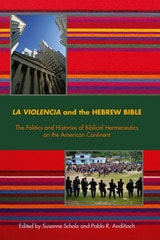
La Violencia and the Hebrew Bible
The Politics and Histories of Biblical Hermeneutics on the AmericaSusanne Scholz
SBL Press, 2016
Exegetically noteworthy and culturally-theologically relevant
Violence in its wide range of horrifying expressions is real in people’s lives, and biblical interpreters must take violence in the world seriously to arrive at relevant ideas about the place of the Bible in the world. Each essay addresses people’s experiences of violence in the study of the Bible through the context of la violencia, the Spanish noun referring to the brutal, repressive, and murderous policies of state-sponsored violence practiced in many South and Central American and Caribbean countries during the twentieth century that external powers such as the USA often endorsed and fostered. The volume represents an important contribution to biblical studies and to the field of Latina/o studies. The contributors are Cheryl B. Anderson, Pablo Andiñach, Nancy Bedford, Lee Cuéllar, Steed V. Davidson, Serge Frolov, Renata Furst, Julia M. O’Brien, Todd Penner, José Enrique Ramírez, Ivoni Richter Reimer, and Susanne Scholz.
Features:
- Twelve essays by scholars living and working on the American continent
- Articles reveal the complex historical, political, and cultural conditions on the American continent that have contributed to our understanding of violence in the Bible
- Focus on themes of racial, social, and cultural violence
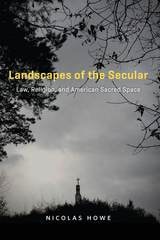
Landscapes of the Secular
Law, Religion, and American Sacred SpaceNicolas Howe
University of Chicago Press, 2016
Fusing geography, legal scholarship, and religion in a potent analysis, Howe shows how seemingly routine questions about how to look at a sunrise or a plateau or how to assess what a mountain is both physically and ideologically, lead to complex arguments about the nature of religious experience and its implications for our lives as citizens. In American society—nominally secular but committed to permitting a diversity of religious beliefs and expressions—such questions become all the more fraught and can lead to difficult, often unsatisfying compromises regarding how to interpret and inhabit our public lands and spaces. A serious commitment to secularism, Howe shows, forces us to confront the profound challenges of true religious diversity in ways that often will have their ultimate expression in our built environment. This provocative exploration of some of the fundamental aspects of American life will help us see the land, law, and society anew.
Law and Religion in a Secular Age
Rafael Domingo
Catholic University of America Press, 2023
Letters from Lockdown
Sustaining Public Service Values During the Covid-19 PandemicClaire Foster-Gilbert
Haus Publishing, 2020
Letters from the Lockdown presents the twelve original letters alongside new, deeply personal accounts from public servants on the job. Together, this collection provides an opportunity to reflect on how public values meet practice as the global crisis unfolds.
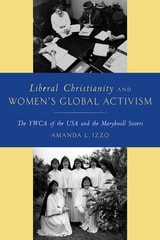
Liberal Christianity and Women's Global Activism
The YWCA of the USA and the Maryknoll SistersAmanda L. Izzo
Rutgers University Press, 2018
Focusing on the histories of two highly influential groups, the Young Women’s Christian Association of the USA, an interdenominational Protestant organization, and the Maryknoll Sisters, a Roman Catholic religious order, Izzo offers new perspectives on the contributions of these women to transnational social movements, women’s history, and religious studies, as she traces the connections between turn-of-the-century Christian women’s reform culture and liberal and left-wing religious social movements of the 1960s and 1970s. Izzo suggests that shared ethical, theological, and institutional underpinnings can transcend denominational divides, and that strategies for social change often associated with secular feminism have ties to spiritually inspired social movements.
Liberal Suppression
Section 501(c)(3) and the Taxation of SpeechPhilip Hamburger
University of Chicago Press, 2018
Tracing the history of American liberalism, including theological liberalism and its expression in nativism, Hamburger shows the centrality of turbulent popular anxieties about the Catholic Church and other potentially orthodox institutions. He argues persuasively that such theopolitical fears about the political speech of churches and related organizations underlay the adoption, in 1934 and 1954, of section 501(c)(3)’s speech limits. He thereby shows that the speech restrictions have been part of a broad majority assault on minority rights and that they are grossly unconstitutional.
Along the way, Hamburger explores the role of the Ku Klux Klan and other nativist organizations, the development of American theology, and the cultural foundations of liberal “democratic” political theory. He also traces important legal developments such as the specialization of speech rights and the use of law to homogenize beliefs. Ultimately, he examines a wide range of contemporary speech restrictions and the growing shallowness of public life in America.
His account is an unflinching look at the complex history of American liberalism and at the implications for speech, the diversity of belief, and the nation’s future.
Liberals, Conservatives, and Mavericks
On Christian Churches of Eastern Europe since 1980. A Festschrift for Sabrina P. RametFrank Cibulka
Central European University Press, 2025
No Church is monolithic—this is the preliminary premise of this volume on the public place of religion in a representative number of post-communist countries. The studies confirm that within any religious organization we can expect to find fissures, factions, theological or ideological quarrels, and perhaps even competing interest groups, such as missionary workers, regular clergy versus secular clergy, and sometimes even competing ecclesiastical hierarchies. The main focus of the book rests on the divisions arising within select Christian Churches, as they confront the processes of secularization and atheization. The coverage area includes Russia and the Ukraine, East-Central Europe and South-Eastern Europe. Some chapters focus on individual clergy who challenge the mainstream of their given Church either from a more liberal or from a more conservative perspective, while others deal with the divisive forces impacting the religious organizations.
This festschrift to honor Sabrina Ramet’s seminal contribution to the study of religion in the politics of the communist and post-communist world, brings together several generations of scholars from a variety of countries, both those well established in their fields of study as well as young promising academics.
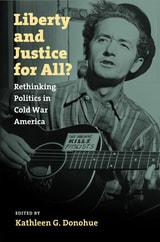
Liberty and Justice for All?
Rethinking Politics in Cold War AmericaKathleen G. Donohue
University of Massachusetts Press, 2012
From the congressional debate over the “fall of China” to the drama of the Army–McCarthy hearings to the kitchen faceoff between Richard Nixon and Nikita Khrushchev, the political history of the early Cold War was long dominated by studies of presidential administrations, anticommunism, and foreign policy. In Liberty and Justice for All? a group of distinguished historians representing a variety of disciplinary perspectives—social history, cultural history, intellectual history, labor history, urban history, women's history, African American studies, and media studies—expand on the political history of the early Cold War by rethinking the relationship between politics and culture. How, for example, did folk music help to keep movement culture alive throughout the 1950s? How did the new medium of television change fundamental assumptions about politics and the electorate? How did American experiences with religion in the 1950s strengthen the separation of church and state? How did race, class, and gender influence the relationship between citizens and the state? These are just some of the questions addressed in this wide-ranging set of essays.
In addition to volume editor Kathleen G. Donohue, contributors include Howard Brick, Kari Frederickson, Andrea Friedman, David Greenberg, Grace Elizabeth Hale, Jennifer Klein, Laura McEnaney, Kevin M. Schultz, Jason Scott Smith, Landon R. Y. Storrs, and Jessica Weiss.

Life of the 381st Bomb Group
The World War II Diary of Eighth Air Force Chaplain James Good BrownBob Korkuc
University of Missouri Press, 2026
While working on his first book, Bob Korkuc became intimately familiar with the 381st Bombardment Group of the Mighty Eighth Air Force and met the group’s chaplain, James Good Brown. Brown kept a diary during his time with the bomb group (1943 to 1945) in which he chronicled the daily experiences of the men.
Years after the war, Brown self-published his diary, which today is hard to find. Through his friendship with Brown, Korkuc gained access to and chose to edit the original docu - ment so that more readers might appreciate this insightful wartime eyewitness account.
Serving in his early forties alongside men twenty years his junior—whom he called the “Mighty Men of the 381st”—Brown took part in morning briefings, shared meals with crews, and anxiously awaited their return from dangerous daylight bombing missions. Flying as a noncombatant, an unnecessary eleventh crewmember, Brown describes his own observations of a Flying Fortress combat mission over Germany. Writing with extraordinary candor, Brown documents the inner workings of a bomb group that flew 297 combat missions over Europe, providing vivid character assessments of his fellow airmen and capturing both their victories and devastating losses.
In addition to judiciously editing Brown’s original diary for readability, Korkuc created a unique appendix, which reveals the fate of every airman who served with Brown. The immediacy of Brown’s narration combined with Korkuc’s meticulous editing make this a promising new resource for scholars and general readers alike.
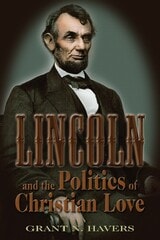
Lincoln and the Politics of Christian Love
Grant N. Havers
University of Missouri Press, 2009
In this provocative book, Grant Havers argues that charity is a central tenet of what Lincoln once called America’s “political religion.” He explores the implications of making Christian love the highest moral standard for American democracy, showing how Lincoln’s legacy demands that a true democracy be charitable toward all—and that only a people who lived according to such ideals could succeed in building democracy as Lincoln understood it.
Havers argues that it is simplistic to conflate Lincoln’s invocation of “with charity for all” with his abiding support for the ideal of human equality. The ethic of charity in his view also brought a uniquely Christian realism to the universalism of democracy. He also describes how, since World War I, intellectuals and political leaders have denied that there exists a necessary relation between democracy and Christian love, proposing that democracy is sufficiently ethical without reliance on a specific religious tradition. Today’s neoconservatives and liberals instead posit a universal yearning for democracy that requires no foundation in the ethic of charity. Havers shows that this democratic universalism, espoused by those who believe a “chosen people” should uphold the natural rights of humanity, is alien to the sober thought of both the founders and Lincoln.
This carefully argued work defends Lincoln’s understanding of charity as essential to democracy while emphasizing the difficulty of fusing this ethic with the desire to spread democracy to people who do not share America’s Christian heritage. In considering the prospect of America’s leaders rediscovering a moral foreign policy based on charity rather than the costly idolization of democracy, Lincoln and the Politics of Christian Love makes a timely contribution to the wider debate over both the meaning of religion in American politics and the mission of America in the world—and opens a new window on Lincoln’s lasting legacy.
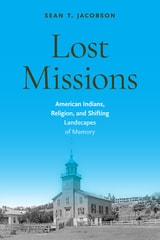
Lost Missions
American Indians, Religion, and Shifting Landscapes of MemorySean T. Jacobson
University of Massachusetts Press, 2026
Tracing how shuttered mission schools became contested commemorative landscapes
During the Early Republic and Jacksonian eras, Euro-American colonists and Native nations in the South and Old Northwest established mission schools intended to Christianize Indigenous peoples. In Lost Missions, Sean T. Jacobson recovers the histories and afterlives of these institutions, arguing that they played a far more consequential role in Native–settler relations than scholars have previously acknowledged. Mission schools advanced a spiritual vision of a multiethnic Christian America—one that ultimately collapsed amid the federally sponsored Indian Removal campaigns of the 1830s and 1840s.
Following the closure of these schools, their physical and symbolic landscapes became powerful sites of memory. Euro-American Christians later transformed former missions into commemorative spaces that celebrated “frontier” piety and national expansion. Through monuments, pageantry, and local histories, Protestant and Catholic Americans alike recast missionary labor as a foundational component of American nation-building. In doing so, these narratives framed the Christianization of Native peoples as a benevolent civilizing project, one that implicitly—and sometimes explicitly—sanitized the coercion, dispossession, and violence that accompanied westward expansion and the forced removal of Indigenous nations.
By the late twentieth century, however, these commemorative narratives faded. Suburban development, commercialization, and shifting cultural priorities rendered many mission sites once again “lost,” stripped of the civic meaning they once held. Yet Jacobson shows that these landscapes still speak, especially when viewed from Indigenous perspectives. Reinterpreted through Native histories of endurance and survival, former missions reveal counternarratives of persistence amid profound loss. As tribal nations increasingly engage with these sites today, Lost Missions probes their contested status as places of memory and conscience, illuminating how public history continues to shape and challenge understandings of America’s colonial past.