Results by title
53 books match the query 'Research & Methodology' and 4 start with l
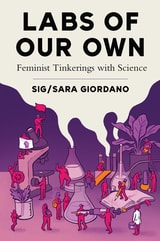
Labs of Our Own
Feminist Tinkerings with ScienceSig / Sara Giordano
Rutgers University Press, 2025
From climate change to COVID-19 to reproductive justice, there has been deep political polarization around science. Labs of Our Own provides a unique entry point into these twenty-first-century science wars by focusing on our affective relationships to science. The book delves into various sites where scientists, teachers, artists, and activists claim to create more democratic access to science—from DIY biology community labs to feminist classrooms to activist science practitioners. The reader will find that these claims for and attempts at democratic sciences not only impact what counts as science and who counts as a scientist but reconfigure who is included in the proper public. Instead of arguing for a knee-jerk defense of science against right-wing attacks, Labs of Our Own builds the case for a feminist, antiracist, decolonial, queer science tinkering practice that intentionally, politically, and ethically acts to produce new challenges to the definition and boundaries of the human.
[more]
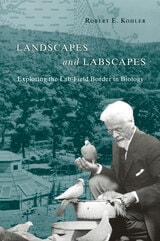
Landscapes and Labscapes
Exploring the Lab-Field Border in BiologyRobert E. Kohler
University of Chicago Press, 2002
What is it like to do field biology in a world that exalts experiments and laboratories? How have field biologists assimilated laboratory values and practices, and crafted an exact, quantitative science without losing their naturalist souls?
In Landscapes and Labscapes, Robert E. Kohler explores the people, places, and practices of field biology in the United States from the 1890s to the 1950s. He takes readers into the fields and forests where field biologists learned to count and measure nature and to read the imperfect records of "nature's experiments." He shows how field researchers use nature's particularities to develop "practices of place" that achieve in nature what laboratory researchers can only do with simplified experiments. Using historical frontiers as models, Kohler shows how biologists created vigorous new border sciences of ecology and evolutionary biology.
In Landscapes and Labscapes, Robert E. Kohler explores the people, places, and practices of field biology in the United States from the 1890s to the 1950s. He takes readers into the fields and forests where field biologists learned to count and measure nature and to read the imperfect records of "nature's experiments." He shows how field researchers use nature's particularities to develop "practices of place" that achieve in nature what laboratory researchers can only do with simplified experiments. Using historical frontiers as models, Kohler shows how biologists created vigorous new border sciences of ecology and evolutionary biology.
[more]
Leading Edges in Social and Behavioral Science
R. Duncan Luce
Russell Sage Foundation, 1990
The reach of the social and behavioral sciences is currently so broad and interdisciplinary that staying abreast of developments has become a daunting task. The thirty papers that constitute Leading Edges in Social and Behavioral Science provide a unique composite picture of recent findings and promising new research opportunities within most areas of social and behavioral research. Prepared by expert scholars under the auspices of the National Academy of Sciences, these timely and well-documented reports define research priorities for an impressive range of topics: Part I: Mind and Brain Part II: Behavior in Social Context Part III: Choice and Allocation Part IV: Evolving Institutions Part V: Societies and International Orders Part VI: Data and Analysis
[more]
Looking at Lives
American Longitudinal Studies of the Twentieth CenturyErin Phelps
Russell Sage Foundation, 2002
The impact of long-term longitudinal studies on the landscape of twentieth century social and behavioral science cannot be overstated. The field of life course studies has grown exponentially since its inception in the 1950s, and now influences methodologies as well as expectations for all academic research. Looking at Lives offers an unprecedented "insider's view" into the intentions, methods, and findings of researchers engaged in some of the 20th century's landmark studies. In this volume, eminent American scholars—many of them pioneers in longitudinal studies—provide frank and illuminating insights into the difficulties and the unique scientific benefits of mounting studies that track people's lives over a long period of time. Looking at Lives includes studies from a range of disciplines, including psychology, sociology, and education, which together cover a span of more than fifty years. The contributors pay particular attention to the changing historical, cultural, and scientific context of their work, as well as the theoretical and methodological changes that have occurred in their fields over decades. What emerges is a clear indication of the often unexpected effects these studies have had on public policies and public opinion—especially as they relate to such issues as the connection between poverty and criminal behavior, or the consequences of teen-age pregnancy and drug use for inner-city youth. For example, David Weikart reveals how his long-term research on preschool intervention projects, begun in 1959, permitted him to show how surprisingly effective preschool education can be in improving the lives of disadvantaged children. In another study, John Laub and Robert Sampson build on findings from a groundbreaking study begun by Sheldon and Eleanor Glueck in the 1950s to reveal the myriad ways in which juvenile delinquency can predict criminal behavior in adults. And Arland Thornton, Ronald Freedman, and William Axinn employ an intergenerational study of women and their children begun in 1962 to examine the substantial relaxation of social mores for family and individual behavior in the latter decades of the 20th century. Looking at Lives is full of striking testimony to the importance of long-term, longitudinal studies. As a unique chronicle of the origins and development of longitudinal studies in America, this collection will be an invaluable aid to 21st century investigators who seek to build on the successes and the experiences of the pioneers in life-course studies.
[more]