Results by title
110 books match the query 'Romanticism' and 5 start with l
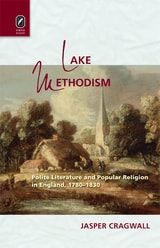
Lake Methodism
Jasper Cragwall
The Ohio State University Press, 2013
Lake Methodism: Polite Literature and Popular Religion in England, 1780-1830, reveals the traffic between Romanticism’s rhetorics of privilege and the most socially toxic religious forms of the eighteenth and nineteenth centuries. The “Lake Poets,” of whom William Wordsworth and Samuel Taylor Coleridge are the most famous, are often seen as crafters of a poetics of spontaneous inspiration, transcendent imagination, and visionary prophecy, couched within lexicons of experimental simplicity and lyrical concision. But, as Jasper Cragwall argues, such postures and principles were in fact received as the vulgarities of popular Methodism, an insurgent religious movement whose autobiographies, songs, and sermons reached sales figures of which the Lakers could only dream.
With these religious histories, Lake Methodism unsettles canonical Romanticism, reading, for example, the grand declaration opening Wordsworth’s spiritual autobiography—“to the open fields I told a prophecy”—not as poetic self-sanctification, but as a means of embarrassing Methodism, responsible for the suppression of The Prelude for half a century. The book measures this fearful symmetry between Romantic and religious enthusiasms in figures iconic and unfamiliar: John Wesley, Robert Southey, Wordsworth, Coleridge, as well as the eponymous scientist of Mary Shelley’s Frankenstein, and even Joanna Southcott, an illiterate servant turned latter-day Virgin Mary, who, at the age of sixty-five, mistook a fatal dropsy for the Second Coming of Christ (and so captivated a nation).
[more]
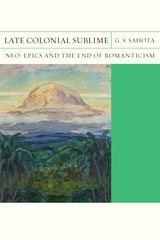
Late Colonial Sublime
Neo-Epics and the End of RomanticismG. S. Sahota
Northwestern University Press, 2018
Taking cues from Walter Benjamin’s fragmentary writings on literary-historical method, Late Colonial Sublime reconstellates the dialectic of Enlightenment across a wide imperial geography, with special focus on the fashioning of neo-epics in Hindi and Urdu literary cultures in British India. Working through the limits of both Marxism and postcolonial critique, this book forges an innovative approach to the question of late romanticism and grounds categories such as the sublime within the dynamic of commodification. While G. S. Sahota takes canonical European critics such as Theodor Adorno and Max Horkheimer to the outskirts of empire, he reads Indian writers such as Muhammad Iqbal and Jayashankar Prasad in light of the expansion of instrumental rationality and the neotraditional critiques of the West it spurred at the onset of decolonization.
By bringing together distinct literary canons—both metropolitan and colonial, hegemonic and subaltern, Western and Eastern, all of which took shape upon the common realities of imperial capitalism—Late Colonial Sublime takes an original dialectical approach. It experiments with fragments, parallaxes, and constellational form to explore the aporias of modernity as well as the possible futures they may signal in our midst. A bold intervention into contemporary debates that synthesizes a wealth of sources, this book will interest readers and scholars in world literature, critical theory, postcolonial criticism, and South Asian studies.
By bringing together distinct literary canons—both metropolitan and colonial, hegemonic and subaltern, Western and Eastern, all of which took shape upon the common realities of imperial capitalism—Late Colonial Sublime takes an original dialectical approach. It experiments with fragments, parallaxes, and constellational form to explore the aporias of modernity as well as the possible futures they may signal in our midst. A bold intervention into contemporary debates that synthesizes a wealth of sources, this book will interest readers and scholars in world literature, critical theory, postcolonial criticism, and South Asian studies.
[more]
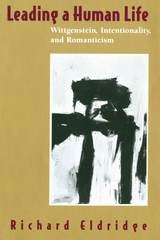
Leading a Human Life
Wittgenstein, Intentionality, and RomanticismRichard Eldridge
University of Chicago Press, 1997
In this provocative new study, Richard Eldridge presents a highly original and compelling account of Wittgenstein's Philosophical Investigations, one of the most enduring yet enigmatic works of the twentieth century. He does so by reading the text as a dramatization of what is perhaps life's central motivating struggle—the inescapable human need to pursue an ideal of expressive freedom within the difficult terms set by culture.
Eldridge sees Wittgenstein as a Romantic protagonist, engaged in an ongoing internal dialogue over the nature of intentional consciousness, ranging over ethics, aesthetics, and philosophy of mind. The picture of the human mind that emerges through this dialogue unsettles behaviorism, cognitivism, and all other scientifically oriented orthodoxies. Leading a human life becomes a creative act, akin to writing a poem, of continuously seeking to overcome both complacency and skepticism. Eldridge's careful reconstruction of the central motive of Wittgenstein's work will influence all subsequent scholarship on it.
Eldridge sees Wittgenstein as a Romantic protagonist, engaged in an ongoing internal dialogue over the nature of intentional consciousness, ranging over ethics, aesthetics, and philosophy of mind. The picture of the human mind that emerges through this dialogue unsettles behaviorism, cognitivism, and all other scientifically oriented orthodoxies. Leading a human life becomes a creative act, akin to writing a poem, of continuously seeking to overcome both complacency and skepticism. Eldridge's careful reconstruction of the central motive of Wittgenstein's work will influence all subsequent scholarship on it.
[more]
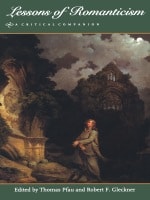
Lessons of Romanticism
A Critical CompanionThomas Pfau and Robert F. Gleckner, eds.
Duke University Press, 1998
Moving beyond views of European Romanticism as an essentially poetic development, Lessons of Romanticism strives to strengthen a critical awareness of the genres, historical institutions, and material practices that comprised the culture of the period. This anthology—in recasting Romanticism in its broader cultural context—ranges across literary studies, art history, musicology, and political science and combines a variety of critical approaches, including gender studies, Lacanian analysis, and postcolonial studies.
With over twenty essays on such diverse topics as the aesthetic and pedagogical purposes of art exhibits in London, the materiality of late Romantic salon culture, the extracanonical status of Jane Austen and Fanny Burney, and Romantic imagery in Beethoven’s music and letters, Lessons of Romanticism reveals the practices that were at the heart of European Romantic life. Focusing on the six decades from 1780 to 1832, this collection is arranged thematically around gender and genre, literacy, marginalization, canonmaking, and nationalist ideology. As Americanists join with specialists in German culture, as Austen is explored beside Beethoven, and as discussions on newly recovered women’s writings follow fresh discoveries in long-canonized texts, these interdisciplinary essays not only reflect the broad reach of contemporary scholarship but also point to the long-neglected intertextual and intercultural dynamics in the various and changing faces of Romanticism itself.
With over twenty essays on such diverse topics as the aesthetic and pedagogical purposes of art exhibits in London, the materiality of late Romantic salon culture, the extracanonical status of Jane Austen and Fanny Burney, and Romantic imagery in Beethoven’s music and letters, Lessons of Romanticism reveals the practices that were at the heart of European Romantic life. Focusing on the six decades from 1780 to 1832, this collection is arranged thematically around gender and genre, literacy, marginalization, canonmaking, and nationalist ideology. As Americanists join with specialists in German culture, as Austen is explored beside Beethoven, and as discussions on newly recovered women’s writings follow fresh discoveries in long-canonized texts, these interdisciplinary essays not only reflect the broad reach of contemporary scholarship but also point to the long-neglected intertextual and intercultural dynamics in the various and changing faces of Romanticism itself.
Contributors. Steven Bruhm, Miranda J. Burgess, Joel Faflak, David S. Ferris, William Galperin, Regina Hewitt, Jill Heydt-Stevenson, H. J. Jackson, Theresa M. Kelley, Greg Kucich, C. S. Matheson, Adela Pinch, Marc Redfield, Nancy L. Rosenblum, Marlon B. Ross, Maynard Solomon, Richard G. Swartz, Nanora Sweet, Joseph Viscomi, Karen A. Weisman, Susan I. Wolfson
[more]
Literature and the Child
Romantic Continuations, Postmodern ContestationsJames Holt Mcgavran
University of Iowa Press, 1999
The Romantic myth of childhood as a transhistorical holy time of innocence and spirituality, uncorrupted by the adult world, has been subjected in recent years to increasingly serious interrogation. Was there ever really a time when mythic ideals were simple, pure, and uncomplicated? The contributors to this book contend—although in widely differing ways and not always approvingly—that our culture is indeed still pervaded, in this postmodern moment of the very late twentieth century, by the Romantic conception of childhood which first emerged two hundred years ago.
In the wake of the French Revolution and the Industrial Revolution, western Europe experienced another fin de siècle characterized by overwhelming material and institutional change and instability. By historicizing the specific political, social, and economic conflicts at work within the notion of Romantic childhood, the essayists in Literature and the Child show us how little these forces have changed over time and how enriching and empowering they can still be for children and their parents.
In the first section, “Romanticism Continued and Contested,” Alan Richardson and Mitzi Myers question the origins and ends of Romantic childhood. In “Romantic Ironies, Postmodern Texts,” Dieter Petzold, Richard Flynn, and James McGavran argue that postmodern texts for both children and adults perpetuate the Romantic complexities of childhood. Next, in “The Commerce of Children's Books,” Anne Lundin and Paula Connolly study the production and marketing of children's classics. Finally, in “Romantic Ideas in Cultural Confrontations,” William Scheick and Teya Rosenberg investigate interactions of Romantic myths with those of other cultural systems.
[more]