Results by title
140 books match the query 'Science Fiction & Fantasy' and 6 start with l
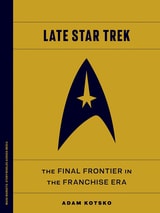
Late Star Trek
The Final Frontier in the Franchise EraAdam Kotsko
University of Minnesota Press, 2025
How Star Trek’s twenty-first-century reinventions illuminate the unique challenges and opportunities of franchise-style corporate storytelling
Late Star Trek explores the beloved science fiction franchise’s repeated attempts to reinvent itself after the end of its 1990s golden age. Beginning with the prequel series Enterprise, Adam Kotsko analyzes the wealth of content set within Star Trek’s sprawling continuity—including authorized books, the three “Kelvin Timeline” films, and the streaming series Discovery, Picard, Lower Decks, Prodigy, and Strange New Worlds—along with fan discourse, to reflect on the perils and promise of the franchise as a unique form of storytelling.
Significantly including the licensed novels and comic books that fill out the Star Trek universe for its fans, Kotsko brings the multiple productions of the early twenty-first century together as a unified whole rather than analyzing them in their current stratified view. He argues that the variety of styles and approaches in this tumultuous era of Star Trek history provides the perfect opportunity to reflect on the nature of the franchise storyworlds that now dominate popular culture. By taking the spin-offs and tie-ins seriously as creative attempts to tell a new story within an established universe, Late Star Trek highlights creative triumphs as well as the tendency for franchise faithfulness to get in the way of creating engaging characters and ideas.
Arguing forcefully against the prevailing consensus that franchises are a sign of cultural decay, Kotsko contends that the Star Trek universe exemplifies an approach to storytelling that has been perennial across cultures. Instead, he finds that what limits creativity within franchises is not their reliance on the familiar but their status as modern myths, held not as common cultural heritage but rather owned as corporate intellectual property.
Retail e-book files for this title are screen-reader friendly with images accompanied by short alt text and/or extended descriptions.
Learning from Other Worlds
Estrangement, Cognition, and the Politics of Science Fiction and UtopiaPatrick Parrinder, ed.
Duke University Press, 2001
In exploring the relationship between imaginative invention and that of allegory or fable, the essays in Learning from Other Worlds comment on the field’s most abiding concerns and employ a variety of critical approaches—from intellectual history and genre studies to biographical criticism, feminist cultural studies, and political textual analysis. Among the topics discussed are the works of John Wyndham, Kim Stanley Robinson, Stanislau Lem, H.G. Wells, and Ursula Le Guin, as well as the media’s reactions to the 1997 cloning of Dolly the Sheep. Darko Suvin’s characteristically outspoken and penetrating afterword responds to the essays in the volume and offers intimations of a further stage in his long and distinguished career.
This useful compendium and companion offers a coherent view of science fiction studies as it has evolved while paying tribute to the debt it owes Suvin, one of its first champions. As such, it will appeal to critics and students of science fiction, utopia, and fantasy writing.
Contributors. Marc Angenot, Marleen S. Barr, Peter Fitting, Carl Freedman, Edward James, Fredric Jameson, David Ketterer, Gerard Klein, Tom Moylan, Rafail Nudelman, Darko Suvin
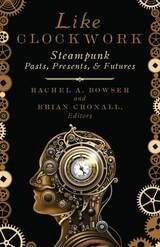
Like Clockwork
Steampunk Pasts, Presents, and FuturesRachel A. Bowser
University of Minnesota Press, 2016
Co-winner, Ray & Pat Browne Award for Best Edited Collection in Popular Culture and American Culture
Once a small subculture, the steampunk phenomenon exploded in visibility during the first years of the twenty-first century, its influence and prominence increasing ever since. From its Victorian and literary roots to film and television, video games, music, and even fashion, this subgenre of science fiction reaches far and wide within current culture. Here Rachel A. Bowser and Brian Croxall present cutting-edge essays on steampunk: its rise in popularity, its many manifestations, and why we should pay attention.
Like Clockwork offers wide-ranging perspectives on steampunk’s history and its place in contemporary culture, all while speaking to the “why” and “why now” of the genre. In her essay, Catherine Siemann draws on authors such as William Gibson and China Miéville to analyze steampunk cities; Kathryn Crowther turns to disability studies to examine the role of prosthetics within steampunk as well as the contemporary culture of access; and Diana M. Pho reviews the racial and national identities of steampunk, bringing in discussions of British chap-hop artists, African American steamfunk practitioners, and multicultural steampunk fan cultures.
From disability and queerness to ethos and digital humanities, Like Clockwork explores the intriguing history of steampunk to evaluate the influence of the genre from the 1970s through the twenty-first century.
Contributors: Kathryn Crowther, Perimeter College at Georgia State University; Shaun Duke, University of Florida; Stefania Forlini, University of Calgary (Canada); Lisa Hager, University of Wisconsin–Waukesha; Mike Perschon, MacEwan University in Edmonton, Alberta; Diana M. Pho; David Pike, American University; Catherine Siemann, New Jersey Institute of Technology; Joseph Weakland, Georgia Institute of Technology; Roger Whitson, Washington State University.
Lingua Cosmica
Science Fiction from around the WorldEdited by Dale Knickerbocker
University of Illinois Press, 2018
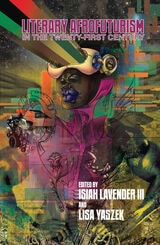
Literary Afrofuturism in the Twenty-First Century
Edited by Isiah Lavender III and Lisa Yaszek
The Ohio State University Press, 2020
In Literary Afrofuturism in the Twenty-First Century, eminent contributors pay tribute to Afrofuturism as a powerful and evolving aesthetic practice that communicates the experience of science, technology, and race across centuries, continents, and cultures. While Ryan Coogler and Janelle Monáe may have helped bring the genre into contemporary pop consciousness, it in fact extends back to the writing of eighteenth-century poet Phyllis Wheatley and has continued in the work of Samuel R. Delany, Octavia E. Butler, N. K. Jemisin, and many others. In examining this heritage, contributors in this volume question generic boundaries, recover lost artists and introduce new ones, and explore how the meteoric rise of a new, pan-African speculative literary tradition may or may not connect with Afrofuturism.
Additionally, the editors have marshaled some of today’s most exciting writers for a roundtable discussion of the genre: Bill Campbell, Minister Faust, Nalo Hopkinson, N. K. Jemisin, Chinelo Onwualu, Nisi Shawl, and Nick Wood. Pioneering author and editor Sheree R. Thomas limns how black women have led new developments in contemporary Afrofuturism, and artist Stacey Robinson’s illustrations orient readers to the spirited themes of this enduring and consequential literary tradition.
Lois McMaster Bujold
Edward James
University of Illinois Press, 2015
Acclaimed science fiction scholar Edward James traces Bujold's career, showing how Bujold emerged from fanzine culture to win devoted male and female readers despite working in genres--military SF, space opera--perceived as solely by and for males. Devoted to old-school ideas such as faith in humanity and the desire to probe and do good in the universe, Bujold simultaneously subverted genre conventions and experimented with forms that led her in bold creative directions. As James shows, her iconic hero Miles Vorkosigan--unimposing, physically impaired, self-conscious to a fault--embodied Bujold's thematic concerns. The sheer humanity of her characters, meanwhile, gained her a legion of fans eager to provide her with feedback, expand her vision through fan fiction, and follow her into fantasy.