Results by title
60 books match the query 'Sculpture & Installation' and 4 start with l
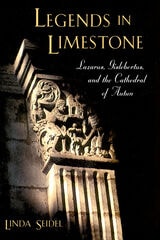
Legends in Limestone
Lazarus, Gislebertus, and the Cathedral of AutunLinda Seidel
University of Chicago Press, 1999
Legends in Limestone reveals how "Gislebertus, sculptor" was discovered and subsequently sanctified over the course of the last century. Seidel makes a compelling case for the identification of the name with an ancestor of the local ducal family, invoked for his role in the acquisition of the precious relics. With the aid of evidence drawn from the richly carved decoration of the building, she demonstrates how medieval visitors would have read a different holy narrative in the church fabric, one that constructed before their eyes an account of their patron saint's life.
Legends in Limestone, an absorbing study of one of France's most revered medieval monuments, provides fresh insights into modern and medieval interpretive practices.
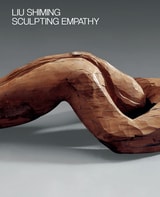
Liu Shiming
Sculpting EmpathyRichard Vine
Rutgers University Press, 2026
Liu Shiming (1926–2010) is a revered Chinese artist whose works have had a distinct impact on the course of modern Chinese sculpture. Born in Tianjin in 1926, Shiming attended the prestigious Central Academy of Fine Arts (CAFA) in Beijing, where he was part of the first generation of sculptors trained by the People’s Republic of China to study both traditional Chinese art and French modernist principles. Shiming received early recognition for his work, and his student project Measuring Land (1950) was one of the first works exhibited abroad following the establishment of the People’s Republic of China.
Though well respected in China, the sculptor, who died in 2010 at the age of eighty-four, is only now beginning to win the wider recognition he deserves. Meanwhile, contemporary competitors are numberless, most of them Instagram-friendly, while art history tends to focus on towering names and indisputably major movements and events: Braque and Picasso inventing Cubism, Duchamp’s readymades redefining art itself, Warhol’s mind-bending Brillo Boxes, and so on. So why examine an artist in the middle ground? Perhaps, first, because that is where the vast majority of us live, trying to make sense of our lives and grateful for the occasional insight, release, or enrichment that visual art can bring us. Second, because the story of Liu Shiming reveals a great deal about the forces that have shaped postwar art worldwide. He was a man who sought to lead a simple life, dedicated entirely to art, in the midst of China’s epochal, dangerously complex twentieth-century social and political changes.
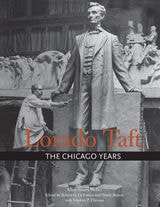
Lorado Taft
The Chicago YearsAllen Stuart Weller; Edited by Robert G. La France and Henry Adams with Stephen P. Thomas
University of Illinois Press, 2014
Returning to Chicago from France, Taft established a bustling studio and began a twenty-one-year career as an instructor at the Art Institute, succeeded by three decades as head of the Midway Studios at the University of Chicago. This triumphant era included ephemeral sculpture for the 1893 World's Columbian Exposition; a prolific turn-of-the-century period marked by the gold-medal-winning The Solitude of the Soul; the 1913 Fountain of the Great Lakes; the 1929 Alma Mater at the University of Illinois; and large-scale projects such as his ambitious program for Chicago's Midway with the monumental Fountain of Time. In addition, the book charts Taft's mentoring of women artists, including the so-called White Rabbits at the World's Fair, many of whom went on to achieve artistic success.
Lavishly illustrated with color images of Taft's most celebrated works, Lorado Taft: The Chicago Years completes the first major study of a great American artist.
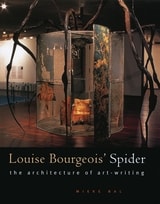
Louise Bourgeois' Spider
The Architecture of Art-WritingMieke Bal
University of Chicago Press, 2001
Known for her commentary on the issue of temporality in art, Bal argues that art must be understood in relationship to the present time of viewing as opposed to the less-immediate contexts of what has preceded the viewing, such as the historical past of influences and art movements, biography and interpretation. In ten short chapters, or "takes," Bal demonstrates that the closer the engagement with the work of art, the more adequate the result of the analysis. She also confronts issues of biography and autobiography—key themes in Bourgeois's work—and evaluates the consequences of "ahistorical" experiences for art criticism, drawing on diverse sources such as Bernini and Benjamin, Homer and Eisenstein.
This short, beautiful book offers both a theoretical model for analyzing art "out of context" and a meditation on a key work by one of the most engaging artists of our era.