Results by title
67 books match the query 'Sea' and 5 start with l

Land and Sea
The Lyric Poetry of Philip FreneauRichard C. Vitzthum
University of Minnesota Press, 1978
Land and Sea was first published in 1978. Minnesota Archive Editions uses digital technology to make long-unavailable books once again accessible, and are published unaltered from the original University of Minnesota Press editions.
Although Philip Freneau is best known as the poet of the American Revolution, half his poems had nothing to do with the war, Professor Vitzthum points out, and this, the first systematic, in-depth study of Freneau's lyric poetry, provides a fresh perspective on the poet's non-political work. Demonstrating that there is a heretofore unrecognized pattern of land-sea imagery and symbolism in Freneau's best work. Professor Vitzthum traces changes reflected in this imagery to developments in the poet's thought, which in turn related to major intellectual and literary trends in revolutionary and early republican America. An introductory chapter assesses twentieth century biographical and critical estimates of Freneau, outlines the key themes in his work, and links his thirty-year career as sailor and ship captain to his creation of a covert, symbolistic poetic method. The following five chapters chronologically discuss Freneau's non-political poems from 1772 through 1815. Professor Vitzthum concludes that Freneau was not the derivative and unsuccessful artist he is currently thought to have been but, rather, one of America's genuinely important poets.

Like a Sea
Samuel Amadon
University of Iowa Press, 2010
Drawing equally from Wallace Stevens, Gertrude Stein, John Berryman, and Robert Frost, Samuel Amadon’s award-winning Like a Sea is a collection of poems where personality is foregrounded and speech is both bizarre and familiar. Central to this weirdly talky work is “Each H,” a sequence of eleven monologues and dialogues wherein an unknown number of speakers examine their collective and singular identities while simultaneously distorting them. From a sequence of pared-down sonnets to a more traditional lyric to a procedural collage inspired by J. D. Salinger, Ezra Pound, Robert Lowell, Walter Benjamin, Jane Kenyon, Joris-Karl Huysmans, Primo Levi, Eugenio Montale, and Edwin Arlington Robinson, Like a Sea is a book of significant variation and originality.
Amadon’s electric collection begins with the line “I could not sound like anyone but me,” and through a wide range of forms and styles and voices he tests the true limits of that statement. The image of a half-abandoned Hartford, Connecticut, remains in the background of these poems, casting a tone of brokenness and haplessness. Ultimately Amadon’s poems present the confusion and fear of the current moment, of Stevens’s “river that flows nowhere, like a sea,” equally alongside its joyful ridiculousness and possibility. Rather than create worlds, they point out what a strange world already exists.
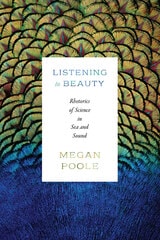
Listening to Beauty
Rhetorics of Science in Sea and SoundMegan Poole
University of Chicago Press, 2025
Our attempts to understand the world are always more than simply rational. Our bodies learn through lived experience, our natural environments challenge what we think we know, and we take lessons from our nonhuman kin. Even scientists, often considered paragons of rationality, frequently describe their findings in the language of beauty. For rhetorician Megan Poole, beauty is integral to how scientific research works.
Drawing on interviews with leading biologists, Poole explores what happens when scientists set aside objectivity and listen for beauty around them. The wonder we feel at the plumage of birds, the melodies of whales, or the caretaking of elephants may not help us (on its own) to isolate a given fact, but such encounters may teach us to open ourselves to a different way of knowing entirely. Through stories about researchers’ encounters with wonder, Listening to Beauty reveals how scientific discovery happens sometimes unsystematically, sometimes incoherently, often beautifully.

Living by the Rules of the Sea
David M. Bush, Orrin H. Pilkey and William J. Neal
Duke University Press, 1996
Living by the Rules of the Sea is a primer for people living along the nation's coastlines, those considering moving to the coast, or those who want a greater understanding of the risks and dangers posed by living at the seacoast. Published as part of Duke University Press's Living with the Shore series, but without a direct focus on the coastline of one particular state, this book is intended as an overall guide to coastal physical processes, risk assessment of potential property damage from coastal natural hazards, and property damage mitigation.
Over the past twenty years, the authors have mapped and studied most of the barrier islands in the United States and have experienced coastal processes such as storms and shoreline retreat at close range. They represent a coastal geology/oceanographic perspective that is decidedly in favor of preserving the natural protective capabilities of the native coastal environment. While strongly anti-engineering in outlook, Living by the Rules of the Sea does provide a review of coastal engineering techniques. It also examines methods of repairing damage to the natural environment that lessen the prospect of further property damage. Finally, it employs a more inclusive "coastal zone" approach rather than simply concentrating on a more narrowly defined shoreline. Barrier islands are viewed as part of a larger system in which changes in one part of the system—for example, the mining of sand dunes or dredging offshore for beach replenishment sand—can have profound effects on another part of the system, predictable effects even though they may not be visible for years or decades.
A comprehensive handbook with references to recent storms including hurricanes Andrew, Gilbert, Hugo, Emily, and Opal, Living by the Rules of the Sea is designed to help people make better and more informed choices about where or if to live at the coast.

Lords of the Sea
Pirates, Violence, and Commerce in Late Medieval JapanPeter D. Shapinsky
University of Michigan Press, 2014