Results by title
262 books match the query 'Sex role' and 3 start with l

Like a Captive Bird
Gender and Virtue in PlutarchLunette Warren
Lever Press, 2023
The full extent of Plutarch’s moral educational program remains largely understudied, at least in those aspects pertaining to women and the gendered other. As a result, scholarship on his views on women have differed significantly in their conclusions, with some scholars suggesting that he is overwhelmingly positive towards women and marriage and perhaps even a “precursor to feminism,” and others arguing that he was rather negative on the issue. Like a Captive Bird: Gender and Virtue in Plutarch is an examination of these educational methods employed in Plutarch’s work to regulate the expression of gender identity in women and men. In six chapters, author Lunette Warren analyzes Plutarch’s ideas about women and gender in Moralia and Lives. The book examines the divergences between real and ideal, the aims and methods of moral philosophy and psychagogic practice as they relate to identity formation, and Plutarch’s theoretical philosophy and metaphysics.
Warren argues that gender is a flexible mode of being that expresses a relation between body and soul, and that gender and virtue are inextricably entwined. Plutarch’s expression of gender is also an expression of a moral condition that signifies relationships of power, Warren claims, especially power relationships between the husband and wife. Uncovered in these texts is evidence of a redistribution of power, which allows some women to dominate other women and, in rare cases, men too. Like a Captive Bird offers a unique and fresh interpretation of Plutarch’s metaphysics which centers gender as one of the organizational principles of nature. It is aimed at scholars of Plutarch, ancient philosophy, and ancient gender studies, especially those who are interested in feminist studies of antiquity.

Love, Sex, and Desire in Modern Egypt
Navigating the Margins of RespectabilityBy L. L. Wynn
University of Texas Press, 2018
Cairo is a city obsessed with honor and respectability—and love affairs. Sara, a working-class woman, has an affair with a married man and becomes pregnant, only to be abandoned by him; Ayah and Zeid, a respectably engaged couple, argue over whether Ayah’s friend is a prostitute or a virgin; Malak, a European belly dancer who sometimes gets paid for sex, wants to be loved by a man who won’t treat her like a whore just because she’s a dancer; and Alia, a Christian banker who left her abusive husband, is the mistress of a wealthy Muslim man, Haroun, who encourages business by hosting risqué parties for other men and their mistresses.
Set in transnational Cairo over two decades, Love, Sex, and Desire in Modern Egypt is an ethnography that explores female respectability, male honor, and Western theories and fantasies about Arab society. L. L. Wynn uses stories of love affairs to interrogate three areas of classic anthropological theory: mimesis, kinship, and gift. She develops a broad picture of how individuals love and desire within a cultural and political system that structures the possibilities of, and penalties for, going against sexual and gender norms. Wynn demonstrates that love is at once a moral horizon, an attribute that “naturally” inheres in particular social relations, a social phenomenon strengthened through cultural concepts of gift and kinship, and an emotion deeply felt and desired by individuals.
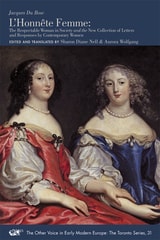
L’Honnête Femme
The Respectable Woman in Society and the New Collection of Letters and Responses by Contemporary WomenJacques Du Bosc
Iter Press, 2014
—Reverend John J. Conley, SJ
Knott Professor of Philosophy, Loyola University Maryland