Results by title
4038 books match the query 'Social aspects' and 120 start with l
La Consentida
Settlement, Subsistence, and Social Organization in an Early Formative Mesoamerican CommunityGuy David Hepp
University Press of Colorado, 2019
La Consentida explores Early Formative period transitions in residential mobility, subsistence, and social organization at the site of La Consentida in coastal Oaxaca, Mexico. Examining how this site transformed during one of the most fundamental moments of socioeconomic change in the ancient Americas, the book provides a new way of thinking about the social dynamics of Mesoamerican communities of the period.
Guy David Hepp summarizes the results of several seasons of fieldwork and laboratory analysis under the aegis of the La Consentida Archaeological Project, drawing on various forms of evidence—ground stone tools, earthen architecture, faunal remains, human dental pathologies, isotopic indicators, ceramics, and more— to reveal how transitions in settlement, subsistence, and social organization at La Consentida were intimately linked. While Mesoamerica is too diverse for research at a single site to lay to rest ongoing debates about the Early Formative period, evidence from La Consentida should inform those debates because of the site’s unique ecological setting, its relative lack of disturbance by later occupations, and because it represents the only well-documented Early Formative period village in a 300-mile stretch of Mexico’s Pacific coast.
One of the only studies to closely document multiple lines of evidence of the transition toward a sedentary, agricultural society at an individual settlement in Mesoamerica, La Consentida is a key resource for understanding the transition to settled life and social complexity in Mesoamerican societies.
La India María
Mexploitation and the Films of María Elena VelascoBy Seraina Rohrer
University of Texas Press, 2017
La India María—a humble and stubborn indigenous Mexican woman—is one of the most popular characters of the Mexican stage, television, and film. Created and portrayed by María Elena Velasco, La India María has delighted audiences since the late 1960s with slapstick humor that slyly critiques discrimination and the powerful. At the same time, however, many critics have derided the iconic figure as a racist depiction of a negative stereotype and dismissed the India María films as exploitation cinema unworthy of serious attention. By contrast, La India María builds a convincing case for María Elena Velasco as an artist whose work as a director and producer—rare for women in Mexican cinema—has been widely and unjustly overlooked.
Drawing on extensive interviews with Velasco, her family, and film industry professionals, as well as on archival research, Seraina Rohrer offers the first full account of Velasco’s life; her portrayal of La India María in vaudeville, television, and sixteen feature film comedies, including Ni de aquí, ni de allá [Neither here, nor there]; and her controversial reception in Mexico and the United States. Rohrer traces the films’ financing, production, and distribution, as well as censorship practices of the period, and compares them to other Mexploitation films produced at the same time. Adding a new chapter to the history of a much-understudied period of Mexican cinema commonly referred to as “la crisis,” this pioneering research enriches our appreciation of Mexploitation films.
La Verdad
An International Dialogue on Hip Hop LatinidadesEdited by Melissa Castillo-Garsow and Jason Nichols
The Ohio State University Press, 2016
A truly international effort, La Verdad: An International Dialogue on Hip Hop Latinidades brings together exciting new work about Latino/a hip hop across more than a dozen countries, from scholars and practitioners in the United States and in Latin America, highlighting in new ways the participation of women, indigenous peoples, and Afro-descendants in a reimagined global, hip hop nation. From graffitera crews in Costa Rica and Nicaragua to Mexican hip hop in New York, from Aymara rap in Bolivia to Chicano rap in Taiwan, this volume explodes stereotypes of who and how hip hop is consumed, lived, and performed. Examining hip hop movements in Spanish, English, Portuguese, Aymara, and Creole, La Verdad demonstrates that Latino hip hop is a multilingual expression of gender, indigeneity, activism, and social justice.

Labor of Love
Gestational Surrogacy and the Work of Making BabiesJacobson, Heather
Rutgers University Press, 2016
For more, visit http://www.heatherjacobsononline.com/
Labor's End
How the Promise of Automation Degraded WorkJason Resnikoff
University of Illinois Press, 2022
A forceful intellectual history, Labor's End challenges entrenched assumptions about automation's transformation of the American workplace.
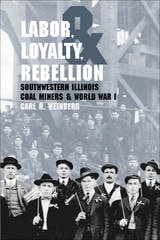
Labor, Loyalty, and Rebellion
Southwestern Illinois Coal Miners & World War ICarl R. Weinberg
Southern Illinois University Press, 2005
On April 5, 1918, as American troops fought German forces on the Western Front, German American coal miner Robert Prager was hanged from a tree outside Collinsville, Illinois, having been accused of disloyal utterances about the United States and chased out of town by a mob. In Labor, Loyalty, and Rebellion: Southwestern Illinois Coal Miners and World War I, Carl R. Weinberg offers a new perspective on the Prager lynching and confronts the widely accepted belief among labor historians that workers benefited from demonstrating loyalty to the nation.
The first published study of wartime strikes in southwestern Illinois is a powerful look at a group of people whose labor was essential to the war economy but whose instincts for class solidarity spawned a rebellion against mine owners both during and after the war. At the same time, their patriotism wreaked violent working-class disunity that crested in the brutal murder of an immigrant worker. Weinberg argues that the heightened patriotism of the Prager lynching masked deep class tensions within the mining communities of southwestern Illinois that exploded after the Great War ended.

Labs of Our Own
Feminist Tinkerings with ScienceSig / Sara Giordano
Rutgers University Press, 2025

Ladies and Gents
Public Toilets and Genderedited by Olga Gershenson and Barbara Penner, foreword by Judith Plaskow, afterword by Peter Greenaway
Temple University Press, 2009
Public toilets provide a unique opportunity for interrogating how conventional assumptions about the body, sexuality, privacy, and technology are formed in public spaces and inscribed through design across cultures. This collection of original essays from international scholars is the first to explore the cultural meanings, histories, and ideologies of public toilets as gendered spaces.
Ladies and Gents consists of two sets of essays. The first, "Potty Politics: Toilets, Gender and Identity," establishes the importance of accessible, secure public toilets to the creation of inclusive cities, work, and learning environments. The second set of essays, "Toilet Art: Design and Cultural Representations," discusses public toilets as spaces of representation and representational spaces, with reference to architectural design, humor, film, theater, art, and popular culture. Compelling visual materials and original artwork are included throughout, depicting subjects as varied as female urinals, art installations sited in public restrooms, and the toilet in contemporary art.
Taken together, these seventeen essays demonstrate that public toilets are often sites where gendered bodies compete for resources and recognition—and the stakes are high.
Contributors include: Nathan Abrams, Jami L. Anderson, Johan Andersson, Kathryn H. Anthony, Kathy Battista, Andrew Brown-May, Ben Campkin, Meghan Dufresne, Peg Fraser, Deborah Gans, Clara Greed, Robin Lydenberg, Claudia Mitchell, Alison Moore, Frances Pheasant-Kelly, Bushra Rehman, Alex Schweder, Naomi Stead, and the editors.
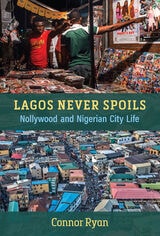
Lagos Never Spoils
Nollywood and Nigerian City LifeConnor Ryan
University of Michigan Press, 2023
Winner of the Society for Cinema and Media Studies, Media Industries Scholarly Interest Group Outstanding Book Award
The slogan “Lagos shall not spoil,” found in print media, political campaigns, and common conversation, represents a shared expression of the optimism the city embodies. However, on city streets the phrase also appears scrawled in irreverent variations—“Lagos cannot spoil more than this!”—that meet the frustrations of city life with irony. In both cases, the slogan captures the resilience and persistence with which residents of Lagos live on, despite it all. This book examines the circumstances that make it possible for residents to persist in pursuing their various projects and for the city to remain a platform that supports these projects and creates space for even more to emerge. Author Connor Ryan argues that residents continually work to combine contingency and endurance in opportunistic ways that make the city work for them, and as such, Lagos never spoils: it endures.
What makes Lagos remarkable is what residents have made of it, and Nollywood—the industry and the body of films—both embodies and represents this continual urban transformation. Lagos Never Spoils traces how Nollywood arose from the social milieu of Lagos and, in turn, generates a repertoire of stories, images, styles, and sentiments with which audiences come to grips with city life. The book traces the evolution of the screen media industry in Lagos and explores how this corresponds with historical phases in the city’s representation onscreen. It discusses important urban spaces of production and consumption, including historic movie halls, video marketplaces, film sets, and multiplex cinemas. Across six chapters, it attends to celluloid films about oil-boom wealth, television sitcoms about urban tricksters, video melodramas about urban crisis, glossy romantic comedies about young professionals, and dark thrillers on streaming platforms about the pleasure of moral transgression. In this fashion, the book offers new approaches to the interpretation of screen texts produced in and about Lagos, a place that is today the most influential image of West African city life.
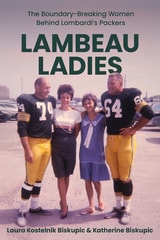
Lambeau Ladies
The Boundary-Breaking Women Behind Lombardi’s PackersLaura Kostelnik Biskupic
Wisconsin Historical Society Press, 2026
A book for anyone who thinks they know everything there is to know about the Green Bay Packers!
Long before NFL players had teams of trainers, nutritionists, therapists, agents, and other specialists, the dynastic Green Bay Packers of the 1960s relied on a different kind of support staff: their wives. In Lambeau Ladies, mother and daughter Laura Kostelnik Biskupic and Katherine Biskupic tell the remarkable, largely untold story of the women who helped to keep the Lombardi-era Packers performing at a championship level. From preparing game-day sandwiches, nursing injuries, and reviewing game film to managing households, hosting social gatherings, and providing emotional strength to their spouses, these women were a driving force behind one of the greatest teams in football history.
Through intimate interviews and vivid storytelling, the authors bring to life the experiences of Cherry Starr, Vicky Aldridge, Barbara Gregg, Ruth Pitts, Peggy Kostelnik, and many other wives who formed deep friendships and carved out lives of meaning far from their hometowns, often in the face of social and racial barriers. With humor and candor, they describe making ends meet on modest salaries, feeding hungry young players who wandered into their kitchens, boosting their husbands’ confidence, and coming up with ingenious strategies for staying warm—and stylish—on the sidelines during Green Bay’s frigid winters.
Their stories reach far beyond football. Some of these women helped integrate Green Bay during the civil rights movement. One became one of the district’s first Black teachers; another was half of one of the NFL’s first interracial marriages. Others made contributions in their own singular ways—fostering children, launching a business and a community organization, becoming a voice in local media. And at the center of it all was Marie Lombardi, the coach’s wife and the de facto mentor of the entire wives’ cohort, whose influence extended from locker-room culture to community life.
Lambeau Ladies paints a rich portrait of midcentury Green Bay—a place where championship football, small-town rhythms, and national social change converged—and reveals how the Packers’ dynasty was shaped as much in living rooms, kitchens, and carpool lanes as on the frozen turf of Lambeau Field.
Warm, funny, and deeply inspiring, Lambeau Ladies celebrates the extraordinary women who helped build a dynasty—and, in the process, changed their town, their team, and each other.
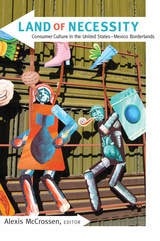
Land of Necessity
Consumer Culture in the United States–Mexico BorderlandsAlexis McCrossen, ed.
Duke University Press, 2009
In Land of Necessity, historians and anthropologists unravel the interplay of the national and transnational and of scarcity and abundance in the region split by the 1,969-mile boundary line dividing Mexico and the United States. This richly illustrated volume, with more than 100 images including maps, photographs, and advertisements, explores the convergence of broad demographic, economic, political, cultural, and transnational developments resulting in various forms of consumer culture in the borderlands. Though its importance is uncontestable, the role of necessity in consumer culture has rarely been explored. Indeed, it has been argued that where necessity reigns, consumer culture is anemic. This volume demonstrates otherwise. In doing so, it sheds new light on the history of the U.S.-Mexico borderlands, while also opening up similar terrain for scholarly inquiry into consumer culture.
The volume opens with two chapters that detail the historical trajectories of consumer culture and the borderlands. In the subsequent chapters, contributors take up subjects including smuggling, tourist districts and resorts, purchasing power, and living standards. Others address home décor, housing, urban development, and commercial real estate, while still others consider the circulation of cinematic images, contraband, used cars, and clothing. Several contributors discuss the movement of people across borders, within cities, and in retail spaces. In the two afterwords, scholars reflect on the U.S.-Mexico borderlands as a particular site of trade in labor, land, leisure, and commodities, while also musing about consumer culture as a place of complex political and economic negotiations. Through its focus on the borderlands, this volume provides valuable insight into the historical and contemporary aspects of the big “isms” shaping modern life: capitalism, nationalism, transnationalism, globalism, and, without a doubt, consumerism.
Contributors. Josef Barton, Peter S. Cahn, Howard Campbell, Lawrence Culver, Amy S. Greenberg, Josiah McC. Heyman, Sarah Hill, Alexis McCrossen, Robert Perez, Laura Isabel Serna, Rachel St. John, Mauricio Tenorio-Trillo, Evan R. Ward
Land, Memory, Reconstruction, and Justice
Perspectives on Land Claims in South AfricaCherryl Walker
Ohio University Press, 2010
Land is a significant and controversial topic in South Africa. Addressing the land claims of those dispossessed in the past has proved to be a demanding, multidimensional process. In many respects the land restitution program that was launched as part of the county’s transition to democracy in 1994 has failed to meet expectations, with ordinary citizens, policymakers, and analysts questioning not only its progress but also its outcomes and parameters.
Land, Memory, Reconstruction, and Justice brings together a wealth of topical material and case studies by leading experts in the field who present a rich mix of perspectives from politics, sociology, geography, social anthropology, law, history, and agricultural economics. The collection addresses both the material and the symbolic dimensions of land claims, in rural and urban contexts, and explores the complex intersection of issues confronting the restitution program, from the promotion of livelihoods to questions of rights, identity, and transitional justice.
A valuable contribution to the field of land and agrarian studies, both in South Africa and internationally, it is undoubtedly the most comprehensive treatment to date of South Africa’s postapartheid land claims process and will be essential reading for scholars and students of land reform for years to come.
Landscape and Interaction. The Troodos Archaeological and Environmental Survey Project, Cyprus. Volume 1. Methodology, Analysis and Interpretation
Michael Given
Council for British Research in the Levant, 2013

Landscape, Memory and History
Anthropological PerspectivesEdited by Pamela J. Stewart and Andrew Strathern
Pluto Press, 2003
Contributors from North America, Australia, New Zealand, Taiwan, and Europe explore a wide variety of case studies that includes seascapes in Jamaica; the Solomon Islands; the forests of Madagascar; Aboriginal and European notions of landscape in Australia; place and identity in 19th century maps and the bogs of Ireland; contemporary concerns over changing landscapes in Papua New Guinea; and representations of landscape and history in the poetry of the Scottish Borders.
Landscapes and Social Transformations on the Northwest Coast
Colonial Encounters in the Fraser ValleyJeff Oliver
University of Arizona Press, 2010
The Fraser Valley has long been a scene of natural resource appropriation—furs and fish, timber and agriculture—with settlement patterns and land claims centering on the use of these materials. Oliver demonstrates how social change and cultural understanding are tied to the way that people use and remake the landscape. Drawing on ethnographic texts, archaeological evidence, cartography, and historical writing, he has created a deep history of the valley that enables us to view how human entanglements with landscape were creative of a variety of contentious issues. By capturing the multiple dynamics that were operating in the past, Oliver shows us not only how landscape transformations were implicated in constructing different perceptions of place but also how such changes influenced peoples’ understanding of history and identity.
This groundbreaking work examines engagement between people and the environment across a variety of themes, from aboriginal appropriation of nature to colonists’ reworking of physical and conceptual geographies, demonstrating the consequences of these interactions as they permeated various social and cultural spheres. It offers a new lens for viewing a region as it provides fresh insight into such topics as landscape change, perceptions of place, and Indigenous-white relations.
Landscapes of Activism
Civil Society, HIV and AIDS Care in Northern MozambiqueReed, Joel Christian
Rutgers University Press, 2018
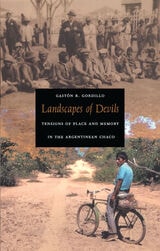
Landscapes of Devils
Tensions of Place and Memory in the Argentinean ChacoGastón R. Gordillo
Duke University Press, 2004
As Gordillo explains, the bush is the result of social, cultural, and political processes that intertwine this place with other geographies. Labor exploitation, state violence, encroachment by settlers, and the demands of Anglican missionaries all transformed this land. The Toba’s lives have been torn between alienating work in sugar plantations and relative freedom in the bush, between moments of domination and autonomy, abundance and poverty, terror and healing. Part of this contradictory experience is culturally expressed in devils, evil spirits that acquire different features in different places. The devils are sources of death and disease in the plantations, but in the bush they are entities that connect with humans as providers of bush food and healing power. Enacted through memory, the experiences of the Toba have produced a tense and shifting geography. Combining extensive fieldwork conducted over a decade, historical research, and critical theory, Gordillo offers a nuanced analysis of the Toba’s social memory and a powerful argument that geographic places are not only objective entities but also the subjective outcome of historical forces.
Language Machines
Cultural AI and the End of Remainder HumanismLeif Weatherby
University of Minnesota Press, 2025
How generative AI systems capture a core function of language
Looking at the emergence of generative AI, Language Machines presents a new theory of meaning in language and computation, arguing that humanistic scholarship misconstrues how large language models (LLMs) function. Seeing LLMs as a convergence of computation and language, Leif Weatherby contends that AI does not simulate cognition, as widely believed, but rather creates culture. This evolution in language, he finds, is one that we are ill-prepared to evaluate, as what he terms “remainder humanism” counterproductively divides the human from the machine without drawing on established theories of representation that include both.
To determine the consequences of using AI for language generation, Weatherby reads linguistic theory in conjunction with the algorithmic architecture of LLMs. He finds that generative AI captures the ways in which language is at first complex, cultural, and poetic, and only later referential, functional, and cognitive. This process is the semiotic hinge on which an emergent AI culture depends. Weatherby calls for a “general poetics” of computational cultural forms under the formal conditions of the algorithmic reproducibility of language.
Locating the output of LLMs on a spectrum from poetry to ideology, Language Machines concludes that literary theory must be the backbone of a new rhetorical training for our linguistic-computational culture.
Language Use and Language Change in Brunei Darussalam
Mis Sea#100Peter W. Martin
Ohio University Press, 1996
The oil-rich sultanate of Brunei Darussalam is located on the northern coast of Borneo between the two Malaysian states of Sarawak and Sabah. Though the country is small in size and in population, the variety of language use there provides a veritable laboratory for linguists in the fields of Austronesian linguistics, bilingual studies, and sociolinguistic studies, particularly those dealing with language shift.
This useful reference is divided into three sections: one on varieties of the Malay language used in the country, one on other indigenous languages, and one on the role and form of the English used there. Contributors to the collection include Bruneian scholars as well as established experts in the fields of Austronesian linguistics, sociolinguistics studies, and the description of new varieties of English.
Language Variety in the South Revisited
Cynthia Bernstein
University of Alabama Press, 1994
Top linguists from diverse fields address language varieties in the South.
Language and Ethnicity among the K'ichee' Maya
Sergio Romero
University of Utah Press, 2015
This book explores the articulation between “accent” and ethnic identification in K’ichee’, a Mayan language spoken by more than one million people in the western highlands of Guatemala. Based on years of ethnographic work, it is the first anthropological examination of the social meaning of dialectal difference in any Mayan language. Romero deconstructs essentialist perspectives on ethnicity in Mesoamerica and argues that ethnic identification among the highland Maya is multiple and layered, the result of a diverse linguistic precipitate created by centuries of colonial resistance.
In K’ichee’, dialect stereotypes—accents—act as linguistic markers embodying particular ethnic registers. K’ichee’ speakers use and recombine their linguistic repertoire—colloquial K’ichee’, traditional K’ichee’ discourse, colloquial Spanish, Standard Spanish, and language mixing—in strategic ways to mark status and authority and to revitalize their traditional culture. The book surveys literary genres such as lyric poetry, political graffiti, and radio broadcasts, which express new experiences of Mayan-ness and anticolonial resistance. It also takes a historical perspective in examining oral and written K’ichee’ discourses from the sixteenth to the twenty-first centuries, including the famous chronicle known as the Popol Vuh, and explores the unbreakable link between language, history, and culture in the Maya highlands.
Language and Power Reader
Representations of Race in a "Post-Racist" EraRobert Eddy
Utah State University Press, 2014
A Language and Power Reader organizes reading and writing activities for undergraduate students, guiding them in the exploration of racism and cross-racial rhetorics.
Introducing texts written from and about versions of English often disrespected by mainstream Americans, A Language and Power Reader highlights English dialects and discourses to provoke discussions of racialized relations in contemporary America. Thirty selected readings in a range of genres and from writers who work in ?alternative? voices (e.g., Pidgin, African American Language, discourse of international and transnational English speakers) focus on disparate power relations based on varieties of racism in America and how those relations might be displayed, imposed, or resisted across multiple rhetorics. The book also directs student participation and discourse. Each reading is followed by comments and guides to help focus conversation.
Research has long shown that increasing a student?s metalinguistic awareness improves a student?s writing. No other reader available at this time explores the idea of multiple rhetorics or encourages their use, making A Language and Power Reader a welcome addition to writing classrooms.
Language of the Gun
Youth, Crime, and Public PolicyBernard E. Harcourt
University of Chicago Press, 2006
Home to over 150 repeat offenders ranging in age from twelve to seventeen, the Catalina Mountain School is made up of a particular stratum of boys—those who have committed the most offenses but will still be released upon reaching adulthood. In an effort to understand the symbolic and emotional language of guns and gun carrying, Harcourt interviewed dozens of these incarcerated Catalina boys. What do these youths see in guns? What draws them to handguns? Why do some of them carry and others not? For Harcourt, their often surprising answers unveil many of the presuppositions that influence our laws and policies.
Language, History, and Identity
Ethnolinguistic Studies of the Arizona TewaPaul V. Kroskrity
University of Arizona Press, 1993
Language, Resistance and Revival
Republican Prisoners and the Irish Language in the North of IrelandFeargal Mac Ionnrachtaigh
Pluto Press, 2013
Language, Resistance and Revival tells the untold story of the truly groundbreaking linguistic and educational developments that took place among Republican prisoners in Long Kesh prison from 1972-2000.
During a period of bitter struggle between Republican prisoners and the British state, the Irish language was taught and spoken as a form of resistance during incarceration. The book unearths this story for the first time and analyses the rejuvenating impact it had on the cultural revival in the nationalist community beyond the prison walls.
Based on unprecedented interviews, Feargal Mac Ionnrachtaigh explores a key period in Irish history through the original and 'insider' accounts of key protagonists in the contemporary Irish language revival.
Last Outpost on the Zulu Frontiers
Fort Napier and the British Imperial GarrisonGraham Dominy
University of Illinois Press, 2016
Last Words
Large Language Models and the AI ApocalypsePaul Kockelman
Prickly Paradigm Press, 2024
What kind of meaning can machines make—and why does it matter that it’s not the same as ours?
Anthropologist Paul Kockelman's Last Words offers a rigorous but accessible account of how large language models actually work—and why the meaning they produce is fundamentally different from human meaning-making. Drawing on the semiotics of C.S. Peirce, Kockelman’s witty and insightful pamphlet shows how LLMs are trained to predict word-word relations, not word-world relations, which explains both their uncanny fluency and their systematic blind spots. The result is a compact, essential guide to cutting through the hype: not a dismissal of AI, but a precise account of what it can and cannot do—and who profits from the confusion.
Latin* Students in Engineering
An Intentional Focus on a Growing PopulationLara Perez-Felkner
Rutgers University Press, 2024
Winner of the American Association of Hispanics in Higher Education Edited Volume Book of the Year Award
Winner of the 2026 Distinguished Contributions to Gender Equity in Educational Research Award from the American Educational Research Association
The growing population of engineering students who identify as Latin* are underrepresented in the field of engineering. Latin* refers to an individual of Latin American origin or descent, without restricting to a specific gender. The asterisk (*) includes related identity terms such as Latina/é/o/u/x.There is, however, a rising need to train U.S. students in engineering skills to meet the demands of our increasingly technological workforce. Structurally excluding Latin* students hinders their economic and educational opportunities in engineering. Latin* Students in Engineering examines the state of Latin* engineering education at present as well as considerations for policy and practice regarding engineering education aimed at enhancing opportunity and better serving Latin* students. The essays in this volume first consider, theoretically and empirically, the experiences of Latin* students in engineering education and then expand beyond the student level to focus on institutional and social structures that challenge Latin* students' success and retention. Finally, it illuminates emergent work and considers future research, policy, and practice.
Latina/os and World War II
Mobility, Agency, and IdeologyEdited by Maggie Rivas-Rodriguez and B.V. Olguín
University of Texas Press, 2014
The first book-length study of Latina/o experiences in World War II over a wide spectrum of identities and ancestries—from Cuban American, Spanish American, and Mexican American segments to the under-studied Afro-Latino experience—Latina/os and World War II probes the controversial aspects of Latina/o soldiering and citizenship in the war, the repercussions of which defined the West during the twentieth century. The editors also offer a revised, more accurate tabulation of the number of Latina/os who served in the war.
Spanning imaginative productions, such as vaudeville and the masculinity of the soldado razo theatrical performances; military segregation and the postwar lives of veterans; Tejanas on the homefront; journalism and youth activism; and other underreported aspects of the wartime experience, the essays collected in this volume showcase rarely seen recollections. Whether living in Florida in a transformed community or deployed far from home (including Mexican Americans who were forced to endure the Bataan Death March), the men and women depicted in this collection yield a multidisciplinary, metacritical inquiry. The result is a study that challenges celebratory accounts and deepens the level of scholarly inquiry into the realm of ideological mobility for a unique cultural crossroads. Taking this complex history beyond the realm of war narratives, Latina/os and World War II situates these chapters within the broader themes of identity and social change that continue to reverberate in postcolonial lives.
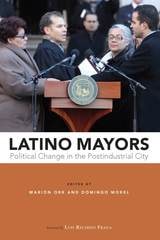
Latino Mayors
Political Change in the Postindustrial CityMarion Orr
Temple University Press, 2018
As recently as the early 1960s, Latinos were almost totally excluded from city politics. This makes the rise of Latino mayors in the past three decades a remarkable American story—one that explains ethnic succession, changing urban demography, and political contexts. The vibrant collection Latino Mayors features case studies of eleven Latino mayors in six American cities: San Antonio, Los Angeles, Denver, Hartford, Miami, and Providence.
The editors and contributors analyze Latino mayors for their governing styles and policies. They describe how candidates shaped race, class, and economic issues—particularly in deracialized campaigns. Latino Mayors also addresses coalition politics, political incorporation, and how community groups operate, as well as the challenges these pioneers have faced in office from political tensions and governance issues that sometimes even harm Latinos.
Ultimately, Latino Mayors charts the performances, successes, and failures of these elected officials to represent their constituents in a changing economic and urban environment.
Contributors include: Stefanie Chambers, Carlos E. Cuéllar, Emily M. Farris, Maria Ilcheva, Robert Preuhs, Heywood T. Sanders, Ellen Shiau, and the editors.
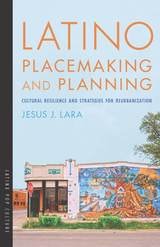
Latino Placemaking and Planning
Cultural Resilience and Strategies for ReurbanizationJesus J. Lara
University of Arizona Press, 2018
Latino Placemaking and Planning offers a pathway to define, analyze, and evaluate the role that placemaking can have with respect to Latino communities in the context of contemporary urban planning, policy, and design practices. Using strategically selected case studies, Jesus J. Lara examines how Latinos contribute to the phenomenon of urban revitalization through the (re)appropriation of physical space for their own use and the consequent transformation of what were previously economically downtrodden areas into vibrant commercial and residential centers.
The book examines the formation of urban cultures and reurbanization strategies from the perspective of Latino urbanism and is divided into four key sections, which address (1) emerging new urban geographies; (2) the power of place and neighborhood selection; (3) Latino urbanism case studies; and (4) lessons and recommendations for “reurbanizing” the city. Latino Placemaking and Planning illustrates the importance of placemaking for Latino communities and provides accessible strategies for planners, students, and activists to sustainable urban revitalization.
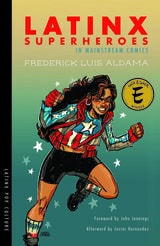
Latinx Superheroes in Mainstream Comics
Frederick Luis Aldama; Foreword by John Jennings; Afterword by Javier Hernandez
University of Arizona Press, 2017
Whether good or evil, beautiful or ugly, smart or downright silly, able-bodied or differently abled, gay or straight, male or female, young or old, Latinx superheroes in mainstream comic book stories are few and far between. It is as if finding the Latinx presence in the DC and Marvel worlds requires activation of superheroic powers.
Latinx Superheroes in Mainstream Comics blasts open barriers with a swift kick. It explores deeply and systematically the storyworld spaces inhabited by brown superheroes in mainstream comic book storyworlds: print comic books, animation, TV, and film. It makes visible and lets loose the otherwise occluded and shackled. Leaving nothing to chance, it sheds light on how creators (authors, artists, animators, and directors) make storyworlds that feature Latinos/as, distinguishing between those that we can and should evaluate as well done and those we can and should evaluate as not well done.
The foremost expert on Latinx comics, Frederick Luis Aldama guides us through the full archive of all the Latinx superheros in comics since the 1940s. Aldama takes us where the superheroes live—the barrios, the hospitals, the school rooms, the farm fields—and he not only shows us a view to the Latinx content, sometimes deeply embedded, but also provokes critical inquiry into the way storytelling formats distill and reconstruct real Latinos/as.
Thoroughly entertaining but seriously undertaken, Latinx Superheroes in Mainstream Comics allows us to truly see how superhero comic book storyworlds are willfully created in ways that make new our perception, thoughts, and feelings.
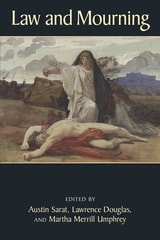
Law and Mourning
Austin Sarat
University of Massachusetts Press, 2017
In addition to the editors, the contributors include Andrea Brady, Catherine Kellogg, Shai Lavi, Ray Madoff, Ann Pelligrini, and Mark Sanders.
Law by Night
Jonathan Goldberg-Hiller
Duke University Press, 2023
Leaning Into The Wind
A Memoir Of Midwest WeatherSusan Allen Toth
University of Minnesota Press, 2006
Learned Patriots
Debating Science, State, and Society in the Nineteenth-Century Ottoman EmpireM. Alper Yalçinkaya
University of Chicago Press, 2015
In Learned Patriots, M. Alper Yalçinkaya examines what it meant for nineteenth-century Ottoman elites themselves to have a debate about science. Yalçinkaya finds that for anxious nineteenth-century Ottoman politicians, intellectuals, and litterateurs, the chief question was not about the meaning, merits, or dangers of science. Rather, what mattered were the qualities of the new “men of science.” Would young, ambitious men with scientific education be loyal to the state? Were they “proper” members of the community? Science, Yalçinkaya shows, became a topic that could hardly be discussed without reference to identity and morality.
Approaching science in culture, Learned Patriots contributes to the growing literature on how science travels, representations and public perception of science, science and religion, and science and morality. Additionally, it will appeal to students of the intellectual history of the Middle East and Turkish politics.
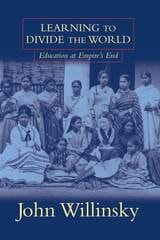
Learning To Divide The World
Education at Empire’s EndJohn Willinsky
University of Minnesota Press, 2000
Learning Under Algorithmic Conditions
Elizabeth de Freitas
University of Minnesota Press, 2026
Exploring the influence of AI technologies on theories of reason, cognition, learning, and education
Learning Under Algorithmic Conditions presents twenty-seven concise essays that collectively chart the shifting terrain of learning in the age of artificial intelligence. Providing historical and philosophical context, this innovative volume features prominent scholars from the fields of media studies, philosophy, and education research, who shed light on how learning has become newly envisioned, machinic, and more-than-human. The contributors unravel various histories of machine intelligence and elucidate the current impact of machine learning technologies on practices of knowledge production. Teeming with theoretical and practical insights, Learning Under Algorithmic Conditions is an interdisciplinary guide for those working across the humanities and social sciences as well as anyone interested in understanding our changing social, political, and technical infrastructures.
Contributors: Craig Carson, Adelphi U; Felicity Coleman, U of the Arts London; Ed Dieterle; Shayan Doroudi, U of California, Irvine; David Gauthier, Utrecht U; Cathrine Hasse, Aarhus U; Talha Can İşsevenler, CUNY; Goda Klumbytė; Robb Lindgren, U of Illinois Urbana-Champaign; Michael Madiao; Henry Neim Osman; Luciana Parisi, Duke U; Carolyn Pedwell, Lancaster U; Arkady Plotnitsky, Purdue U; Julian Quiros, U of Pennsylvania; Sina Rismanchian; Warren Sack, U of California, Santa Cruz; R. Joshua Scannell, The New School; Gregory J. Seigworth, Millersville U; Rebecca Uliasz, U of Michigan; David Wagner, U of New Brunswick; Ben Williamson, U of Edinburgh.
Retail e-book files for this title are screen-reader friendly with images accompanied by short alt text and/or extended descriptions.
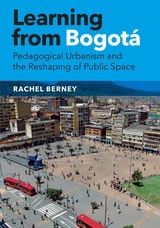
Learning from Bogotá
Pedagogical Urbanism and the Reshaping of Public SpaceBy Rachel Berney
University of Texas Press, 2017
Once known as a “drug capital” and associated with kidnappings, violence, and excess, Bogotá, Colombia, has undergone a transformation that some have termed “the miracle of Bogotá.” Beginning in the late 1980s, the city emerged from a long period of political and social instability to become an unexpected model of urban development through the redesign and revitalization of the public realm—parks, transportation, and derelict spaces—under the leadership of two “public space mayors,” Antanas Mockus and Enrique Peñalosa (the latter reelected in 2015). In Learning from Bogotá, Rachel Berney analyzes how these mayors worked to reconfigure the troubled city into a pedagogical one whose public spaces and urban policy have helped shape a more tolerant and aware citizenry.
Berney examines the contributions of Mockus and Peñalosa through the lenses of both spatial/urban design and the city’s history. She shows how, through the careful intertwining of new public space and transportation projects, the reclamation of privatized public space, and the refurbishment of dilapidated open spaces, the mayors enacted an ambitious urban vision for Bogotá without resorting to the failed method of the top-down city master plan. Illuminating the complex interplay between formal politics, urban planning, and improvised social strategies, as well as the negative consequences that accompanied Bogotá’s metamorphosis, Learning from Bogotá offers significant lessons about the possibility for positive and lasting change in cities around the world.
Learning to Be Latino
How Colleges Shape Identity PoliticsReyes, Daisy Verduzco
Rutgers University Press, 2018
Drawing on extensive ethnographic observations, Reyes shows how college campuses shape much more than students’ academic and occupational trajectories; they mold students’ ideas about inequality and opportunity in America, their identities, and even how they intend to practice politics.
Learning to Glow
A Nuclear ReaderJohn Bradley
University of Arizona Press, 2000
In Learning to Glow, twenty-four essays testify to many of the unsuspected human and environmental costs of atomic science. They show that Americans have paid a terrible price for supposedly "winning" the Cold War--for although the nuclear nightmare may be over, we are still living with nuclear threats every day. Writers such as Scott Russell Sanders, Terry Tempest Williams, and Barbara Kingsolver reveal the psychic and emotional fallout of the Cold War and of subsequent developments in nuclear science. The essays include personal testimonies of what it was like to grow up with family members in nuclear-related jobs; hard-hitting journalism on the health and environmental costs of our nuclear policies and practices; and poignant stories of coming to terms with nuclear power, including contributions by writers who revisit Hiroshima in an attempt to heal the wounds left by the Bomb.
These essays offer an alternative to the official version of nuclear history as told to us by school textbooks, government authorities, and nuclear industry officials. They are stories of and by ordinary people who have suffered the consequences of the decisions made by those in power-stories that have been largely ignored, dismissed, or suppressed. They will challenge readers to re-examine their preconceptions about the way we deal with issues of nuclear arms and radioactive waste because they show that nuclear history does not belong to experts but to us all.
Contributors:
Marilou Awiakta
John Bradley
Jim Carrier
Alison Hawthorne Deming
Mary Dickson
Edward Dougherty
Ray Gonzalez
Karl Grossman
Sonya Huber
Barbara Kingsolver
Valerie Kuletz
Mary Laufer
Kay Mack
Craig McGrath
Bill Mesler
Richard H. Minear
Randy Morris
Mayumi Oda
Catherine Quigg
Richard Rawles
Kenneth Robbins
Scott Russell Sanders
David Seaborg
Terry Tempest Williams
Bill Witherup
Phil Woods
Learning to Live with the Past
Krishna Kumar
Seagull Books, 2023
How does education shape political rivalry and hostility? The Partition of the Indian subcontinent in 1947—the violence that followed it, and its living legacy of rival nationalisms—has made a deep and pervasive impact on education in both India and Pakistan. In Learning to Live with the Past, educationist Krishna Kumar dwells on the complex terrain every history teacher has to navigate: how to make the past come alive without running the risk of creating a desire to lose this “pastness.”
Substantiating this question with a wealth of experiences gained from his extensive research on history textbooks, as well as his interactions with students and teachers in both countries, Kumar explores the integral function the discipline of history plays in the project of nation-building. To help children learn to live with the past, Kumar amplifies the need for spaces that create possibilities for inquiries into a “longer” common heritage shared by South Asia without necessarily denying a national narrative or encouraging an urge to undo the past.

Leave Me Alone and I'll Make You Rich
How the Bourgeois Deal Enriched the WorldDeirdre Nansen McCloskey and Art Carden
University of Chicago Press, 2020
For readers looking for a distillation of McCloskey’s magisterial work, Leave Me Alone and I’ll Make You Rich is what you’ve been waiting for. In this lively volume, McCloskey and the economist and journalist Carden bring together the trilogy’s key ideas and its most provocative arguments. The rise of the west, and now the rest, is the story of the rise of ordinary people to a dignity and liberty inspiring them to have a go. The outcome was an explosion of innovation after 1800, and a rise of real income by an astounding 3,000 percent. The Great Enrichment, well beyond the conventional Industrial Revolution, did not, McCloskey and Carden show, come from the usual suspects, capital accumulation or class struggle. It came from the idea of economic liberty in Holland and the Anglosphere, then Sweden and Japan, then Italy and Israel and China and India, an idea that bids fair in the next few generations to raise up the wretched of the earth. The original shift to liberalism arose from 1517 to 1789 from theological and political revolutions in northwest Europe, upending ancient hierarchies. McCloskey and Carden contend further that liberalism and “innovism” made us better humans as well as richer ones. Not matter but ideas. Not corruption but improvement.
Leave Me Alone and I’ll Make You Rich draws in entertaining fashion on history, economics, literature, philosophy, and popular culture, from growth theory to the Simpsons. It is the perfect introduction for a broad audience to McCloskey’s influential explanation of how we got rich. At a time when confidence in the economic system is under challenge, the book mounts an optimistic and persuasive defense of liberal innovism, and of the modern world it has wrought.
Left of Hollywood
Cinema, Modernism, and the Emergence of U.S. Radical Film CultureBy Chris Robé
University of Texas Press, 2010
In the 1930s as the capitalist system faltered, many in the United States turned to the political Left. Hollywood, so deeply embedded in capitalism, was not immune to this shift. Left of Hollywood offers the first book-length study of Depression-era Left film theory and criticism in the United States. Robé studies the development of this theory and criticism over the course of the 1930s, as artists and intellectuals formed alliances in order to establish an engaged political film movement that aspired toward a popular cinema of social change. Combining extensive archival research with careful close analysis of films, Robé explores the origins of this radical social formation of U.S. Left film culture.
Grounding his arguments in the surrounding contexts and aesthetics of a few films in particular—Sergei Eisenstein's Que Viva Mexico!, Fritz Lang's Fury, William Dieterle's Juarez, and Jean Renoir's La Marseillaise—Robé focuses on how film theorists and critics sought to foster audiences who might push both film culture and larger social practices in more progressive directions. Turning at one point to anti-lynching films, Robé discusses how these movies united black and white film critics, forging an alliance of writers who championed not only critical spectatorship but also the public support of racial equality. Yet, despite a stated interest in forging more egalitarian social relations, gender bias was endemic in Left criticism of the era, and female-centered films were regularly discounted. Thus Robé provides an in-depth examination of this overlooked shortcoming of U.S. Left film criticism and theory.
Legal Spectatorship
Slavery and the Visual Culture of Domestic ViolenceKelli Moore
Duke University Press, 2022
Duke University Press Scholars of Color First Book Award recipient
Legible Sovereignties
Rhetoric, Representations, and Native American MuseumsLisa King
Oregon State University Press, 2017
King tracks the exhibit spaces at the Saginaw Chippewa Indian Tribe of Michigan’s Ziibiwing Center, Haskell Indian Nation University’s Cultural Center and Museum, and the Smithsonian’s Washington, DC branch of the National Museum of the American Indian over their first ten years, from their opening until the summer of 2014. Far from formulaic, each site has developed its own rhetorical approaches to reaching its public, revealing multiple challenges and successes in making Native self-representation legible and accessible.
Through documentation and analysis of the inaugural exhibits and recent installations, interviews with curators and staff, and investigation into audience reception of these spaces, Legible Sovereignties argues that there can be no single blanket solution for effective Indigenous self-representation. Instead, Legible Sovereignties demonstrates the nuanced ways in which each site must balance its rhetorical goals and its audience's needs, as well as its material constraints and opportunities, in order to reach its visitors and have Indigenous voices heard.
Legitimating Life
Adoption in the Age of Globalization and Biotechnologyvan Wichelen, Sonja
Rutgers University Press, 2019
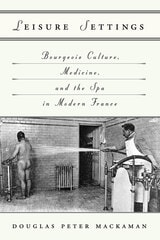
Leisure Settings
Bourgeois Culture, Medicine, and the Spa in Modern FranceDouglas P. Mackaman
University of Chicago Press, 1998
Taking us into the vibrant social world of France's great spas, Mackaman explores the links between class identity and vacationing. Mackaman shows how, after 1800, physicians and entrepreneurs zealously tried to break their milieu's strong association with aristocratic excess and indecency by promoting spas as a rational, ordered equivalent to the busy lives of the bourgeoisie. Rather than seeing leisure time as slothful, Mackaman argues, the bourgeoisie willingly became patients at spas and viewed this therapeutic vacation as a sensible, even productive, way of spending time. Mackaman analyzes this transformation, and ultimately shows how the premier vacation of an era made and was made by the bourgeoisie.
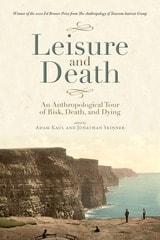
Leisure and Death
An Anthropological Tour of Risk, Death, and DyingAdam Kaul
University Press of Colorado, 2018
This anthropological study examines the relationship between leisure and death, specifically how leisure practices are used to meditate upon—and mediate—life. Considering travelers who seek enjoyment but encounter death and dying, tourists who accidentally face their own mortality while vacationing, those who intentionally seek out pleasure activities that pertain to mortality and risk, and those who use everyday leisure practices like social media or dogwalking to cope with death, Leisure and Death delves into one of the most provocative subsets of contemporary cultural anthropology.
These nuanced and well-developed ethnographic case studies deal with different and distinct examples of the intertwining of leisure and death. They challenge established conceptions of leisure and rethink the associations attached to the prospect of death. Chapters testify to encounters with death on a personal and scholarly level, exploring, for example, the Cliffs of Moher as not only one of the most popular tourist destinations in Ireland but one of the most well-known suicide destinations as well, and the estimated 30 million active posthumous Facebook profiles being repurposed through proxy users and transformed by continued engagement with the living. From the respectful to the fascinated, from the macabre to the morbid, contributors consider how people deliberately, or unexpectedly, negotiate the borderlands of the living.
An engaging, timely book that explores how spaces of death can be transformed into spaces of leisure, Leisure and Death makes a significant contribution to the burgeoning interdisciplinary literature on leisure studies and dark tourism. This book will appeal to students, scholars, and laypeople interested in tourism studies, death studies, cultural studies, heritage studies, anthropology, sociology, and marketing.
Contributors: Kathleen M. Adams, Michael Arnold, Jane Desmond, Keith Egan, Maribeth Erb, James Fernandez, Martin Gibbs, Rachel Horner-Brackett, Shingo Iitaka, Tamara Kohn, Patrick Laviolette, Ruth McManus, James Meese, Bjorn Nansen, Stravoula Pipyrou, Hannah Rumble, Cyril Schafer
Lend Me Your Ear
Brenda Jo Brueggemann
Gallaudet University Press, 1999