Results by title
70 books match the query 'Social conflict' and 3 start with l
Life, Emergent
The Social in the Afterlives of ViolenceYasmeen Arif
University of Minnesota Press, 2016
How does an inquiry into life as it lives (or dies) amid mass violence look like from the perspective of the “social”? Taking us from Sierra Leone to India to Lebanon, Life, Emergent challenges conventional understandings of biopolitics, weaving a politics of life through the lens of life, not death.
Arguing that the “letting die” element of biopolitics has been overemphasized, Yasmeen Arif zeros in on biopolitics’ other pole: “making live.” She does so by highlighting the various means and the forms of life configured in the aftermath—or afterlives—of violent events in contexts of law, justice, community, and identity. Her analysis of the social repercussions is both global and local in scope. Arif examines the convictions made in the Special Court of Sierra Leone, the first hybrid court of its nature under international criminal law. Next, she explores the making of a justice movement in the context of Hindu–Muslim violence in 2002 in the state of Gujarat, India. From there she revisits the Sikh carnage in Delhi of 1984. Finally, she explores a span of civil violence in Lebanon, and particularly, its effects on the city of Beirut.
This rigorously argued book brings together the various strands of life and the social that each chapter has disentangled—and in doing so it begins to frame a politics of, and in, life.
Limbo Beirut
By Hilal Chouman<br>Translated by Anna Ziajka Stanton
University of Texas Press, 2016
In Hilal Chouman’s Limbo Beirut, a gay artist, a struggling novelist, a pregnant woman, a disabled engineering student, a former militia member, and a medical intern all take turns narrating the violent events of May 2008, when Hezbollah militants and Sunni fighters clashed in the streets of Beirut. For most of these young men and women, the Lebanese Civil War (1975–1990) is but a vague recollection, but the brutality of May 2008 serves to reawaken forgotten memories and stir up fears of a revival of sectarian violence. Yet despite these fears, the violence these characters witness helps them to break free from the mundane details of their lives and look at the world anew.
The multiple narrative voices and the dozens of pen-and-ink illustrations that accompany the text allow Chouman to achieve a mesmerizing cinematic quality with this novel that is unique in modern Arabic fiction. Not only will readers appreciate the meaningful exploration of the effects of violence on the psyche, but they will also enjoy discovering how the lives of these characters—almost all of whom are strangers to one another—intersect in surprising ways.
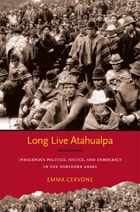
Long Live Atahualpa
Indigenous Politics, Justice, and Democracy in the Northern AndesEmma Cervone
Duke University Press, 2012
Cervone describes how the Inca Atahualpa contested racial subordination by intervening in matters of resource distribution, justice, and cultural politics. Considering local indigenous politics and indigenous mobilization at the national and international levels, she explains how, beginning in the 1960s, state-led modernization created political openings by generating new economic formations and social categories. Long Live Atahualpa sheds new light on indigenous peoples operating at the crossroads of global capitalism and neoliberal reforms as they redefine historically rooted relationships of subordination.