Results by title
231 books match the query 'Society' and 3 start with l
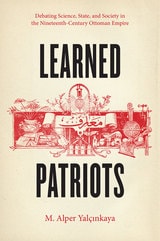
Learned Patriots
Debating Science, State, and Society in the Nineteenth-Century Ottoman EmpireM. Alper Yalçinkaya
University of Chicago Press, 2015
The nineteenth century was, for many societies, a period of coming to grips with the growing, and seemingly unstoppable, domination of the world by the “Great Powers” of Europe. The Ottoman Empire was no exception: Ottomans from all walks of life—elite and non-elite, Muslim and non-Muslim—debated the reasons for what they considered to be the Ottoman decline and European ascendance. One of the most popular explanations was deceptively simple: science. If the Ottomans would adopt the new sciences of the Europeans, it was frequently argued, the glory days of the empire could be revived.
In Learned Patriots, M. Alper Yalçinkaya examines what it meant for nineteenth-century Ottoman elites themselves to have a debate about science. Yalçinkaya finds that for anxious nineteenth-century Ottoman politicians, intellectuals, and litterateurs, the chief question was not about the meaning, merits, or dangers of science. Rather, what mattered were the qualities of the new “men of science.” Would young, ambitious men with scientific education be loyal to the state? Were they “proper” members of the community? Science, Yalçinkaya shows, became a topic that could hardly be discussed without reference to identity and morality.
Approaching science in culture, Learned Patriots contributes to the growing literature on how science travels, representations and public perception of science, science and religion, and science and morality. Additionally, it will appeal to students of the intellectual history of the Middle East and Turkish politics.
[more]
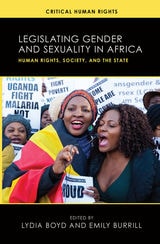
Legislating Gender and Sexuality in Africa
Human Rights, Society, and the StateEdited by Lydia Boyd and Emily Burrill
University of Wisconsin Press, 2020
In recent decades, a more formalized and forceful shift has emerged in the legislative realm when it comes to gender and sexual justice in Africa. This rigorous, timely volume brings together leading and rising scholars across disciplines to evaluate these ideological struggles and reconsider the modern history of human rights on the continent. Broad in geographic coverage and topical in scope, chapters investigate such subjects as marriage legislation in Mali, family violence experienced by West African refugees, sex education in Uganda, and statutes criminalizing homosexuality in Senegal. These case studies highlight the nuances and contradictions in the varied ways key actors make arguments for or against rights. They also explore how individual countries draft and implement laws that attempt to address the underlying problems.
Legislating Gender and Sexuality in Africa details how legal efforts in the continent can often be moralizing enterprises, illuminating how these processes are closely tied to notions of ethics, personhood, and citizenship. The contributors provide new appraisals of recent events, with fresh arguments about the relationships between local and global fights for rights. This interdisciplinary approach will appeal to scholars in African studies, anthropology, history, and gender studies.
Legislating Gender and Sexuality in Africa details how legal efforts in the continent can often be moralizing enterprises, illuminating how these processes are closely tied to notions of ethics, personhood, and citizenship. The contributors provide new appraisals of recent events, with fresh arguments about the relationships between local and global fights for rights. This interdisciplinary approach will appeal to scholars in African studies, anthropology, history, and gender studies.
[more]
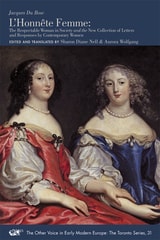
L’Honnête Femme
The Respectable Woman in Society and the New Collection of Letters and Responses by Contemporary WomenJacques Du Bosc
Iter Press, 2014
I heartily recommend this translation and edition of the two works by Jacques Du Bosc. The introduction provides a solid, erudite entry to Du Bosc and his world, with a clear emphasis on the gender issues central to the Other Voice. Especially good is the detailed study ofthe reception of these works. Moreover, the translation is clear and readable. A great deal of work was required to transform the periodic sentences and paragraphs of seventeenthcentury French prose into an English work that is so readable and lucid for a contemporary reader who is not a specialist in the field. The long, informative titles to the essays and letters (already transparent in the table of contents) further situate material that can seem obscure to a contemporary reader. The informative notes, especially the biographical tags and the excellent use of Furetière to explore ambiguous or archaic phrases, illuminate a world that would otherwise seem opaque to many contemporary readers.
—Reverend John J. Conley, SJ
Knott Professor of Philosophy, Loyola University Maryland
—Reverend John J. Conley, SJ
Knott Professor of Philosophy, Loyola University Maryland
[more]