Results by title
100 books match the query 'Sociolinguistics' and 8 start with l
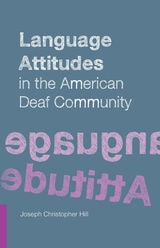
Language Attitudes in the American Deaf Community
Joseph C. Hill
Gallaudet University Press, 2012
In a diverse signing community, it is not unusual to encounter a wide variety of expression in the types of signs used by different people. Perceptions of signing proficiency often vary within the community, however. Conventional wisdom intimates that those who learned at an early age at home or in school know true standard American Sign Language, while those who learned ASL later in life or use contact or coded signs are considered to be less skillful. Joseph Christopher Hill’s new study Language Attitudes in the American Deaf Community explores the linguistic and social factors that govern such stereotypical perceptions of social groups about signing differences.
Hill’s analysis focuses on affective, cognitive, and behavioral types of evaluative responses toward particular language varieties, such as ASL, contact signing, and Signed English. His work takes into account the perceptions of these signing types among the social groups of the American Deaf community that vary based on generation, age of acquisition, and race. He also gauges the effects of social information on these perceptions and the evaluations and descriptions of signing that results from their different concepts of a signing standard. Language Attitudes concludes that standard ASL’s value will continue to rise and the Deaf/Hearing cultural dichotomy will remain relevant without the occurrence of a dramatic cultural shift.

Language Policy and Planning for Sign Languages
Timothy G. Reagan
Gallaudet University Press, 2010
This volume addresses the burgeoning need for language policy and language planning for the sign languages used by deaf people. Author Timothy Reagan writes for two audiences in his new book, those who know language policy and language planning but not the Deaf World, and those well-versed in the Deaf cultural community but unfamiliar with language planning studies. To begin, Chapter 1 presents an overview of the Deaf World and a brief introduction to sign language in general. The second chapter outlines a broad overview of language policy and language planning studies both as an academic discipline and an applied type of social engineering.
In Chapter 3, Reagan examines the specifics of American Sign Language in terms of the history of language policy and planning from the nineteenth century to the post-Congress of Milan period and its form in recent years. The fourth chapter critically examines the creation of manual codes used in deaf education in the U.S. and elsewhere. Chapter 5 analyzes language policy and planning in settings around the world, and the final chapter recommends steps and methods for future language policy and planning efforts for sign language. The cohesive rationale offered in Language Policy and Planning for Sign Languages will prove to be invaluable to all administrators and educators working with populations that use sign languages.

Language and Hegemony in Gramsci
Peter Ives
Pluto Press, 2004
This book places Gramsci’s ideas within the linguistically influenced social theory of the twentieth century. It summarizes some of the major ideas of Ferdinand de Saussure, Ludwig Wittgenstein, language philosophy and post-structuralism in relation to Gramsci’s position. By paying great attention to the linguistic underpinnings of Gramsci's Marxism, Language and Hegemony in Gramsci shows how his theorization of power, language and politics address issues raised by post-modernism and the work of Michel Foucault, Jacques Derrida, Chantal Mouffe, and Ernesto Laclau.

Language and Power in the Modern World
Mary Talbot
University of Alabama Press, 2003
An accessible overview of five major issues in sociolinguistics and the relationship between language and power
This book analyzes the key ways in which language constitutes and conveys power and social relationships in modern society. It offers selected readings that illustrate the thematic introductions and a set of tasks designed to guide linguistic analysis of data and to stimulate student discussion, in five specific areas:
• Multilingualism, Identity, and Ethnicity: examines the phenomena of linguistic diversity from the perspective of language planning and language policies, with emphasis on personal, psychological, educational, cultural, and political issues.
• Language and Youth: examines the languages of old age and the language of youth subcultures.
• Language and Gender: explores the claim that men and women use interactional communication styles based on power and solidarity, respectively.
• Language and the Media: considers the extent to which verbal interaction through mass media differs from other kinds of communication and its consequences in terms of power relations.
• Language and Organizations: explores the use of language as a tool of power in public institutions and bureaucracies and how control over individuals is articulated through a range of different discourse structures and strategies.
With a unique combination of selected readings and student-centered tasks in a single volume, Language and Power in the Modern World covers contemporary issues of communication theory and sociolinguistics, ranging from the global to the interpersonal.
Language and Sexuality
Contesting Meaning in Theory and PracticeEdited by Kathryn Campbell-Kibler, Robert J. Podesva, Sarah Roberts, and Andrew
CSLI, 2001
Language and the Law in Deaf Communities
Ceil Lucas
Gallaudet University Press, 2003
Language
A Right and a Resource: Approaches to Linguistic Human RightsTibor Várady
Central European University Press, 2000
Linguistic Human Rights (LHR) is a fast growing new area of study combining the principles of national and international law with the study of language as a central dimension of ethnicity. Implementation of these principles is aimed at ensuring that no state or society violates these basic rights.
This path breaking study broadens our knowledge of the important role of language in minority rights and in social and political struggles for LHRs. Exploring the interactions of linguistic diversity, biodiversity, the free market and human rights, the contributors present case studies to highlight such issues as Kurdish satellite TV attempting to create a virtual state on the air through trying to achieve basic LHR’s for Kurds in Turkey; the implementation of LHRs in the Baltic states; language rights activism in Canada; the spread of English as an international language; and the obstacles met in education by Roma and the Deaf in Hungary because of lack of appropriate LHRs.
Language: A Right and a Resource is a valuable multi-disciplinary text which can be used in a variety of different areas of study in the legal profession, linguistics, cultural and political studies.

Life in Language
Mission Feminists and the Emergence of a New Protestant SubjectIngie Hovland
University of Chicago Press, 2025
The language of the Bible is a powerful lens through which many Protestants understand themselves and their world, and its prohibitions on women’s speech pose complicated challenges to women. Nevertheless, women frequently serve as vocal leaders in Protestant organizations, including the early twentieth-century Norwegian Mission Society. In Life in Language, Ingie Hovland offers a unique biography of Henny Dons, a leader of the society’s so-called mission feminists, that grapples with ways Protestant women crafted innovative, expansive self-understandings through Christian language. More than their male peers, the mission feminists turned to religious speech to express material, as well as heavenly, desires for paid work, voting rights, and more, and Hovland argues that these experiments in women speaking, reading, writing, and listening paved the way for a new way of being in the world.