323 books match the query 'Southeast Asia' and 15 start with l
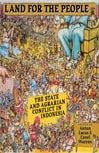
cover of Land for the People: The State and Agrarian Conflict in Indonesia

Land for the People

The State and Agrarian Conflict in Indonesia

Anton Lucas

Ohio University Press, 2013

Half of Indonesia’s massive population still lives on farms, and for these tens of millions of people the revolutionary promise of land reform remains largely unfulfilled. The Basic Agrarian Law, enacted in the wake of the Indonesian revolution, was supposed to provide access to land and equitable returns for peasant farmers. But fifty years later, the law’s objectives of social justice have not been achieved.

Land for the People provides a comprehensive look at land conflict and agrarian reform throughout Indonesia’s recent history, from the roots of land conflicts in the prerevolutionary period and the Sukarno and Suharto regimes, to the present day, in which democratization is creating new contexts for people’s claims to the land. Drawing on studies from across Indonesia’s diverse landscape, the contributors examine some of the most significant issues and events affecting land rights, including shifts in policy from the early postrevolutionary period to the New Order; the Land Administration Project that formed the core of land policy during the late New Order period; a long-running and representative dispute over a golf course in West Java that pitted numerous local farmers against the government and local elites; Suharto’s notorious “million hectare” project that resulted in loss of access to land and resources for numerous indigenous farmers in Kalimantan; and the struggle by Bandung’s urban poor to be treated equitably in the context of commercial land development. Together, these essays provide a critical resource for understanding one of Indonesia’s most pressing and most influential issues.

Contributors: Afrizal, Dianto Bachriadi, Anton Lucas, John McCarthy, John Mansford Prior, Gustaaf Reerink, Carol Warren, and Gunawan Wiradi.
[more]
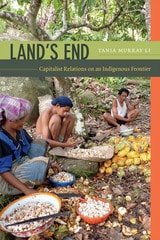
cover of Land's End: Capitalist Relations on an Indigenous Frontier

Land's End

Capitalist Relations on an Indigenous Frontier

Tania Murray Li

Duke University Press, 2014

Drawing on two decades of ethnographic research in Sulawesi, Indonesia, Tania Murray Li offers an intimate account of the emergence of capitalist relations among indigenous highlanders who privatized their common land to plant a boom crop, cacao. Spurred by the hope of ending their poverty and isolation, some prospered, while others lost their land and struggled to sustain their families. Yet the winners and losers in this transition were not strangers—they were kin and neighbors. Li's richly peopled account takes the reader into the highlanders' world, exploring the dilemmas they faced as sharp inequalities emerged among them.

The book challenges complacent, modernization narratives promoted by development agencies that assume inefficient farmers who lose out in the shift to high-value export crops can find jobs elsewhere. Decades of uneven and often jobless growth in Indonesia meant that for newly landless highlanders, land's end was a dead end. The book also has implications for social movement activists, who seldom attend to instances where enclosure is initiated by farmers rather than coerced by the state or agribusiness corporations. Li's attention to the historical, cultural, and ecological dimensions of this conjuncture demonstrates the power of the ethnographic method and its relevance to theory and practice today.
[more]
cover of Landbridge: Life in Fragments

Landbridge

Life in Fragments

Y-Dang Troeung

Duke University Press, 2024
In 1980, Y-Dang Troeung and her family were among the last of the 60,000 refugees from Cambodia that Canada agreed to admit. Their landing was widely documented in newspapers, with photographs of the prime minister shaking Troeung’s father’s hand and patting baby Y-Dang’s head. Troeung became a literal poster child for the benevolence of the Canadian refugee project. She returns to this moment forty years later in her arresting memoir Landbridge, where she explores the tension between that public narrative of happy “arrival,” and the multiple, often hidden truths of what happened to her family. In precise, beautiful prose, Troeung moves back and forth in time to tell stories about her parents and two brothers who lived through the Cambodian genocide, about the lives of her grandparents and extended family, about her own childhood in the refugee camps and in rural Ontario, and eventually about her young son’s illness and her own diagnosis with a terminal disease. Throughout this brilliant and astonishing book, Troeung looks with bracing clarity at refugee existence and dares to imagine a better future, with love.
[more]
cover of Landing Zones: Southern Veterans Remember Vietnam

Landing Zones

Southern Veterans Remember Vietnam

James R. Wilson

Duke University Press, 1990

Landing Zones brings to life the dramatic, gripping, and often painful stories of twenty-four Vietnam Veterans from the American South. The men and women interviewed here represent a remarkable range of experience, including a marine rifleman, a helicopter pilot, an army nurse, a prisoner of war, a riverboat gunner, and the commanding general William Westmoreland. Skillfully interviewed by James R. Wilson, a journalist and Army press officer in Vietnam, each narrative explores and describes the war’s events before following the veterans home and carrying them to the present.
These stories focus on a uniquely southern view of Vietnam. In terms of numbers the South shouldered more than its share of human cost—31 percent of Americans who served came from one of the eleven states of the old Confederacy, and 28 percent of the dead were southerners. Southerners also brought to Vietnam certain shared cultural tastes and a particularly southern heritage of honor in military service stemming from the Civil War. For many, as their testimony reveals, a sense of patriotism was tested and questioned by the horrors of war, and for others that patriotism was a continued source of strength.
Individually and collectively, however, these oral histories make up a picture of war that prevents us from forgetting the truth as one veteran put it: “Vietnam was not one war, but a thousand little nasty wars.”
[more]
cover of Laughing at Leviathan: Sovereignty and Audience in West Papua

Laughing at Leviathan

Sovereignty and Audience in West Papua

Danilyn Rutherford

University of Chicago Press, 2012
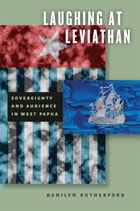
For West Papua and its people, the promise of sovereignty has never been realized, despite a long and fraught struggle for independence from Indonesia. In Laughing at Leviathan, Danilyn Rutherford examines this struggle through a series of interlocking essays that drive at the core meaning of sovereignty itself—how it is fueled, formed, and even thwarted by pivotal but often overlooked players: those that make up an audience. Whether these players are citizens, missionaries, competing governmental powers, nongovernmental organizations, or the international community at large, Rutherford shows how a complex interplay of various observers is key to the establishment and understanding of the sovereign nation-state.
 
Drawing on a wide array of sources, from YouTube videos to Dutch propaganda to her own fieldwork observations, Rutherford draws the history of Indonesia, empire, and postcolonial nation-building into a powerful examination of performance and power. Ultimately she revises Thomas Hobbes, painting a picture of the Leviathan not as a coherent body but a fragmented one distributed across a wide range of both real and imagined spectators. In doing so, she offers an important new approach to the understanding of political struggle.
[more]
cover of Law and Kingship in Thailand During the Reign of King Chulalongkorn

Law and Kingship in Thailand During the Reign of King Chulalongkorn

David M. Engel

University of Michigan Press, 1975
This essay originated in an attempt to bring together the study of law and Thai history in a description of the transformation of Thailand during the late nineteenth and early twentieth centuries as seen from a legal point of view. The resulting work is based for the most part upon those royal enactments from 1873 to 1910 which seemed most crucially to affect the executive, legislative, and judicial functions of the king and the rights of private citizens. [ix]
[more]
cover of Legitimizing Empire: Filipino American and U.S. Puerto Rican Cultural Critique

Legitimizing Empire

Filipino American and U.S. Puerto Rican Cultural Critique

Faye Caronan

University of Illinois Press, 2015

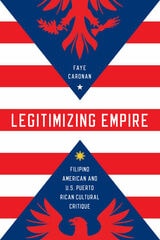
When the United States acquired the Philippines and Puerto Rico, it reconciled its status as an empire with its anticolonial roots by claiming that it would altruistically establish democratic institutions in its new colonies. Ever since, Filipino and Puerto Rican artists have challenged promises of benevolent assimilation and portray U.S. imperialism as both self-interested and unexceptional among empires.
 
Faye Caronan's examination interprets the pivotal engagement of novels, films, performance poetry, and other cultural productions as both symptoms of and resistance against American military, social, economic, and political incursions. Though the Philippines became an independent nation and Puerto Rico a U.S. commonwealth, both remain subordinate to the United States. Caronan's juxtaposition reveals two different yet simultaneous models of U.S. neocolonial power and contradicts American exceptionalism as a reluctant empire that only accepts colonies for the benefit of the colonized and global welfare. Her analysis, meanwhile, demonstrates how popular culture allows for alternative narratives of U.S. imperialism, but also functions to contain those alternatives.
[more]
cover of Lessons from East Asia

Lessons from East Asia

Danny M. Leipziger, Editor

University of Michigan Press, 2001
This compilation of case studies and cross-country essays focuses on the role of public policy in the experience of East Asian economies. A major theme running through the volume is regional learning and regional contagion -- the spread of that learning. Beginning with the model and experience of Japan and continuing with the impressive achievements of countries originally considered unviable in the 1950s and 1960s, like Korea and Taiwan, contributors demonstrate how regional policy lessons permeated borders easily. The 1980s brought further lessons and flows of capital to the second generation of rapid industrializers. And the 1990s have seen regional contagion benefit new aspirants like Vietnam. As the chapters cumulatively reveal, however, the transferability of lessons depends on the institutional framework in which policy is formulated, the consistency of policy, and the quality of implementation. Part 1 includes the case studies for the first generation of rapidly developing East Asian economics -- the tigers -- while Part 2 incorporates the later generation success stories -- the cubs -- plus the Philippines, a country only now beginning to show significant progress. Part 3 includes cross-country essays on public investment, foreign direct investment, and cross-country patterns that synthesize the lessons learned and propose actions for other development aspirants to pursue. The essays aim to fill two major gaps -- the paucity of country-specific work on the institutional side of development policy and the failure to explain the mixed record of industrial policies in East Asia. The volume will appeal to students, scholars, and policymakers in development economics. This title was formally part of the Studies in International Trade Policy Series, now called Studies in International Economics.
[more]
cover of Liberalism and the Postcolony: Thinking the State in 20th-Century Philippines

Liberalism and the Postcolony

Thinking the State in 20th-Century Philippines

Lisandro E. Claudio

National University of Singapore Press, 2017

The Philippines entered the twentieth century newly free of Spanish rule and faced with the task of building a nation. Due in part to American control of the country for the first half of the twentieth century, liberalism played a dynamic role in shaping the government and philosophy of the Philippines.

Through the biographies of four Filipino scholar-bureaucrats—Camilo Osias, Salvador Araneta, Carlos P. Romulo, and Salvador P. Lopez—Lisandro E. Claudio argues that liberal thought served as the grammar of Filipino democracy in the twentieth century. Melding political philosophy and narrative history, he takes us through various articulations of liberalism in pedagogy, international affairs, economics, and literature. In this first book on Filipino liberals in the twentieth century, Claudio brings to light an obscured history of the Philippine state and also argues for a new liberalism rooted in the postcolonial experience, a timely intervention in light of the ascent of President Rodrigo Duterte and the current developments in Southeast Asian politics.
[more]
cover of Life Under the Palms: The Sublime World of the Anti-colonialist Jacob Haafner

Life Under the Palms

The Sublime World of the Anti-colonialist Jacob Haafner

Paul van der Velde

National University of Singapore Press, 2019

Jacob Gotfried Haafner (1754–1809) was one of the most popular European travel writers of the early nineteenth century, writing in the Romantic mode. A Dutch citizen, Haafner spent more than twenty years of his early life living outside of Europe, in India, Ceylon, Mauritius, Java, and South Africa. Books like his popular Travels in a Palanquin were translated into the major European languages, and his essays against the work of Christian missionaries in Asia stirred up great controversy. Haafner worked to spread understanding of the cultures he’d come to know in his journeys, promoting European understanding of Indian literature, myth, and religion, translating the Ramayana into Dutch.
 
With the help of generous excerpts from Haafner's own writings, including material newly translated into English, Paul van der Velde tells an affecting story of a young man who made a world for himself along the Coromandel Coast, in Ceylon and Calcutta, but who returned to Europe to live the last years of his life in Amsterdam, suffering an acute nostalgia for Asia. This will be compelling reading for anyone interested in European response to the cultures of Asia.
 
[more]
cover of Life in a Cambodian Orphanage: A Childhood Journey for New Opportunities

Life in a Cambodian Orphanage

A Childhood Journey for New Opportunities

Kathie Carpenter

Rutgers University Press, 2021
What is it like to grow up in an orphanage? What do residents themselves have to say about their experiences? Are there ways that orphanages can be designed to meet children's developmental needs and to provide them with necessities they are unable to receive in their home communities? In this book, detailed observations of children's daily life in a Cambodian orphanage are combined with follow-up interviews of the same children after they have grown and left the orphanage. Their thoughtful reflections show that the quality of care children receive is more important for their well-being than the site in which they receive it. Life in a Cambodian Orphanage situates orphanages within the social and political history of Cambodia, and shows that orphanages need not always be considered bleak sites of deprivation and despair. It suggests best practices for caring for vulnerable children regardless of the setting in which they are living.
[more]
cover of Living with Agent Orange: Conversations in Postwar Viet Nam

Living with Agent Orange

Conversations in Postwar Viet Nam

Diane Niblack Fox

University of Massachusetts Press, 2024

For over half a century, the Vietnamese people have endured the harmful legacies of Agent Orange, the toxic herbicide used by the American military as a type of chemical warfare. While scientists and politicians continue to debate how to best address its human and environmental consequences, the nearly three million Vietnamese whose lives have been shaped by its lingering effects have been largely left out of the conversation.

To understand how Agent Orange has impacted the lives and livelihoods of everyday Vietnamese people, Diane Niblack Fox interviewed families and individuals living with its aftereffects across the northern, central, and southern regions of the country. In powerfully written prose, Fox shares the personal accounts of villagers, as they describe caring for loved ones with chronic illnesses and disabilities and their attempts to secure medical and financial assistance. Living with Agent Orange also chronicles the moving stories of rebuilt lives, of family and community support, and of the overriding power of the human spirit.
[more]
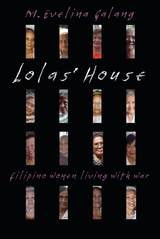
cover of Lolas' House: Filipino Women Living with War

Lolas' House

Filipino Women Living with War

M. Evelina Galang

Northwestern University Press, 2017

During World War II more than one thousand Filipinas were kidnapped by the Imperial Japanese Army. Lolas’ House tells the stories of sixteen surviving Filipino “comfort women.”

M. Evelina Galang enters into the lives of the women at Lolas’ House, a community center in metro Manila. She accompanies them to the sites of their abduction and protests with them at the gates of the Japanese embassy. Each woman gives her testimony, and even though the women relive their horror at each telling, they offer their stories so that no woman anywhere should suffer wartime rape and torture.

Lolas’ House is a book of testimony, but it is also a book of witness, of survival, and of the female body. Intensely personal and globally political, it is the legacy of Lolas’ House to the world.
[more]
cover of Looking Back on the Vietnam War: Twenty-first-Century Perspectives

Looking Back on the Vietnam War

Twenty-first-Century Perspectives

Boyle, Brenda M

Rutgers University Press, 2016
More than forty years have passed since the official end of the Vietnam War, yet the war’s legacies endure. Its history and iconography still provide fodder for film and fiction, communities of war refugees have spawned a wide Vietnamese diaspora, and the United States military remains embroiled in unwinnable wars with eerie echoes of Vietnam. 
 
Looking Back on the Vietnam War brings together scholars from a broad variety of disciplines, who offer fresh insights on the war’s psychological, economic, artistic, political, and environmental impacts. Each essay examines a different facet of the war, from its representation in Marvel comic books to the experiences of Vietnamese soldiers exposed to Agent Orange. By putting these pieces together, the contributors assemble an expansive yet nuanced composite portrait of the war and its global legacies.
 
Though they come from diverse scholarly backgrounds, ranging from anthropology to film studies, the contributors are united in their commitment to original research. Whether exploring rare archives or engaging in extensive interviews, they voice perspectives that have been excluded from standard historical accounts. Looking Back on the Vietnam War thus embarks on an interdisciplinary and international investigation to discover what we remember about the war, how we remember it, and why.
 
[more]
cover of Love, Money and Obligation: Transnational Marriage in a Northeastern Thai Village

Love, Money and Obligation

Transnational Marriage in a Northeastern Thai Village

Patcharin Lapanun

National University of Singapore Press, 2019

Globalization has opened up a flow of economic and cultural exchanges. While we often think about these concepts in terms of trade policies or international treaties, they also play out in more intimate spheres, such as transnational marriages.

Northeast Thailand has seen an increase in marriages between Thai women and farang (Western) men. Often the women are less well off and from rural areas in the country, while the men largely come from the United States and Europe and settle permanently in Thailand. These unions have created a new social class, with distinctive consumption patterns and lifestyles. And they are challenging gender relations and local perceptions of sexuality, marriage, and family.

In Love, Money and Obligation, Patcharin Lapanun offers an exploration of these marriages and their larger effect on Thai communities. Her interviews with women and men engaging in these transnational relationships highlight the complexities of the associations, as they are shaped by love, money, and gender obligations on the one hand and the dynamics of socio-cultural and historical contexts on the other. Her in-depth and even-handed examination highlights the importance of women’s agency and the strength and creativity of people seeking to forge meaningful lives in the processes of social transition and in the face of local and global encounters.
[more]