Results by title
260 books match the query 'Soviet Union' and 7 start with l
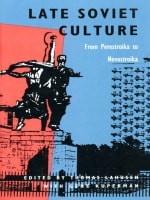
Late Soviet Culture from Perestroika to Novostroika
Thomas Lahusen, with Gene Kuperman, ed.
Duke University Press, 1993
Leading scholars from the former Soviet Union and the West gather here to consider the fate of the people and institutions that constituted Soviet culture. Whether the speculative glance goes back (to czarist Russia or Soviet Freudianism, to the history of aesthetics or the sociology of cinema in the 1930s) or forward (to the "market Stalinism" one writer predicts or the "open text of history" another advocates), a sense of immediacy, or history-in-the-making animates this volume. Will social and cultural institutions now develop organically, the authors ask, or is the society faced with the prospect of even more radical reforms? Does the present rupture mark the real moment of Russia's encounter with modernity? The options explored by literary historians, film scholars, novelists, and political scientists make this book a heady tour of cultural possibilities. An expanded version of a special issue of South Atlantic Quarterly (Spring 1991), with seven new essays, Late Soviet Culture will stimulate scholar and general reader alike.
Contributors. Katerina Clark, Paul Debreczeny, Evgeny Dobrenko, Mikhail Epstein, Renata Galtseva, Helena Goscilo, Michael Holquist, Boris Kagarlitsky, Mikhail Kuraev, Thomas Lahusen, Valery Leibin, Sidney Monas, Valery Podoroga, Donald Raleigh, Irina Rodnyanskaya, Maya Turovskaya
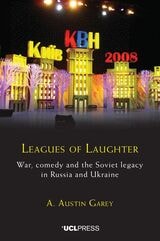
Leagues of Laughter
War, Comedy and the Soviet Legacy in Russia and UkraineA. Austin Garey
University College London, 2025
Leagues of Laughter traces the evolution of a Soviet-created youth game called KVN (Klub veselykh i nakhodchivykh or Club of the Cheerful and Clever) over sixty years as students’ nation-states collapsed, competed, and eventually went to war. Through cross-border narratives, the book shows how humor persists—and transforms—amid authoritarianism, censorship, and conflict. With insight and compassion, author A. Austin Garey reveals how laughter became a mode of resistance, identity, and cultural continuity in the long cultural context of the war in Ukraine. In addition to introducing a novel theory of “tradition as stance” to explain how traditions are reproduced and reinterpreted over time, the book offers a compelling comparative analysis of cultural production under political pressure.
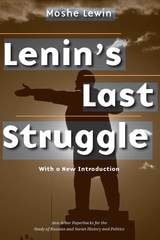
Lenin's Last Struggle
Moshe Lewin
University of Michigan Press, 2005
One of the great political strategists of his era, V. I. Lenin continues to attract historical interest, yet his complex personality eludes full understanding. This new edition of Moshe Lewin's classic political biography, including an afterword by the author, suggests new approaches for studying the Marxist visionary and founder of the Soviet state. Lenin's Last Struggle offers invaluable insights into the rise of the Bolshevik party and the Soviet Union, a saga complicated by complex strategic battles among the leaders of Lenin's generation: leaders whose names are universally known, but whose personalities and motivations are even now not sufficiently understood.
Moshe Lewin was a collective farm worker in the USSR and a soldier in the Soviet army. He later became director of studies at the Ecole Pratique des Hautes Etudes in Paris, a fellow of the Kennan Institute, a senior fellow of Columbia University's Russian Institute, and is now emeritus professor of history at The University of Pennsylvania.
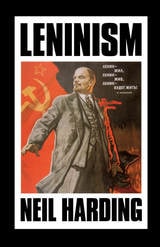
Leninism
Neil Harding
Duke University Press, 1996
Rather than tracing the roots of Leninism to the details of Lenin’s biography, Harding shows how it emerged as a revolutionary Marxist response to the First World War and to the perceived treachery—the support of that war—by social democratic leaders. The economics, politics, and philosophy of Leninism, he argues, were rapidly theorized between 1914 and 1918 and deeply imprinted with the peculiarities of the wartime experience. Its complementary metaphysics of history and science was as intrinsic to its confidence and sureness of purpose as it was to its contempt for democratic practice and tolerance. But, as Harding also shows, although Leninism articulated a complex and coherent critique of capitalist civilization and held a powerful appeal to a variety of constituencies, it was itself caught in a timewarp that fatally limited its capacity to adapt. This book will engage not only Russian and Soviet specialists, but also readers concerned with the varieties of twentieth-century socialism.

Leon Trotsky
Writings in ExileLeon Trotsky
Pluto Press, 2012
Leon Trotsky was a key political figure of the twentieth century – a leader of the Russian Revolution, founder of the Red Army, author of books on literature, history, morality and politics.
Leon Trotsky: Writings in Exile contains some of his most insightful and penetrating works. Exiled and isolated by Stalin, Trotsky used the only weapon he had left – words. In these writings he defends the 1917 revolution, warns prophetically of fascism and analyses anti-colonial movements in the global south.
This collection gives a sense of the real Trotsky – passionate, humanist, Marxist. It will introduce the writings of one of history's great revolutionaries to a new generation.
Lies, Passions, and Illusions
The Democratic Imagination in the Twentieth CenturyFrançois Furet
University of Chicago Press, 2014
This conversation would be, sadly, Furet’s last—he died while Ricoeur was completing his edits. Ricoeur did not want to publish his half without Furet’s approval, so what remains is Furet’s alone, an astonishingly cohesive meditation on the political passions of the twentieth century. With strokes at once broad and incisive, he examines the many different trajectories that nations of the West have followed over the past hundred years. It is a dialogue with history as it happened but also as a form of thought. It is a dialogue with his critics, with himself, and with those major thinkers—from Tocqueville to Hannah Arendt—whose ideas have shaped our understanding of the tragic dramas and upheavals of the modern era. It is a testament to the crucial role of the historian, a reflection on how history is made and lived, and how the imagination is a catalyst for political change. Whether new to Furet or deeply familiar with his work, readers will find thought-provoking assessments on every page, a deeply moving look back at one of the most tumultuous periods of history and how we might learn and look forward from it.
Live and Remember
Valentin Rasputin
Northwestern University Press, 1992