Results by title
75 books match the query 'Syntax' and 5 start with l
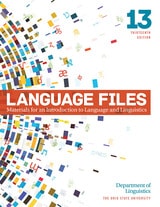
Language Files
Materials for an Introduction to Language and Linguistics, 13th EditionThe Ohio State University Department of Linguistics
The Ohio State University Press, 2022
The thirteenth edition has been revised, clarified, and updated throughout to ensure that it remains the most comprehensive and accessible introductory linguistics textbook on the market. The revised chapter on morphology includes a more thorough discussion of allomorphy and adds sections on templatic morphology, suprasegmental morphology, and morphological metathesis to give students a more complete picture of all morphological phenomena. The chapter on language and computers has been updated with new sections on deep learning, artificial neural networks, and on other areas of computational linguistics, providing readers with a better sense of current research and applications in this rapidly developing field. Other additions include new sections on syntactic non-constituents and non-generative rule systems in the syntax chapter and a complete rewrite to the creole languages file in the language contact chapter. We have also adopted the use of the singular they when referring to a generic person whose gender is unknown or irrelevant. Exercises and lists of other readings have been updated throughout.
Language from a Cognitive Perspective
Grammar, Usage, and ProcessingEdited by Emily M. Bender and Jennifer E. Arnold
CSLI, 2011
This book is a collection of papers on language processing, usage, and grammar, written to commemorate the career of Thomas Wasow on the occasion of his sixty-fifth birthday. Wasow has been professor of linguistics and philosophy at Stanford University since 1973, and is affiliated with the Symbolic Systems Program. He has made significant contributions to the study of English syntax, psycholinguistics, and philosophy of linguistics.
Lectures on Contemporary Syntactic Theories
An Introduction to Government-Binding Theory, Generalized Phrase Structure Grammar, and Lexical-Function GrammarPeter Sells
CSLI, 1985
Lexical and Constructional Aspects of Linguistic Explanation
Edited by Gert Webelhuth, Jean-Pierre Koenig, and Andreas Kathol
CSLI, 1999
Linking by Types in the Hierarchical Lexicon
Anthony R. Davis
CSLI, 2001
Many previous approaches to this problem have employed a set of thematic roles, such as agent and patient, to classify varieties of participants. The alternative developed here fits within the framework of Head-Driven Phrase Structure Grammar while utilizing typed feature structures, certain basic features of verb meaning, a hierarchical classification of verb meanings, and constraints from more general to more specific word classes. Relying on no special mechanisms or components of grammar, this book is unique in its ability to account for the observed range of verb types in human languages with a simple yet widely applicable set of principles.