Results by title
270 books match the query 'Technology' and 2 start with l

Les Paul
Guitar WizardBob Jacobson
Wisconsin Historical Society Press, 2012
This addition to the Badger Biographies series for young readers tells the story of Les Paul, the legendary “Wizard of Waukesha,” who pioneered the solid body electric guitar, multi-track recording, and many other musical inventions. Fascinated since boyhood with musical technology, the young Les moved from experimenting with his mother’s player piano and phonograph to developing his own amplifier and tinkering with crystal radios.
After leaving his hometown of Waukesha at age 17 to pursue a musical career—a decision his mother supported—the budding jazz guitarist lived in Chicago, New York, and Los Angeles, in each city finding a new audience and new musical partnerships. A regular on the radio, Les became a fixture in early television, appearing on the Ed Sullivan Show, and later, a show of his own with partner Mary Ford. Along the way, he overcame numerous physical challenges, including recovery from electric shock and rehabilitation after a horrific car accident—both of which threatened his musical career. And yet, Les Paul pushed musical technology forward more than any other musician of the twentieth century. This Grammy Hall of Fame inductee died in 2009, making Les Paul: Guitar Wizard a timely addition to the series. This lively story is rounded out with sidebars on radio call letters and how an electric guitar works, a full discography, and over 60 historic photographs.
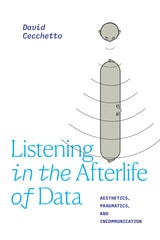
Listening in the Afterlife of Data
Aesthetics, Pragmatics, and IncommunicationDavid Cecchetto
Duke University Press, 2022