Results by title
333 books match the query 'Television' and 14 start with l
Latin American Melodrama
Passion, Pathos, and EntertainmentEdited and with an Introduction by Darlene J. Sadlier
University of Illinois Press, 2008
Like their Hollywood counterparts, Latin American film and TV melodramas have always been popular and highly profitable. The first of its kind, this anthology engages in a serious study of the aesthetics and cultural implications of Latin American melodramas. Written by some of the major figures in Latin American film scholarship, the studies range across seventy years of movies and television within a transnational context, focusing specifically on the period known as the "Golden Age" of melodrama, the impact of classic melodrama on later forms, and more contemporary forms of melodrama. An introductory essay examines current critical and theoretical debates on melodrama and places the essays within the context of Latin American film and media scholarship.
Contributors are Luisela Alvaray, Mariana Baltar, Catherine L. Benamou, Marvin D’Lugo, Paula Félix-Didier, Andrés Levinson, Gilberto Perez, Darlene J. Sadlier, Cid Vasconcelos, and Ismail Xavier.
Latina/o Stars in U.S. Eyes
The Making and Meanings of Film and TV StardomMary C. Beltran
University of Illinois Press, 2008
Latinx TV in the Twenty-First Century
Edited by Frederick Luis Aldama
University of Arizona Press, 2022
In this volume, editor Frederick Luis Aldama brings together leading experts who show how Latinx TV is shaped by historical, social, cultural, regional, and global contexts. Contributors address head on harmful stereotypes in Latinx representation while giving key insights to a positive path forward. TV narratives by and about Latinx people exist across all genres. In this century, we see Latinx people in sitcoms, sci-fi, noir, soap operas, rom-coms, food shows, dramas, action-adventure, and more. Latinx people appear in television across all formats, from quick webisodes, to serialized big-arc narratives, to animation and everything in between. The diverse array of contributors to this volume delve into this rich landscape of Latinx TV from 2000 to today, spanning the ever-widening range of genres and platforms.
Latinx TV in the Twenty-First Century argues that Latinx TV is not just television—it’s an entire movement. Digital spaces and streaming platforms today have allowed for Latinx representation on TV that speaks to Latinx people and non-Latinx people alike, bringing rich and varied Latinx cultures into mainstream television and addressing urbanization, immigration, family life, language, politics, gender, sexuality, class, race, and ethnicity.
Once heavily underrepresented and harmfully stereotypical, Latinx representation on TV is beginning to give careful nuance to regional, communal, and familial experiences among U.S. Latinx people. This volume unpacks the negative implications of older representation and celebrates the progress of new representation, recognizing that television has come a long way, but there is still a lot of important work to do for truly diverse and inclusive representation.
Laughter in the Classroom
London Weekend Television’s Please Sir! (1968–1972)Gillian A.M. Mitchell
University College London, 2026
The first academic study dedicated to Please Sir!, a program that provides valuable insights into British society, television culture, education, and youth culture during the late 1960s and early 1970s.
The situation comedy Please Sir! was televised from 1968 to 1972. This book explores its background, comedic style, cast of characters, its depictions of contemporary issues, and the impact of crises faced by its production company. It argues that Please Sir! reveals much about the social, cultural, and televisual era in which it was produced.
Law and Order
Images, Meanings, MythsValverde, Mariana
Rutgers University Press, 2006
But with television courtrooms appearing more like the studio of The Jerry Springer Show than institutions of justice, and with weekly dramas seamlessly blending cutting-edge forensic science with exaggerated fictions, it calls to question: just what is it about these shows that has the public so captivated? And, what effects do the images of crime and order presented through the media have on society's view of the actual legal and criminal justice systems?
In Law and Order: Images, Meanings, Myths, Mariana Valverde draws on examples from film, television, and newspapers to examine these questions and to demonstrate how popular culture is creating an unrealistic view of crime and crime control. Valverde argues that understanding the impact of media representations of courtrooms, police departments, prisons, and the people who populate them is essential to comprehending the reality of criminal justice.
Introducing a wealth of resources in social and cultural studies along with suggestions for classroom discussions and assignments, this book pushes the field of criminology in new and exciting theoretical directions. It is essential reading for students and scholars of criminal justice and law.
Lear’s Other Shadow
A Cultural History of Queen LearThomas G. Olsen
University of Delaware Press, 2025

Lesbians on Television
New Queer Visibility & the Lesbian NormalKate McNicholas Smith
Intellect Books, 2020
A look at the emergence of queer women characters in popular storytelling and the wide-ranging effects of this mainstream representation.
The twenty-first century has seen LGBTQ+ rights emerge at the forefront of public discourse and national politics in ways that would once have been hard to imagine. In Lesbians on Television, Kate McNicholas Smith maps concurrent contemporary shifts in lesbian visibility within popular media, focusing on the small screens of Europe and North America. Central to these shifts has been a re-imagining of queer lives—or a “new queer visibility”—as LGBTQ+ characters have become increasingly visible within popular culture. Kate McNicholas Smith explores this increased visibility through the lens of television, and in doing so, she identifies a “new lesbian normal”—a normalization of lesbian subjects that both helps and hinders those it represents.
Structured around five central case studies of popular British and American television shows featuring lesbian, bisexual, and queer women characters—The L Word, Skins, Glee, Coronation Street, and The Fosters—the book develops a detailed analysis of the shaping of a new “lesbian normal” through representations of LGBTQ+ figures and examines their televisual representation and reception. Presenting critical queer and feminist theory alongside empirical research that includes interviews and multi-platform media analyses, McNicholas Smith works to untangle the social, political, and cultural implications of new visibility in a period of significant social change in the LGBTQ+ experience.
Live From the Trenches
The Changing Role of the Television News CorrespondentEdited by Joe S. Foote. Foreword by Ted Koppel
Southern Illinois University Press, 1998
From Edward R. Murrow to "Sixty Minutes" and CNN, the television news correspondent has become a fixture of American journalism in the latter half of the twentieth century. The correspondent's role has changed, however, as centralized control, changing technology, "infotainment," and profit margin have influenced the way that television networks operate and television news is reported.
In spite of the flood of literature dealing with the American television networks, the evening anchors, and prime-time personalities, little has been written about the "the foot soldier of network news." Live from the Trenches fills that gap, providing the first examination of television news correspondents and their work, with much of the analysis coming from the correspondents themselves.
The correspondents:
Jim Bittermann, a former ABC Paris correspondent, has been the CNN Paris correspondent since 1996. He received a National News Emmy for his coverage of the 1988 Sudan famine.
Chris Bury, correspondent for "Nightline" since 1993, has covered foreign and domestic stories from Waco to Whitewater.
Michael Murrie, after a dozen years in television news at KSDK in St. Louis, is an associate professor and director of the Telecommunications Master's Program for the Department of Radio-Television at Southern Illinois University at Carbondale.
Roger O'Neil, NBC News Denver bureau chief and correspondent since 1983, was the lead reporter for NBC during the Oklahoma City bombing trial of Timothy McVeigh.
Walter C. Rodgers, bureau chief and correspondent in Jerusalem, joined CNN in 1993 as the Berlin correspondent. Prior to joining CNN, he worked for ABC for twelve years.
Marlene Sanders broke barriers for women throughout her career and has won three Emmies. As a correspondent at ABC News in 1964, she was the first woman to anchor a prime-time network newscast.
George Strait is the primary ABC News correspondent for medical and health news. Among his many awards are the Alfred I. duPont Award and Gold Medal Award from the National Association of Black Journalists.
Ed Turner is CNN's first editor-at-large. Based in Washington, he represents the CNN News Group globally.
Garrick Utley joined CNN in 1997 after thirty years covering more than seventy countries for ABC.

Live from Atlantic City
The Miss America Pageant Before, After, and In Spite of TelevisionA. R. Riverol
University of Wisconsin Press, 1992
A. R. Riverol takes the reader to times and places where no television camera has focused. Drawing upon (and sometimes debating with) primary and secondary sources, the author paints a vivid picture of life in Atlantic City during pageant week—whether that week be in 1944 or 1984. More than just chronicling events, the author also presents two opposing perspectives on the pageant: the pageant as celebration and idealization of American womanhood and the pageant as sexist, exploitative anachronism.
Living Color
Race and Television in the United StatesSasha Torres, ed.
Duke University Press, 1998
Ranging across television genres, historical periods, and racial formations, Living Color—as it positions race as a key element of television’s cultural influence—moves the discussion out of a black-and-white binary and illustrates how class, gender, and sexuality interact with images of race. In addition to essays on representations of "Oriental" performers and African Americans in the early years of television, this collection also examines how the celebrity of the late MTV star Pedro Zamora countered racist and homophobic discourses; reveals how news coverage on drug use shifted from the white middle-class cocaine user in the early 1980s to the black "crack mother" of the 1990s; and takes on TV coverage of the Rodney King beating and the subsequent unrest in Los Angeles. Other essays consider O.J. Simpson’s murder trial, comparing television’s treatment of Simpson to that of Michael Jackson, Magic Johnson, Michael Jordan, and Clarence Thomas and look at the racism directed at Asian Americans by the recurring "Dancing Itos" on Jay Leno’s Tonight Show.
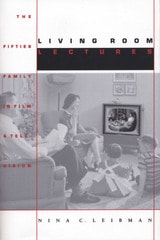
Living Room Lectures
The Fifties Family in Film and TelevisionBy Nina C. Leibman
University of Texas Press, 1995
With a breadwinner dad, a homemaker mom, and squeaky-clean kids, the 1950s television family has achieved near mythological status as a model of what real families "ought" to be. Yet feature films of the period often portrayed families in trouble, with parents and children in conflict over appropriate values and behaviors. Why were these representations of family apparently so far apart?
Nina Leibman analyzes many feature films and dozens of TV situation comedy episodes from 1954 to 1963 to find surprising commonalities in their representations of the family. Redefining the comedy as a family melodrama, she compares film and television depictions of familial power, gender roles, and economic attitudes. Leibman's explorations reveal how themes of guilt, deceit, manipulation, anxiety, and disfunctionality that obviously characterize such movies as Rebel without a Cause,A Summer Place, and Splendor in the Grass also crop up in such TV shows as The Adventures of Ozzie and Harriet,Father Knows Best,Leave It to Beaver,The Donna Reed Show, and My Three Sons.
Drawing on interviews with many of the participants of these productions, archival documents, and trade journals, Leibman sets her discussion within a larger institutional history of 1950s film and television. Her discussions shed new light not only on the reasons for both media's near obsession with family life but also on changes in American society as it reconfigured itself in the postwar era.
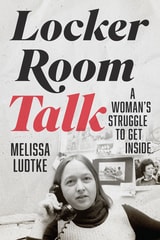
Locker Room Talk
A Woman’s Struggle to Get InsideMelissa Ludtke
Rutgers University Press, 2024
While sportswriters rushed into Major League Baseball locker rooms to talk with players, MLB Commissioner Bowie Kuhn barred the lone woman from entering along with them. That reporter, 26-year-old Sports Illustrated reporter Melissa Ludtke, charged Kuhn with gender discrimination, and after the lawyers argued Ludtke v. Kuhn in federal court, she won. Her 1978 groundbreaking case affirmed her equal rights, and the judge’s order opened the doors for several generations of women to be hired in sports media.
Locker Room Talk is Ludtke’s gripping account of being at the core of this globally covered case that churned up ugly prejudices about the place of women in sports. Kuhn claimed that allowing women into locker rooms would violate his players’ “sexual privacy.” Late-night television comedy sketches mocked her, as newspaper cartoonists portrayed her as a sexy, buxom looker who wanted to ogle the naked athletes’ bodies. She weaves these public perspectives throughout her vivid depiction of the court drama overseen by Judge Constance Baker Motley, the first Black woman to serve on the federal bench. She recounts how her lawyer, F.A.O. “Fritz” Schwarz, employed an ingenious legal strategy that persuaded Judge Motley to invoke the Fourteenth Amendment’s Equal Protection Clause in giving Ludtke access identical to that of her male counterparts. Locker Room Talk is both an inspiring story of one woman’s determination to do a job dominated by men and an illuminating portrait of a defining moment for women’s rights.
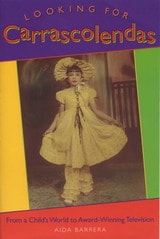
Looking for Carrascolendas
From a Child's World to Award-Winning TelevisionBy Aida Barrera
University of Texas Press, 2001
If your childhood friends were Agapito, the bombastic, bilingual lion; Campamocha, the fix-it man; Caracoles, the restaurant owner; Uncle Andy, the shoe seller; Berta and Dyana, the life-size dolls; and Señorita Barrera, then you grew up watching Carrascolendas. This award-winning show, which originally aired on PBS in the 1970s and was subsequently broadcasted throughout the country in the 1980s and 1990s, was the first Spanish and English children's educational television program broadcast to national audiences in the United States.
In this engagingly written memoir, creator-producer Aida Barrera describes how the mythical world of Carrascolendas grew out of her real-life experiences as a Mexican American child growing up in the Valley of South Texas. She recalls how she drew on those early experiences to create television programming that specifically addressed the needs of Hispanic children, even as it remained accessible and entertaining to children of other cultural backgrounds.
In addition to her personal story, Barrera recounts the long-term struggles for network acceptance and funding that made the production of Carrascolendas something of a miracle. This off-camera story adds an important chapter to the history of Anglo-Mexican cultural politics during the 1970s. Given the fact that Latino characters are still under- and stereotypically represented on network television, Carrascolendas remains an important reminder of what is possible and what has been lost in authentically multicultural television programming.
Lost City, Found Pyramid
Understanding Alternative Archaeologies and Pseudoscientific PracticesEdited by Jeb J. Card and David S. Anderson
University of Alabama Press, 2016
A critical investigation into how modern myths shape interpretations of the ancient past.
Lost City, Found Pyramid delves into the fascinating world of sensational “pseudoarchaeology,” from perennial discoveries of lost pyramids or civilizations to contemporary ghost-hunting and reality TV. It examines how nonscientific pursuit of myths and legends warps both public perceptions of archaeology and of human history itself.
A collection of twelve engaging and insightful essays, Lost City, Found Pyramid does far more than argue for the simple debunking of false archaeology. Rather, it brings into focus the value of understanding how and why pseudoarchaeology captures the public imagination. By comprehending pseudoarchaeology’s appeal as a media product, cultural practice, and communication strategy, archaeologists can enhance and enliven how they communicate about real archaeology in the classroom and in the public arena.
The first part of Lost City, Found Pyramid provides numerous case studies. Some examine the work of well-intentioned romantics who project onto actual archaeological data whimsical interpretative frameworks or quixotic “proofs” that confirm legends, such as that of the Lost White City of Honduras, or other alternative claims. Other case studies lay bare how false claims may inadvertently lead to the perpetuation of ethnic stereotypes, economic exploitation, political adventurism, and a misunderstanding of science.
Offering much of interest to scholars and students of archaeology, archaeology buffs, as well as policy-makers involved in the discovery, curation, and care of archaeological sites and relics, Lost City, Found Pyramid provides an invaluable corrective and hopeful strategy for engaging the public’s curiosity with the compelling world of archaeological discovery.