Results by title
64 books match the query 'Text' and 4 start with l
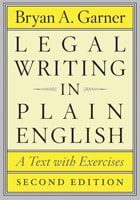
Legal Writing in Plain English, Second Edition
A Text with ExercisesBryan A. Garner
University of Chicago Press, 2013
Accessible and witty, Legal Writing in Plain English draws on real-life writing samples that Garner has gathered through decades of teaching experience. Trenchant advice covers all types of legal materials, from analytical and persuasive writing to legal drafting, and the book’s principles are reinforced by sets of basic, intermediate, and advanced exercises in each section.
In this new edition, Garner preserves the successful structure of the original while adjusting the content to make it even more classroom-friendly. He includes case examples from the past decade and addresses the widespread use of legal documents in electronic formats. His book remains the standard guide for producing the jargon-free language that clients demand and courts reward.
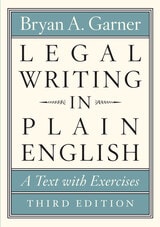
Legal Writing in Plain English, Third Edition
A Text with ExercisesBryan A. Garner
University of Chicago Press, 2023
Admirably clear, concise, down-to-earth, and powerful—all too often, legal writing embodies none of these qualities. Its reputation for obscurity and needless legalese is widespread. Since 2001, Bryan A. Garner’s Legal Writing in Plain English has helped address this problem by providing lawyers, judges, paralegals, law students, and legal scholars with sound advice and practical tools for improving their written work. Now the leading guide to clear writing in the field, this indispensable volume encourages legal writers to challenge conventions and offers valuable insights into the writing process: how to organize ideas, create and refine prose, and improve editing skills.
Accessible and witty, Legal Writing in Plain English draws on real-life writing samples that Garner has gathered through decades of teaching experience. Trenchant advice covers all types of legal materials, from analytical and persuasive writing to legal drafting, and the book’s principles are reinforced by sets of basic, intermediate, and advanced exercises in each section.
For this third edition, Garner has retained the structure of the previous versions, with updates and new material throughout. There are new sections on making your writing vivid and concrete and on using graphics to enhance your argument. The coverage and examples of key topics such as achieving parallelism, avoiding legalese, writing effective openers and summaries, and weaving quotations into your text have also been expanded. And the sample legal documents and exercises have been updated, while newly added checklists provide quick summaries of each section.
Altogether, this new edition will be the most useful yet for legal professionals and students seeking to improve their prose.
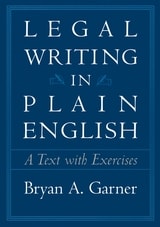
Legal Writing in Plain English
A Text with ExercisesBryan A. Garner
University of Chicago Press, 2001
Replete with common sense and wit, the book draws on real-life writing samples that Garner has gathered through more than a decade of teaching in the field. Trenchant advice covers all types of legal materials, from analytical and persuasive writing to legal drafting. Meanwhile, Garner explores important aspects of document design. Basic, intermediate, and advanced exercises in each section reinforce the book's principles. (An answer key to basic exercises is included in the book; answers to intermediate and advanced exercises are provided in a separate Instructor's Manual, free of charge to instructors.) Appendixes include a comprehensive punctuation guide with advice and examples, and four model documents.
Today more than ever before, legal professionals cannot afford to ignore the trend toward clear language shorn of jargon. Clients demand it, and courts reward it. Despite the age-old tradition of poor writing in law, Legal Writing in Plain English shows how legal writers can unshackle themselves.
Legal Writing in Plain English includes:
*Tips on generating thoughts, organizing them, and creating outlines.
*Sound advice on expressing your ideas clearly and powerfully.
*Dozens of real-life writing examples to illustrate writing problems and solutions.
*Exercises to reinforce principles of good writing (also available on the Internet).
*Helpful guidance on page layout.
*A punctuation guide that shows the correct uses of every punctuation mark.
*Model legal documents that demonstrate the power of plain English.
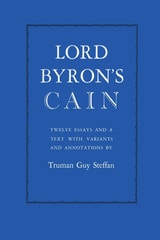
Lord Byron's Cain
Twelve essays and a text with variants and annotationsEdited by Truman Guy Steffan
University of Texas Press, 1968
Cain has been ranked as one of the two best dramatic poems written in England in the nineteenth century. Because of its religious heterodoxy, which veiled a political iconoclasm, and also because of Byron’s notoriety, Cain stirred up a storm among Tories and clergymen “from Kentish town to Pisa.” From 1821 to 1830 more was printed about its eighteen hundred alarming lines than about the twenty thousand of Don Juan. One solemn Frenchman even translated the work in order to supply his countrymen with a text that he could then rewrite and confute.
After the initial controversy, readers began to regard Cain not merely as revolutionary propaganda but as a fictional portrait of common youthful experience: a sequence of aspiration, discontent, uncertainty, confusion, misunderstood isolation, fear, frustration, anger, and finally a rash, inevitable, but futile revolt that led to a future of hopeless regret.
Truman Guy Steffan here presents a text, arrived at by collation of the first and several later editions with the original manuscript (presently in the Stark Collection of the Miriam Lutcher Stark Library at the Harry Ransom Center, the University of Texas at Austin).
The first eight essays, which comprise Part I, cover a number of literary topics: Byron’s defense of his purposes in Cain and the relevance of his dramatic theory to the poem; the characterization that is an ideological confrontation, a revelation of personal conflict, as well as a rendering of individuals who have an existence independent of the author; the principles that controlled Byron’s absorption and expansion of biblical materials; the integration of the imagery with the dramatic substance; the incongruities of the language; the metrical heterodoxy; and a description of the manuscript and of Byron’s insertions.
Part II contains the text of Cain, accompanied by notes on the variants, the manuscript cancellations and additions, certain linguistic details, and the scansion of some unusual verses. Then follow annotations on allusions, sources, and analogues, and on a few passages of the play that have elicited unusual conflict over interpretation.
Part III provides a history of Cain criticism, from the opinions of Byron’s social and literary circle and of the major periodicals and pamphlets to the more complicated contribution of the twentieth century.
This important work stands not only as a valuable addition to Byron scholarship but also as an illuminating record of the changing critical and cultural attitudes from the early nineteenth century to the 1960s. Steffan has done a remarkable job in bringing together and synthesizing an enormous body of material.