Results by title
91 books match the query 'Theater and society' and 5 start with l
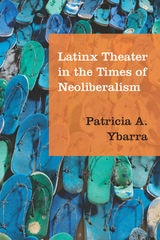
Latinx Theater in the Times of Neoliberalism
Patricia A. Ybarra
Northwestern University Press, 2018
Patricia A. Ybarra examines IMF interventions, NAFTA, shifts in immigration policy, the escalation of border industrialization initiatives, and austerity programs. She demonstrates how these policies have created the conditions for many of the most tumultuous events in the Americas in the last forty years, including dictatorships in the Southern Cone; the 1994 Cuban Rafter Crisis; femicides in Juárez, Mexico; the Zapatista uprising in Chiapas, Mexico; and the rise of narcotrafficking as a violent and vigorous global business throughout the Americas.
Latinx artists have responded to these crises by writing and developing innovative theatrical modes of representation about neoliberalism. Ybarra analyzes the work of playwrights María Irene Fornés, Cherríe Moraga, Michael John Garcés, Caridad Svich, Quiara Alegría Hudes, Victor Cazares, Jorge Ignacio Cortiñas, Tanya Saracho, and Octavio Solis. In addressing histories of oppression in their home countries, these playwrights have newly imagined affective political and economic ties in the Americas. They also have rethought the hallmark movements of Latin politics in the United States—cultural nationalism, third world solidarity, multiculturalism—and their many discontents.
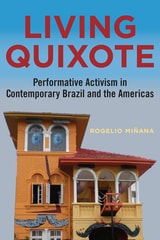
Living Quixote
Performative Activism in Contemporary Brazil and the AmericasRogelio Minana
Vanderbilt University Press, 2020
In this book, Cervantes scholar Rogelio Miñana examines long-term, Quixote-inspired activist efforts at the ground level. Through what the author terms performative activism, Quixote-inspired theater companies and nongovernmental organizations deploy a model for rewriting and enacting new social roles for underprivileged youth. Unique in its transatlantic, cross-historical, and community-based approach, Living Quixote offers both a new reading of Don Quixote and an applied model for cultural activism—a model based, in ways reminiscent of Paulo Freire, on the transformative potential of performance, literature, and art.
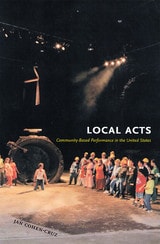
Local Acts
Community-Based Performance in the United StatesCohen-Cruz, Jan
Rutgers University Press, 2005
An eclectic mix of art, theatre, dance, politics, experimentation, and ritual,community-based performance has become an increasingly popular art movement in the United States. Forged by the collaborative efforts of professional artists and local residents, this unique field brings performance together with a range of political, cultural, and social projects, such as community-organizing, cultural self-representation, and education. Local Acts presents a long-overdue survey of community-based performance from its early roots, through its flourishing during the politically-turbulent 1960s, to present-day popular culture. Drawing on nine case studies, including groups such as the African American Junebug Productions, the Appalachian Roadside Theater, and the Puerto Rican Teatro Pregones, Jan Cohen-Cruz provides detailed descriptions of performances and processes, first-person stories, and analysis. She shows how the ritual side of these endeavors reinforces a sense of community identification while the aesthetic side enables local residents to transgress cultural norms, to question group habits, and to incorporate a level of craft that makes the work accessible to individuals beyond any one community. The book concludes by exploring how community-based performance transcends even national boundaries, connecting the local United States with international theater and cultural movements.
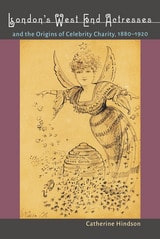
London's West End Actresses and the Origins of Celebrity Charity, 1880-1920
Catherine Hindson
University of Iowa Press, 2016
In the late nineteenth century, theatre’s fundraising for charitable causes shifted from male-dominated and private to female-directed and public. Although elite women had long been involved in such enterprises, they took on more authority in this period. At the same time, regular, high-profile public charity events became more important and much more visible than private philanthropy. Actresses became key figures in making the growing number of large and heavily publicized fundraisers successful. By 1920, the attitude was “Get an actress first. If you can’t get an actress, then get a duchess.” Actresses’ star power, their ability to orchestrate large events quickly, and their skill at performing a kind of genteel extortion made them essential to this model of charity. Actresses also benefited from this new role. Taking a prominent, public, offstage position was crucial in making them, individually and collectively, respectable professionals.
Author Catherine Hindson reveals this history by examining the major types of charity events at the turn of the twentieth century, including fundraising matinees, charity bazaars and costume parties, theatrical tea and garden parties, and benefit performances. Her study concludes with a look at the involvement of actresses in raising funds for British soldiers serving in the Anglo-Boer War and the First World War.
Lothario's Corpse
Libertine Drama and the Long-Running Restoration, 1700-1832Daniel Gustafson
Bucknell University Press, 2020
Published by Bucknell University Press. Distributed worldwide by Rutgers University Press.