80 books match the query 'Transition' and 3 start with l
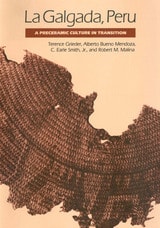
cover of La Galgada, Peru: A Preceramic Culture in Transition

La Galgada, Peru

A Preceramic Culture in Transition

By Terence E. Grieder, Alberto Bueno Mendoza, C. Earle Smith, Jr., and Robert M. Malina

University of Texas Press, 1988

Excavations over many years in the Peruvian Andes and coastal regions have revealed that the village settlements on the west coast of South America were one of the early centers of world civilization. One of these settlements, La Galgada, flourished from 3000 B.C. to 1700 B.C. Its extraordinarily complete cultural remains help to reconstruct a picture of human life, health, activities, and trade relations as they were 4,000 years ago and allow us to enter the mental and artistic life of this early civilization.

The location of La Galgada on Peru’s Tablachaca River midway between the highlands and the coast caused it to be influenced by the culture of both those regions. The remains found at La Galgada tie together important textile collections from the coastal region with important architectural remains from the Andean highland to give a picture of a complete preceramic culture in ancient Peru. Numerous illustrations provide an exciting visual catalog of the finds at La Galgada. What also makes La Galgada such a significant site are the changes in art and architecture that can be documented in considerable detail from about 2500 B.C. to about 1700 B.C. During that period, La Galgada and the other preceramic communities in northern Peru were transformed with a rapidity that must have seemed shocking and revolutionary to their inhabitants. These changes record the first appearance of the powerful and intimidating Chavín culture that was to dominate the region for the next thousand years. They also allow us to watch a people change and adapt as they try to cope with the powerful pressure of technical and social development in their region.
[more]
cover of Landscapes in Transition

Landscapes in Transition

B. Finlayson

Council for British Research in the Levant, 2010
This volume presents a collection of papers focusing on archaeological approaches to landscape in the context of the adoption of agriculture in Southwest Asia and Northwest Europe. Case studies are presented from these contrasting regions, one where the transition to farming is indigenous, and the other where the transformation is initiated externally. This allows us to consider to what extent hunter-gatherer and farmer landscapes may be different, or the degree to which apparent differences have been constructed by our expectations and traditions of interpretation. While the concept 'landscape' enjoys considerable popularity in archaeological interpretation, it is somewhat ill-defined and inconsistently used. Some have suggested that this fluidity allows landscape to be a 'usefully ambiguous concept' but at times there is a danger that this very ambiguity affords imprecision in our narratives. This is particularly important where differing traditions of archaeological interpretation meet, as, for example, in the transition from hunting and gathering to farming. The transition has been understood as a major division in archaeological practice and attitudes to 'landscape' across the transition reflect this dichotomy. The results of these debates are illuminating, and raise questions beyond the immediate geographical scope of the volume. The contrast between the two regions provides valuable comparisons between traditions of archaeological theory and interpretation and the bodies of evidence.
[more]
cover of Lost in Transition: Ethnographies of Everyday Life after Communism

Lost in Transition

Ethnographies of Everyday Life after Communism

Kristen Ghodsee

Duke University Press, 2011

Lost in Transition tells of ordinary lives upended by the collapse of communism. Through ethnographic essays and short stories based on her experiences with Eastern Europe between 1989 and 2009, Kristen Ghodsee explains why it is that so many Eastern Europeans are nostalgic for the communist past. Ghodsee uses Bulgaria, the Eastern European nation where she has spent the most time, as a lens for exploring the broader transition from communism to democracy. She locates the growing nostalgia for the communist era in the disastrous, disorienting way that the transition was handled. The privatization process was contested and chaotic. A few well-connected foreigners and a new local class of oligarchs and criminals used the uncertainty of the transition process to take formerly state-owned assets for themselves. Ordinary people inevitably felt that they had been robbed. Many people lost their jobs just as the state social-support system disappeared. Lost in Transition portrays one of the most dramatic upheavals in modern history by describing the ways that it interrupted the rhythms of everyday lives, leaving confusion, frustration, and insecurity in its wake.
[more]