57 books match the query 'United States. Congress. House' and 5 start with l
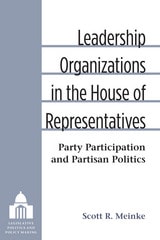
cover of Leadership Organizations in the House of Representatives: Party Participation and Partisan Politics

Leadership Organizations in the House of Representatives

Party Participation and Partisan Politics

Scott R. Meinke

University of Michigan Press, 2016
In recent Congresses, roughly half of the members of the U.S. House of Representatives served in whip organizations and on party committees. According to Scott R. Meinke, rising electoral competition and polarization over the past 40 years have altered the nature of party participation. In the 1970s and 1980s, the participation of a wide range of members was crucial to building consensus. Since then, organizations responsible for coordination in the party have become dominated by those who follow the party line. At the same time, key leaders in the House use participatory organizations less as forums for internal deliberations over policy and strategy than as channels for exchanging information with supporters outside Congress, and broadcasting sharply partisan campaign messages to the public.
 
[more]
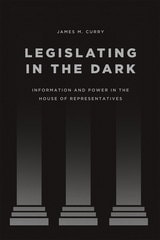
cover of Legislating in the Dark: Information and Power in the House of Representatives

Legislating in the Dark

Information and Power in the House of Representatives

James M. Curry

University of Chicago Press, 2015

The 2009 financial stimulus bill ran to more than 1,100 pages, yet it wasn’t even given to Congress in its final form until thirteen hours before debate was set to begin, and it was passed twenty-eight hours later. How are representatives expected to digest so much information in such a short time.

The answer? They aren’t. With Legislating in the Dark, James M. Curry reveals that the availability of information about legislation is a key tool through which Congressional leadership exercises power. Through a deft mix of legislative analysis, interviews, and participant observation, Curry shows how congresspersons—lacking the time and resources to study bills deeply themselves—are forced to rely on information and cues from their leadership. By controlling their rank-and-file’s access to information, Congressional leaders are able to emphasize or bury particular items, exploiting their information advantage to push the legislative agenda in directions that they and their party prefer.

Offering an unexpected new way of thinking about party power and influence, Legislating in the Dark will spark substantial debate in political science.
[more]
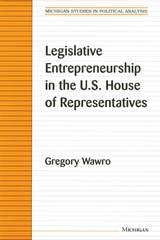
cover of Legislative Entrepreneurship in the U.S. House of Representatives

Legislative Entrepreneurship in the U.S. House of Representatives

Gregory Wawro

University of Michigan Press, 2001
When members are elected to the House of Representatives they have a certain freedom to decide how they will act as members and how they will build their reputations. Just as in the market place entrepreneurs build businesses, so in the House of Representatives members have the freedom to choose to build legislative programs that will enhance their reputations in the institution. And yet entrepreneurship is also costly to members. Gregory Wawro explains why members of the House engage in legislative entrepreneurship by examining what motivates them to acquire policy knowledge, draft legislation, build coalitions, and push their legislation in the House. He considers what incentives members have to perform what many have perceived to be the difficult and unrewarding tasks of legislating.
This book shows how becoming a legislative entrepreneur relates to members' goals of reelection, enacting good public policy, and obtaining influence in the House. The analysis differs from previous studies of this behavior, which for the most part have employed case study methods and have relied on anecdotal evidence to support their arguments. Wawro analyzes legislative entrepreneurship in a general and systematic fashion, developing hypotheses from rational-choice-based theories and testing these hypotheses using quantitative methods.
Wawro argues that members engage in legislative entrepreneurship in order to get ahead within the House. He finds that the more legislative entrepreneurship that members engage in, the more likely it is that they will advance to prestigious positions.
This book is of interest to students of Congress, legislative behavior and institutions, elections, and campaign finance.
Gregory Wawro is Assistant Professor of Political Science, Columbia University.
[more]
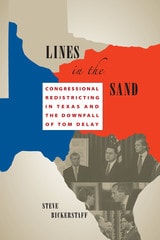
cover of Lines in the Sand: Congressional Redistricting in Texas and the Downfall of Tom DeLay

Lines in the Sand

Congressional Redistricting in Texas and the Downfall of Tom DeLay

By Steve Bickerstaff

University of Texas Press, 2007

The events of 2003 in Texas were important to the political history of this country. Congressman Tom DeLay led a Republican effort to gerrymander the state's thirty-two congressional districts to defeat all ten of the Anglo Democratic incumbents and to elect more Republicans; Democratic state lawmakers fled the state in an effort to defeat the plan. The Lone Star State uproar attracted attention worldwide. The Republicans won this showdown, gaining six additional seats from Texas and protecting the one endangered Republican incumbent. Some of the methods used by DeLay to achieve this result, however, led to his criminal indictment and ultimately to his downfall.

With its eye-opening research, readable style, and insightful commentary, Lines in the Sand provides a front-line account of what happened in 2003, often through the personal stories of members of both parties and of the minority activist groups caught in a political vortex. Law professor Steve Bickerstaff provides much-needed historical perspective and also probes the aftermath of the 2003 redistricting, including the criminal prosecutions of DeLay and his associates and the events that led to DeLay's eventual resignation from the U.S. House of Representatives. As a result, Bickerstaff graphically shows a dark underside of American politics—the ruthless use of public institutional power for partisan gain.
[more]
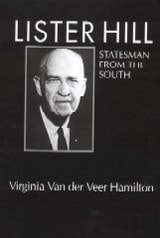
cover of Lister Hill: Statesman from the South

Lister Hill

Statesman from the South

Virginia Van der Veer Hamilton

University of Alabama Press, 2004

"Hamilton makes clear in this intelligent and sensitive biography [that] Hill, whose 45 years in Congress spanned the presidents from Calvin Coolidge to Lyndon Johnson, deserves to be remembered, both for the impressive legislative record he compiled and for the light he shed on southern liberalism in the 20th century." -- Journal of Southern History "Hamilton's fine book is based on extensive research [and] it will be of interest to a general audience as well as to scholars." -- Journal of American History "This is an important work about a highly influential lawmaker." Choice Virginia Van der Veer Hamilton is Professor Emerita of History at The University of Alabama at Birmingham and author of Hugo Black: The Alabama Years.
[more]