Results by title
133 books match the query 'Vietnam War, 1961-1975' and 6 start with l
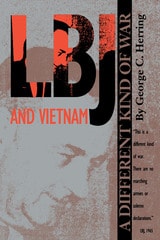
LBJ and Vietnam
A Different Kind of WarBy George C. Herring
University of Texas Press, 1994
Decades later, the Vietnam War remains a divisive memory for American society. Partisans on all sides still debate why the war was fought, how it could have been better fought, and whether it could have been won at all.
In this major study, a noted expert on the war brings a needed objectivity to these debates by examining dispassionately how and why President Lyndon Johnson and his administration conducted the war as they did. Drawing on a wealth of newly released documents from the LBJ Library, including the Tom Johnson notes from the influential Tuesday Lunch Group, George Herring discusses the concept of limited war and how it affected President Johnson's decision making, Johnson's relations with his military commanders, the administration's pacification program of 1965-1967, the management of public opinion, and the "fighting while negotiating" strategy pursued after the Tet Offensive in 1968.
The author's in-depth analysis exposes numerous flaws in Johnson's management of the war. In Herring's view, the Johnson administration lacked any overall strategy for conducting the war. No change in approach was ever discussed, despite popular and even administration dissatisfaction with the progress of the war, and no oversight committee coordinated the activities of the military services and various governmental agencies, which were left to follow their own, often conflicting, agendas.
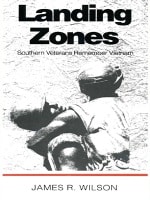
Landing Zones
Southern Veterans Remember VietnamJames R. Wilson
Duke University Press, 1990
These stories focus on a uniquely southern view of Vietnam. In terms of numbers the South shouldered more than its share of human cost—31 percent of Americans who served came from one of the eleven states of the old Confederacy, and 28 percent of the dead were southerners. Southerners also brought to Vietnam certain shared cultural tastes and a particularly southern heritage of honor in military service stemming from the Civil War. For many, as their testimony reveals, a sense of patriotism was tested and questioned by the horrors of war, and for others that patriotism was a continued source of strength.
Individually and collectively, however, these oral histories make up a picture of war that prevents us from forgetting the truth as one veteran put it: “Vietnam was not one war, but a thousand little nasty wars.”
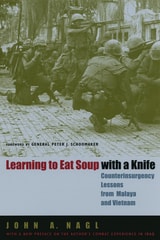
Learning to Eat Soup with a Knife
Counterinsurgency Lessons from Malaya and VietnamJohn A. Nagl
University of Chicago Press, 2005
In examining these two events, Nagl argues that organizational culture is key to the ability to learn from unanticipated conditions, a variable which explains why the British army successfully conducted counterinsurgency in Malaya but why the American army failed to do so in Vietnam, treating the war instead as a conventional conflict. Nagl concludes that the British army, because of its role as a colonial police force and the organizational characteristics created by its history and national culture, was better able to quickly learn and apply the lessons of counterinsurgency during the course of the Malayan Emergency.
With a new preface reflecting on the author's combat experience in Iraq, Learning to Eat Soup with a Knife is a timely examination of the lessons of previous counterinsurgency campaigns that will be hailed by both military leaders and interested civilians.

Life and Death in the Central Highlands
An American Sergeant in the Vietnam War, 1968-1970James T. Gillam
University of North Texas Press, 2010
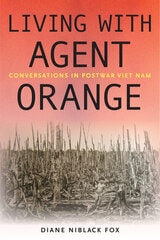
Living with Agent Orange
Conversations in Postwar Viet NamDiane Niblack Fox
University of Massachusetts Press, 2024
For over half a century, the Vietnamese people have endured the harmful legacies of Agent Orange, the toxic herbicide used by the American military as a type of chemical warfare. While scientists and politicians continue to debate how to best address its human and environmental consequences, the nearly three million Vietnamese whose lives have been shaped by its lingering effects have been largely left out of the conversation.
To understand how Agent Orange has impacted the lives and livelihoods of everyday Vietnamese people, Diane Niblack Fox interviewed families and individuals living with its aftereffects across the northern, central, and southern regions of the country. In powerfully written prose, Fox shares the personal accounts of villagers, as they describe caring for loved ones with chronic illnesses and disabilities and their attempts to secure medical and financial assistance. Living with Agent Orange also chronicles the moving stories of rebuilt lives, of family and community support, and of the overriding power of the human spirit.
Looking Back on the Vietnam War
Twenty-first-Century PerspectivesBoyle, Brenda M
Rutgers University Press, 2016