Results by title
53 books match the query 'Voting' and 2 start with l
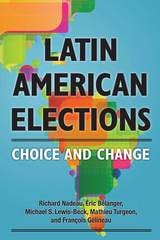
Latin American Elections
Choice and ChangeRichard Nadeau, Éric Bélanger, Michael S. Lewis-Beck, Mathieu Turgeon, and François Gélineau
University of Michigan Press, 2017
The Michigan model, named after the institution where it was first articulated, has been used to explain voting behavior in North American and Western European democracies. In Latin American Elections, experts on Latin America join with experts on electoral studies to evaluate the model’s applicability in this region. Analyzing data from the AmericasBarometer, a scientific public opinion survey carried out in 18 Latin American nations from 2008 to 2012, the authors find that, like democratic voters elsewhere, Latin Americans respond to long-term forces, such as social class, political party ties, and political ideology while also paying attention to short-term issues, such as the economy, crime, corruption. Of course, Latin Americans differ from other Americans, and among themselves. Voters who have experienced left-wing populism may favor government curbs on freedom of expression, for example, while voters enduring high levels of economic deprivation or instability tend to vote against the party in power.
The authors thus conclude that, to a surprising extent, the Michigan model offers a powerful explanatory model for voting behavior in Latin America.
[more]

Learning by Voting
Sequential Choices in Presidential Primaries and Other ElectionsRebecca B. Morton and Kenneth C. Williams
University of Michigan Press, 2001
The presidential primary season used to be a long sequence of elections. In recent years many states have moved their presidential primaries earlier in the year in the belief that this increases their influence over the choice of presidential nominees. Similarly, in the past most voters have gone to a polling place and voted on election day. Now an increasing number of voters are not voting on election day but are using mail-in or absentee ballots to vote, often weeks before other voters.
Does the movement to a large number of early presidential primaries reduce the ability of voters to learn about the candidates? Do voters who vote early miss important information by not following the entire campaign, or are they, as some argue, more partisan? In a unique study Rebecca B. Morton and Kenneth C. Williams investigate the impact these changes have on the choices voters make. The authors combine a formal, theoretical model to derive hypotheses with experiments, elections conducted in labs, to test the hypotheses.
Their analysis finds that sequence in voting does matter. In simultaneous voting elections well-known candidates are more likely to win, even if that candidate is the first preference of only a minority of the voters and would be defeated by another candidate, if that candidate were better known. These results support the concerns of policy makers that front-loaded primaries prevent voters from learning during the primary process. The authors also find evidence that in sequential elections those who vote on election day have the benefit of information received throughout the whole course of the campaign, thus supporting concerns with mail-in ballots and other early balloting procedures.
This book will interest scholars interested in elections, the design of electoral systems, and voting behavior as well as the use of formal modeling and experiments in the study of politics. It is written in a manner that can be easily read by those in the public concerned with presidential elections and voting.
Rebecca B. Morton is Associate Professor of Political Science, University of Iowa. Kenneth C. Williams is Associate Professor of Political Science, Michigan State University.
[more]