Results by title
107 books match the query 'Water' and 6 start with l
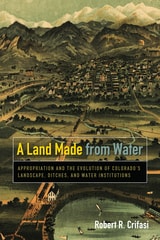
Land Made from Water
Appropriation and the Evolution of Colorado's Landscape, Ditches, and Water InstitutionsRobert R. Crifasi
University Press of Colorado, 2016
A Land Made from Water chronicles how the appropriation and development of water and riparian resources in Colorado changed the face of the Front Range—an area that was once a desert and is now an irrigated oasis suitable for the habitation and support of millions of people. This comprehensive history of human intervention in the Boulder Creek and Lefthand Creek valleys explores the complex interactions between environmental and historical factors to show how thoroughly the environment along the Front Range is a product of human influence.
Author Robert Crifasi examines the events that took place in nineteenth-century Boulder County, Colorado, and set the stage for much of the water development that occurred throughout Colorado and the American West over the following century. Settlers planned and constructed ditches, irrigation systems, and reservoirs; initiated the seminal court decisions establishing the appropriation doctrine; and instigated war to wrest control of the region from the local Native American population. Additionally, Crifasi places these river valleys in the context of a continent-wide historical perspective.
By examining the complex interaction of people and the environment over time, A Land Made from Water links contemporary issues facing Front Range water users to the historical evolution of the current water management system and demonstrates the critical role people have played in creating ecosystems that are often presented to the public as “natural” or “native.” It will appeal to students, scholars, professionals, and general readers interested in water history, water management, water law, environmental management, political ecology, or local natural history.
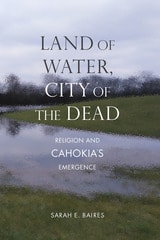
Land of Water, City of the Dead
Religion and Cahokia's EmergenceSarah E. Baires
University of Alabama Press, 2017
Explores the embodiment of religion in the Cahokia land and how places create, make meaningful, and transform practices and beliefs
Cahokia, the largest city of the Mississippian mound cultures, lies outside present-day East St. Louis. Land of Water, City of the Dead reconceptualizes Cahokia’s emergence and expansion (ca. 1050–1200), focusing on understanding a newly imagined religion and complexity through a non-Western lens. Sarah E. Baires argues that this system of beliefs was a dynamic, lived component, based on a broader ontology, with roots in other mound societies. This religion was realized through novel mortuary practices and burial mounds as well as through the careful planning and development of this early city’s urban landscape.
Baires analyzes the organization and alignment of the precinct of downtown Cahokia with a specific focus on the newly discovered and excavated Rattlesnake Causeway and the ridge-top mortuary mounds located along the site axes. Land of Water, City of the Dead also presents new data from the 1954 excavations of the ridge-top mortuary Wilson Mound and a complete analysis of the associated human remains. Through this skeletal analysis, Baires discusses the ways that Cahokians processed and buried their ancestors, identifying unique mortuary practices that include the intentional dismemberment of human bodies and burial with marine shell beads and other materials.
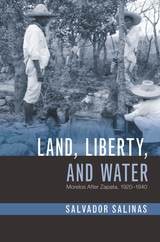
Land, Liberty, and Water
Morelos After Zapata, 1920–1940Salvador Salinas
University of Arizona Press, 2018
Salvador Salinas takes readers inside the diverse pueblos of the former Zapatistas during the 1920s and 1930s and recounts the first statewide land reform carried out in postrevolutionary Mexico. Based on extensive archival research, he reveals how an alliance with the national government that began in 1920 stimulated the revival of rural communities after ten years of warfare and helped once-landless villagers reclaim Morelos’s valley soils, forested mountains, and abundant irrigation waters.
During the presidency of Plutarco Elías Calles (1924–1928), pueblos forged closer ties to the centralized government in Mexico City through a plethora of new national institutions, such as ejidos, forestry cooperatives, water juntas, credit societies, and primary schools. At the same time, the expansion of charcoal production in the Sierra de Ajusco and rice cultivation in the lowland valleys accelerated deforestation and intensified water conflicts.
Salinas recounts how the federal reforms embraced by the countryside aided the revival of the pueblos, and in return, villagers repeatedly came to the defense of an embattled national regime. Salinas gives readers interested in modern Mexico, the Zapatista revolution, and environmental history a deeply researched analysis of the outcomes of the nation’s most famous revolutionary insurgency.
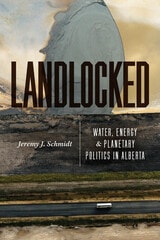
Landlocked
Water, Energy, and Planetary Politics in AlbertaJeremy J. Schmidt
University of Chicago Press, 2026
A study of oil-rich Alberta reveals the entwined relationships among geoscience, governance, and power.
The Canadian province of Alberta holds the world’s fourth-largest reserve of fossil fuels, with oil sands famous for bitumen, a viscous form of petroleum. A critical testing ground for international environmental ideas and energy policies, Alberta pioneered state-led efforts to understand, extract, and sell bitumen. Without natural access to ocean ports, Alberta must negotiate pipeline routes with neighboring provinces and nations to reach global markets. But Alberta is also landlocked in another sense: it is caught in an extractive relationship with oil-rich earth.
In Landlocked, Jeremy J. Schmidt focuses on Alberta’s energy industry, particularly its use of water and oil, to argue for a new way of understanding how political authority is forged and maintained through the environment. Schmidt details how water and oil were enrolled in early state-making projects, such as irrigation, and examines the consequences of Alberta’s efforts to extract value from land, including a series of events in 2013 that released 4.2 million barrels of bitumen into underground environments. By uncovering the ways that geosciences supported activities—from land settlement to the dispossession of Indigenous peoples—that produced environmental policies and approaches to management and governance, he shows that they aren’t merely instruments of state power but central to Alberta’s political identity and legitimacy.

Like Blood in Water
Five MininovelsYuriy Tarnawsky
University of Alabama Press, 2007
In these five surrealist collages, waking life continually gives way before the onslaught of dreams. Yuriy Tarnawsky has condensed the vastness of scope typical of novels into shorter fragments—mininovels—that require the reader’s active participation. The tone is a balance of dead-pan comedy and solemn gothic, sometimes a near-parody of wide-eyed candor, sometimes recounting utterly mad or barely conceivable states of affairs.
A candidate for major surgery struggles unsuccessfully to avoid it. Two strangers meet, and eventually marry, after participating in scream therapy. A pianist stops playing because he believes his hand is not there when he sits at the keyboard. A character sees the giant blue and white flowers he has craved his whole life only at the instance of his electrocution. Tyler Pavarotti, a tailor, voluntarily takes a role in a production in which he will be killed.
Tarnawsky’s language is elegant and careful, and his studied concentration of rhythm allows his work to transcend prose, nestling somewhere within the realm of musical composition. Both tragic and beautiful, in these stories life dissolves in time like blood in water.
Lives of Dust and Water
An Anthropology of Change and Resistance in Northwestern MexicoMaría Luz Cruz-Torres
University of Arizona Press, 2004
A political ecology of human survival in one of the most important ecological regions of Mexico, it describes how these communities contest environmental degradation and economic impoverishment arising from political and economic forces beyond their control. María Luz Cruz-Torres evokes the rich and varied experiences of the people who live in the villages of Celaya and El Cerro, showing how they invent and utilize their own social capital to emerge as whole persons in the face of globalization. She traces the histories of the two villages to illustrate the complex variation involved in community formation and to show how people respond to and utilize Mexican law and reform. Surrounded by limited resources, poverty, illness, sudden death, and daily oppression, these men and women create innovative social and cultural forms that mitigate these impacts.
Cruz-Torres reveals not only how they manage to survive in the midst of horrendous circumstances but also how they transcend those impediments with dignity. She details the participation of household members in the subsistence, formal, and informal sectors of the economy, and how women use a variety of resources to guarantee their families’ survival. A sometimes tragic but ultimately vibrant story of human resistance, Lives of Dust and Water offers an important look at a little-studied but dynamically developing region of Mexico. It contributes to a more precise understanding of how rural coastal communities in Mexico emerged and continue to develop and adjust to the uncertainties of the globalizing world.