Results by title
441 books match the query 'Women and literature' and 9 start with l
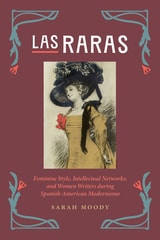
Las Raras
Feminine Style, Intellectual Networks, and Women Writers during Spanish-American ModernismoSarah Moody
Vanderbilt University Press, 2024
Premio al Mejor Libro en Humanidades, Latin American Studies Association–Nineteenth-Century Section, 2025
Premio Victoria Urbano de Monografía Crítica, Association of Gender and Sexuality Studies, 2025 (co-winner)
Segundo Premio, Adela Zamudio Prize, Feministas Unidas, 2025
Las Raras proposes that the Modernistas’ advocacy for a writing style they considered feminine helps us to understand why so few (and perhaps no) women were accepted as active participants in Modernismo. Author Sarah Moody studies how particular writers contributed to the idea of a feminine aesthetic and tracks the intellectual networks of Modernismo through periodicals and personal papers, such as albums and correspondence. Buenos Aires, Paris, and Montevideo figure prominently in this transatlantic study, which reexamines some of the most important period writers in Spanish, including Rubén Darío, Amado Nervo, and Enrique Gómez Carrillo.
This book also considers the critiques launched by women writers, such as Aurora Cáceres, Clorinda Matto de Turner, and María Eugenia Vaz Ferreira, who experienced Modernista exclusion firsthand, deconstructed the Modernista discourse of a modern, “feminine” style, and built literary success in alternative terms. These writers reoriented the discussion about women in modernity to address women’s education, professionalization, and advocacy for social and civic improvements. In this study, Modernismo emerges as both a literary style and an intellectual network, in which style and sociability are mutually determining and combine to form a system of prestige and validation that excluded women writers.
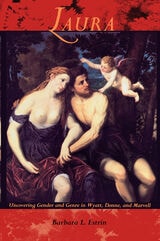
Laura
Uncovering Gender and Genre in Wyatt, Donne and MarvellBarbara L. Estrin
Duke University Press, 1994
Through close readings of the Rime sparse and the works of Wyatt, Donne, and Marvell, Estrin uncovers three Lauras: Laura-Daphne, who denies sexuality; Laura-Eve, who returns the poet’s love; and Laura-Mercury, who reinvents her own life. Estrin claims that in these three guises Laura subverts both genre and gender, thereby introducing multiple desires into the many layers of the poems. Drawing upon genre and gender theories advanced by Jean-François Lyotard and Judith Butler to situate female desire in the poem’s framework, Estrin shows how genre and gender in the Petrarchan tradition work together to undermine the stability of these very concepts.
Estrin’s Laura constitutes a fundamental reconceptualization of the Petrarchan tradition and contributes greatly to the postmodern reassessment of the Renaissance period. In its descriptions of how early modern poets formulate questions about sexuality, society and poetry, Laura will appeal to scholars of the English and Italian Renaissance, of gender studies, and of literary criticism and theory generally.

Lesbian Empire
Radical Crosswriting in the TwentiesGay Wachman
Rutgers University Press, 2001
Wachman places at the center of this tradition Sylvia Townsend Warner's achievement in undermining the inhibitions that faced women writing about forbidden love. She discusses Warner's use of crosswriting to transpose the otherwise unrepresentable lives of invisible lesbians into narratives about gay men, destabilizing the borders of race, class, and gender and challenging the codes of expression on which imperialist patriarchy and capitalism depended.
Lewd and Notorious
Female Transgression in the Eighteenth CenturyKatharine Kittredge, Editor
University of Michigan Press, 2003
Literature after Feminism
Rita Felski
University of Chicago Press, 2003
Spelling out her main arguments clearly and succinctly, Rita Felski explains how feminism has changed the ways people read and think about literature. She organizes her book around four key questions: Do women and men read differently? How have feminist critics imagined the female author? What does plot have to do with gender? And what do feminists have to say about the relationship between literary and political value? Interweaving incisive commentary with literary examples, Felski advocates a double critical vision that can do justice to the social and political meanings of literature without dismissing or scanting the aesthetic.
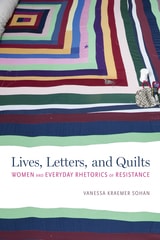
Lives, Letters, and Quilts
Women and Everyday Rhetorics of ResistanceVanessa Kraemer Sohan
University of Alabama Press, 2020
In Lives, Letters, and Quilts: Women and Everyday Rhetorics of Resistance, Vanessa Kraemer Sohan applies a translingual and transmodal framework informed by feminist rhetorical practice to three distinct case studies that demonstrate women using unique and effective rhetorical strategies in political, religious, and artistic contexts. These case studies highlight a diverse set of actors uniquely situated by their race, gender, class, or religion, but who are nevertheless connected by their capacity to envision and recontextualize the seemingly ordinary means and materials available to them in order to effectively persuade others.
The Great Depression provides the backdrop for the first case study, a movement whereby thousands of elderly citizens proselytized and fundraised for a monthly pension plan dreamt up by a California doctor in the hopes of lifting themselves out of poverty. Sohan investigates how the Townsend Plan’s elderly supporters—the Townsendites—worked within and across language, genre, mode, and media to enable them for the first time to be recognized by others, and themselves, as a viable political constituency.
Next, Sohan recounts the story of Quaker minister Eliza P. Kirkbride Gurney who met President Abraham Lincoln in 1862. Their subsequent epistolary exchanges concerning conscientious objectors made such an impression on him that one of her letters was rumored to be in his pocket the night of his assassination. Their exchanges and Gurney’s own accounts of her transnational ministry in her memoir provide useful examples of how, throughout history, women rhetors have adopted and transformed typically underappreciated forms of rhetoric—such as the epideictic—for their particular purposes.
The final example focuses on the Gee’s Bend quiltmakers—a group of African American women living in rural Alabama who repurpose discarded work clothes and other cast-off fabrics into the extraordinary quilts for which they are known. By drawing on the means and materials at hand to create celebrated works of art in conditions of extreme poverty, these women show how marginalized artisans can operate both within and outside the bounds of established aesthetic traditions and communicate the particulars of their experience across cultural and economic divides.

Lost Property
The Woman Writer and English Literary History, 1380-1589Jennifer Summit
University of Chicago Press, 2000
Lost Property traces the representation of women writers from Margery Kempe and Christine de Pizan to Elizabeth I and Mary Queen of Scots, exploring how the woman writer became a focal point for emerging theories of literature and authorship in English precisely because of her perceived alienation from tradition. Through original archival research and readings of key literary texts, Summit writes a new history of the woman writer that reflects the impact of such developments as the introduction of printing, the Reformation, and the rise of the English court as a literary center.
A major rethinking of the place of women writers in the histories of books, authorship, and canon-formation, Lost Property demonstrates that, rather than being an unimaginable anomaly, the idea of the woman writer played a key role in the invention of English literature.
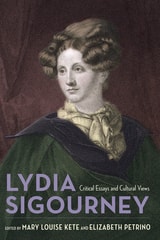
Lydia Sigourney
Critical Essays and Cultural ViewsMary Louise Kete
University of Massachusetts Press, 2018
During her lifetime, Lydia Sigourney was acclaimed as nineteenth-century America's most popular woman poet and published widely as a historian, travel writer, essayist, and educator. While serious critical attention to her work languished following her death and into the twentieth century, a growing number of critics and writers have reexamined Sigourney and her large body of writing and have given her a central place in the “new canon.”
This first collection of original essays devoted to the poet's work puts many of the best scholars on Sigourney together in one place and in conversation with one another. The volume includes critical essays examining her literary texts as well as essays that unpack Sigourney's participation in the cultural movements of her day. Holding powerful opinions about the role of women in society, Sigourney was not afraid to advocate against government policies that, in her view, undermined the promise of America, even as she was held up as a paragon of American womanhood and middle-class rectitude. The resulting portrait promises to engage readers who wish to know more about Sigourney's writing, her career, and the causes that inspired her.
Along with the volume editors, contributors include Ann Beebe, Paula Bernat Bennett, Janet Dean, Sean Epstein-Corbin, Annie Finch, Gary Kelly, Paul Lauter, Amy J. Lueck, Ricardo Miguel-Alfonso, Jennifer Putzi, Angela Sorby, Joan Wry, and Sandra Zagarell.
Lyric Interventions
Feminism, Experimental Poetry, DiscourseLinda A. Kinnahan
University of Iowa Press, 1998
Lyric Interventions explores linguistically innovative poetry by contemporary women in North America and Britain whose experiments give rise to fresh feminist readings of the lyric subject. The works discussed by Linda Kinnahan explore the lyric subject in relation to the social: an “I” as a product of social discourse and as a conduit for change.
Contributing to discussions of language-oriented poetries through its focus on women writers and feminist perspectives, this study of lyric experimentation brings attention to the cultural contexts of nation, gender, and race as they significantly shift the terms by which the “experimental” is produced, defined, and understood.
This study focuses upon lyric intervention in distinct but related spheres as they link public and ideological norms of identity. Firstly, lyric innovations with visual and spatial realms of cultural practice and meaning, particularly as they naturalize ideologies of gender and race in North America and the post-colonial legacies of the Caribbean, are investigated in the works of Barbara Guest, Kathleen Fraser, Erica Hunt, and M. Nourbese Philip. Secondly, experimental engagements with nationalist rhetorics of identity, marking the works of Carol Ann Duffy, Denise Riley, Wendy Mulford, and Geraldine Monk, are explored in relation to contemporary evocations of “self” in Britain. And thirdly, in discussions of all of the poets, but particularly accenuated in regard to Guest, Fraser, Riley, Mulford, and Monk, formal experimentation with the lyric “I” is considered through gendered encounters with critical and avant-garde discourses of poetics.
This fresh, energetic study will be of great interest to literary critics and womens studies scholars, as well as poets on both sides of the Atlantic.