Results by title
141 books match the query 'World War I' and 3 start with l
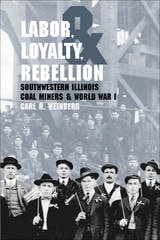
Labor, Loyalty, and Rebellion
Southwestern Illinois Coal Miners & World War ICarl R. Weinberg
Southern Illinois University Press, 2005
On April 5, 1918, as American troops fought German forces on the Western Front, German American coal miner Robert Prager was hanged from a tree outside Collinsville, Illinois, having been accused of disloyal utterances about the United States and chased out of town by a mob. In Labor, Loyalty, and Rebellion: Southwestern Illinois Coal Miners and World War I, Carl R. Weinberg offers a new perspective on the Prager lynching and confronts the widely accepted belief among labor historians that workers benefited from demonstrating loyalty to the nation.
The first published study of wartime strikes in southwestern Illinois is a powerful look at a group of people whose labor was essential to the war economy but whose instincts for class solidarity spawned a rebellion against mine owners both during and after the war. At the same time, their patriotism wreaked violent working-class disunity that crested in the brutal murder of an immigrant worker. Weinberg argues that the heightened patriotism of the Prager lynching masked deep class tensions within the mining communities of southwestern Illinois that exploded after the Great War ended.
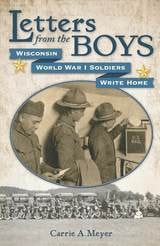
Letters from the Boys
Wisconsin World War I Soldiers Write HomeCarrie A Meyer
Wisconsin Historical Society Press, 2018
On the 100th anniversary of the arrival of the flood of American troops in Europe that would shift the tide of World War I in favor of the Allies, Letters from the Boys brings to life this terrible war as experienced by Wisconsinites writing home.
Technology had transformed the battlefield in alarming ways. Automatic rifles mowed down the young men who went “over the top” to attack enemy trenches; airplanes and improved artillery brought death unseen from miles away; terrifying clouds of poison gas choked and burned the European countryside; the internal combustion engine brought tanks to the battlefield for the first time and revolutionized the way troops deployed.
In the thick of it were young men from Wisconsin who found themselves caught up in geopolitical events half a world away. Professor Carrie A. Meyer combed through three newspapers in Green County, Wisconsin, to collect and synthesize the letters from the boys into a narrative that is both unique and representative, telling the stories of several Green County boys and what they saw, from preparing for war, to life among French families near the front, to the terror of the battlefield. Meyer gracefully removes the veil of obscurity and anonymity hanging over soldiers who participated in a war fought so long ago by great numbers of men, reminding us that armies are made of individuals who strove to do their part and then return to their families.
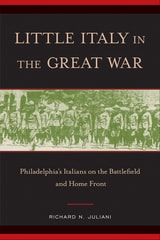
Little Italy in the Great War
Philadelphia's Italians on the Battlefield and Home FrontRichard N. Juliani
Temple University Press, 2020
The Great War challenged all who were touched by it. Italian immigrants, torn between their country of origin and country of relocation, confronted political allegiances that forced them to consider the meaning and relevance of Americanization. In his engrossing study, Little Italy in the Great War, Richard Juliani focuses on Philadelphia’s Italian community to understand how this vibrant immigrant population reacted to the war as they were adjusting to life in an American city that was ambivalent toward them.
Juliani explores the impact of the Great War on many immigrant soldiers who were called to duty as reservists and returned to Italy, while other draftees served in the U.S. Army on the Western Front. He also studies the impact of journalists and newspapers reporting the war in English and Italian, and reactions from civilians who defended the nation in industrial and civic roles on the home front.
Within the broader context of the American experience, Little Italy in the Great War examines how the war affected the identity and cohesion of Italians as a population still passing through the assimilation process.