Results by title
18284 books match the query 'United States' and 698 start with l
Lovable Racists, Magical Negroes, and White Messiahs
David Ikard
University of Chicago Press, 2017
In the book, Ikard explodes the fiction of a postracial society while awakening us to the sobering reality that we must continue to fight for racial equality or risk losing the hard-fought gains of the Civil Rights movement. Through his close reading of novels, films, journalism, and political campaigns, he analyzes willful white blindness and attendant master narratives of white redemption—arguing powerfully that he who controls the master narrative controls the perception of reality. The book sounds the alarm about seemingly innocuous tropes of white redemption that abound in our society and generate the notion that blacks are perpetually indebted to whites for liberating, civilizing, and enlightening them. In Lovable Racists, Magical Negroes, and White Messiahs, Ikard expertly and unflinchingly gives us a necessary critical historical intervention.
Love Across the Color Line
Helen Lefkowitz Horowitz
University of Massachusetts Press, 1996

Love Is My Favorite Flavor
A Midwestern Dining Critic Tells AllWini Moranville
University of Iowa Press, 2024
Amidst the vast changes that have occurred over the years, Love Is My Favorite Flavor underscores the timelessness of what it is we seek when we entrust restaurateurs with our hard-earned money and our hard-won leisure time. Dining out may have changed dramatically since the 1970s, but the joys of being in the hands of people who care deeply about our time at their tables have not.
Love Rules
Silent Hollywood And The Rise Of The Managerial ClassMark Garrett Cooper
University of Minnesota Press, 2003
Traces the surprising connections between silent films and the rise of bureaucracy
Arguing for a sweeping new consideration of the shift from print to cinema as a governing system for organizing modern American social relations, this book uncovers an intimate connection between Hollywood romances of the silent era and the empowerment of a managerial class.
During the 1910s and 1920s, American movies told love stories through what rapidly became ubiquitous images. Again and again, silent features showed lovers separated by seeming happenstance and reunited as if by magical forces. Mark Garrett Cooper argues that this “magic” implies the expertise of the corporate movie studio with its hierarchies of professional experts. In other words, the Hollywood love story amounts to a managerial technique. Through close study of such films as Birth of a Nation, Enoch Arden, The Crowd, Why Change Your Wife? and The Jazz Singer, Love Rules shows how cinematic romance offers an object lesson in how to arrange American society—a lesson that implies that such work can be accomplished only by a managerial class.Love Rules offers a boldly original account of how the Hollywood feature film supplanted the “imagined community” of print culture and, in doing so, played a key role in the transformation of American mass culture.
Love Stories
Sex between Men before HomosexualityJonathan Ned Katz
University of Chicago Press, 2001
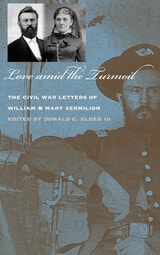
Love amid the Turmoil
The Civil War Letters of William and Mary VermilionDonald C. Elder, III
University of Iowa Press, 2003
William Vermilion (1830-1894) served as a captain in Company F of the 36th Iowa Infantry from October 1862 until September 1865. Although he was a physician in Iconium in south central Iowa at the start of the war, after it ended he became a noted lawyer in nearby Centerville; he was also a state senator from 1869 to 1872. Mary Vermilion (1831-1883) was a schoolteacher who grew up in Indiana; she and William married in 1858. In this volume historian Donald Elder provides a careful selection from the hundreds of supportive, informative, and heart-wrenching letters that they wrote each other during the war—the most complete collection of letters exchanged between a husband and a wife during the Civil War.
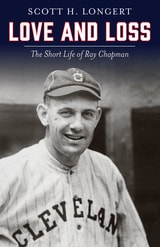
Love and Loss
The Short Life of Ray ChapmanScott H. Longert
Ohio University Press, 2024
The son of a coal miner from a small Illinois town, Cleveland Indians shortstop Ray Chapman lived the American dream until his untimely death at age twenty-nine. In his brief life, he reached the pinnacle of baseball success as the best shortstop in the American League. While many professional ballplayers struggled with meager salaries, the handsome Chapman had married heiress Kathleen Daly, one of Cleveland’s wealthiest women. With a child on the way and an executive job in the offseason, Chapman was moving toward a privileged place in society until an errant fastball fractured his skull and ended his life the next day. Late in the 1920 pennant race, the Indians were in New York for a key series against the Yankees. New York pitcher Carl Mays threw a high hard one that Chapman could not evade. He was taken to a nearby hospital, where doctors tried in vain to save his life. The tragedy did not end there. His widow took her own life eight years later, and their daughter, Rae, subsequently died from meningitis. Today, people visit Chapman’s impressive grave in Cleveland’s Lake View Cemetery, leaving baseballs and gloves in his memory. Though gone over a hundred years, he is well remembered as a Cleveland icon. This book goes far beyond the well-worn accounts of Chapman’s untimely death to illustrate the fullness of his short life.
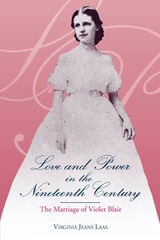
Love and Power in the Nineteenth Century
The Marriage of Violet BlairVirginia Jeans Laas
University of Arkansas Press, 1998
Winner, 1999 Missouri Conference on History Book Award
This fascinating biography of a marriage in the Gilded Age closely examines the dynamic flow of power, control, and love between Washington blue blood Violet Blair and New Orleans attorney Albert Janin. Based on their voluminous correspondence as well as Violet’s extensive diaries, it offers a thoroughly intimate portrait of a fifty-four-year union which, in many ways, conformed to societal strictures, yet always created its own definition of itself in order to fit the flux of needs of both husband and wife.
Central to their story is Violet’s fierce determination to maintain her autonomy within the patriarchic institution of marriage. An enduring belle who thought, talked, and acted with the assurance and self-confidence of one whose wishes demanded obedience, she rejected the Victorian ideal of women as silent, submissive consorts. Yet her feminism was a private one, not played out on a public stage but kept to the confines of her own daily life and marriage.
With abundant documentary evidence to draw upon, Laas ties this compelling story to broader themes of courtiship behavior, domesticity, gender roles, extended family bonds, elitism, and societal stereotyping. Deeply researched and beautifully written, Love and Power in the Nineteenth Century has the dual virtue of making an important historical contribution while also appealing to a broad popular audience.
Love's Revolution
Interracial MarriageMaria Root
Temple University Press, 2001
Love's Revolution traces the social changes that account for the growth of intermarriage as well as the lingering prejudices and false beliefs that oppress racially mixed families. For this book, author Maria P. P. Root, a clinical psychologist, interviewed some 200 people from a wide spectrum of racial and ethnic backgrounds. Speaking out about their views and experiences, these partners, family members, and children of mixed race marriages confirm that the barriers are gradually eroding; but they also testify to the heartache caused by family opposition and disapproving strangers.
Root traces race prejudice to the various institutions that were structured to maintain white privilege, but the heart of the book is her analysis of what happens when people of different races decide to marry. Developing an analogy between families and types of businesses, she shows how both positive and negative reactions to such marriages are largely a matter of shared concepts of family rather than individual feelings about race. She probes into the identity issues that multiracial children confront an draws on her clinical experience to offer child-rearing recommendations for multiracial families. Root's "Bill of Rights for Racially Mixed People" is a document that at once empowers multiracial people and educates those who ominously ask, What about the children?
Love's Revolution paints an optimistic but not idealized picture of contemporary relationships. The "Ten Truths about Interracial Marriage" that close the book acknowledges that mixed race couples experience the same stresses as everyone else in addition to those arising from other people's prejudice or curiosity. Their divorce rates are only slightly higher than those of single race couples, which suggests that their success or failure at marriage is not necessarily a racial issue. And that is a revolutionary idea!
Love, Anarchy, & Emma Goldman
A BiographyFalk, Candace
Rutgers University Press, 1990
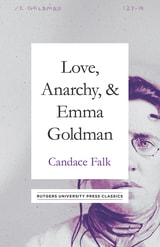
Love, Anarchy, & Emma Goldman
A BiographyCandace Serena Falk
Rutgers University Press, 2019
“Fascinating …With marvelous clarity and depth, Candace Falk illuminates for us an Emma Goldman shaped by her time yet presaging in her life the situation and conflicts of women in our time.” —Tillie Olsen
One of the most famous political activists of all time, Emma Goldman was also infamous for her radical anarchist views and her “scandalous” personal life. In public, Goldman was a firebrand, confidently agitating for labor reform, anarchism, birth control, and women’s independence. But behind closed doors she was more vulnerable, especially when it came to the love of her life.
Love, Anarchy, & Emma Goldman is an account of Goldman’s legendary career as a political activist. But it is more than that—it is a biography that offers an intimate look at how Goldman’s passion for social reform dovetailed with her passion for one man: Chicago activist, hobo king, and red-light district gynecologist Ben Reitman. Candace Falk takes us into the heart of their tumultuous love affair, finding that even as Goldman lectured on free love, she confronted her own intense jealousy.
As director of the Emma Goldman papers, Falk had access to over 40,000 writings by Goldman—including her private letters and notes—and she draws upon these archives to give us a rare insight into this brilliant, complex woman’s thoughts. The result is both a riveting love story and a primer on an exciting, explosive era in American politics and intellectual life.
Love, H
The Letters of Helene Dorn and Hettie JonesHettie Jones
Duke University Press, 2016
Love
A Philadelphia AffairBeth Kephart
Temple University Press, 2017
Philadelphia has been at the heart of many books by award-winning author Beth Kephart, but none more so than the affectionate collection Love. This volume of personal essays and photographs celebrates the intersection of memory and place. Kephart writes lovingly, reflectively about what Philadelphia means to her. She muses about meandering on SEPTA trains, spending hours among the armor in the Philadelphia Museum of Art, and taking shelter at Independence Mall during a downpour.
In Love, Kephart shares her loveof Reading Terminal Market at Thanksgiving: “This abundant, bristling market is, in November, the most unlonesome place around.” She waxes poetic about the shoulder-to-shoulder crowds, the mustard in a Salumeria sandwich, and the “coins slipped between the lips of Philbert the pig.”
Kephart also extends her journeys to the suburbs, Glenside and Ardmore—and beyond, to Lancaster County, Pennsylvania; Stone Harbor, New Jersey; and Wilmington, Delaware. What emerges is a valentine to the City of Brotherly Love and its environs. In Love, Philadelphia is “more than its icons, bigger than its tagline.”
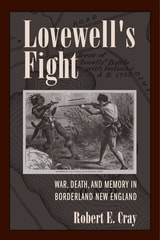
Lovewell's Fight
War, Death, and Memory in Borderland New EnglandRobert E. Cray
University of Massachusetts Press, 2014
In May 1725, during a three-year conflict between English colonists and the Eastern Abenaki Nation, a thirty-four-man expedition led by Captain John Lovewell set out to ambush their adversaries, acquire some scalp bounties, and hasten the end of the war. Instead, the Abenakis staged a surprise attack of their own at Pigwacket, Maine, that left more than a third of the New Englanders dead or severely wounded. Although Lovewell himself was slain in the fighting, he emerged a martyred hero, celebrated in popular memory for standing his ground against a superior enemy force.
In this book, Robert E. Cray revisits the clash known as “Lovewell's Fight” and uses it to illuminate the themes of war, death, and memory in early New England. He shows how a military operation plagued from the outset by poor decision-making, and further marred by less-than-heroic battlefield behavior, came to be remembered as early America's version of the Alamo. The government of Massachusetts bestowed payouts, pensions, and land on survivors and widows of the battle, while early chroniclers drafted a master narrative for later generations to emboss. William Henry Longfellow, Nathaniel Hawthorne, and Henry David Thoreau kept the story alive for later generations. Although some nineteenth-century New Englanders disapproved of Lovewell's notoriety as a scalp hunter, it did not prevent the dedication of a monument in his honor at the Fryeburg, Maine, battlesite in 1904.
Even as the actual story of “Lovewell's Fight” receded into obscurity—a bloody skirmish in a largely forgotten war—it remained part of New England lore, one of those rare military encounters in which defeat transcends an opponent's victory to assume the mantle of legend.
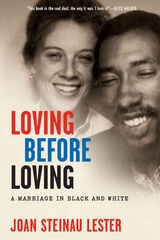
Loving Before Loving
A Marriage in Black and WhiteJoan Steinau Lester
University of Wisconsin Press, 2026
Braiding intellectual, personal, and political history, Lester tells the story of a writer and activist fighting for love and justice before, during, and after the Supreme Court’s 1967 decision striking down bans on interracial marriage in Loving v. Virginia. She describes her own shifts in consciousness, from an activist climbing police barricades by day and reading and writing late into the night to a woman navigating the coming-out process in midlife, before finding the publishing success she had dreamed of. Speaking candidly about every facet of her life, Lester illuminates her journey to fulfillment and healing.
Loving Black Boys
A Black Feminist Bible on Racism and Revolutionary MotheringTamura Lomax
Duke University Press, 2026
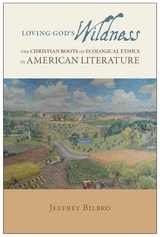
Loving God's Wildness
The Christian Roots of Ecological Ethics in American LiteratureJeffrey Bilbro
University of Alabama Press, 2015
Loving God’s Wildness rediscovers the environmental roots of America’s Puritan heritage. In tracing this history, Jeffrey Bilbro demonstrates how the dualistic Christianity that the Puritans brought to America led them to see the land as an empty wilderness that God would turn into a productive source of marketable commodities. Bilbro carefully explores the effect of this dichotomy in the nature writings of Henry David Thoreau, John Muir, Willa Cather, and Wendell Berry.
Thoreau, Muir, Cather, and Berry imaginatively developed the Puritan theological tradition to propose practical, physical means by which humans should live and worship within the natural temple of God’s creation. They reshaped Puritan dualism, each according to the particular needs of his or her own ecological and cultural contexts, into a theology that demands care for the entire created community. While differing in their approaches and respective ecological ethics, the four authors Bilbro examines all share the conviction that God remains active in creation and that humans ought to relinquish their selfish ends to participate in his wild ecology.
Loving God’s Wildness fills a critical gap in literary criticism and environmental studies by offering a sustained, detailed argument regarding how Christian theology has had a profound and enduring legacy in shaping the contours of the American ecological imagination. Literary critics, scholars of religion and environmental studies, and thoughtful Christians who are concerned about environmental issues will profit from this engaging new book.
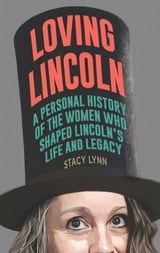
Loving Lincoln
A Personal History of the Women Who Shaped Lincoln's Life and LegacyStacy Lynn
Southern Illinois University Press, 2025
WINNER, 2026 Illinois State Historical Society Russell P. Strange Book of the Year Award!
Rediscovering Lincoln through the female gaze
Abraham Lincoln belongs to everybody. The women he interacted with helped forge the outstanding moral character of America's greatest president. This unique Abraham Lincoln biography features thirty historical and personal essays, and within them, the stories of more than ninety women, each with their own mini biographies in an appendix. Among them are Lincoln’s friends, clients, and extended family, as well as writers, artists, and—blurring the lines between history and memoir—author Stacy Lynn herself.
As a professional Lincoln scholar and editor, Lynn was often frustrated that male historians often overlooked Lincoln’s love for and friendship with women. Here, she posits a new paradigm—one that, instead of downplaying women, lifts up their interactions with Lincoln.
Lincoln understood the importance of the women in his life, and he put women’s wellbeing at the center of his personal, professional, and political ethos. He was loved by two strong pioneer mothers as well as sisters, friends, nieces, friends’ daughters, and his wife. He served women clients during his long legal career. As president, he met with women, dedicating time to hear their concerns despite the burdens of office. He replied to letters women wrote him. He believed in their capabilities and revolutionized the role of women in the workforce. After Lincoln’s death, women continued to shape his legacy. Mary Lincoln ensured his burial among friends, artist Vinnie Ream sculpted his statue in the US Capitol, and biographer Ida Tarbell provided a nuanced portrayal of his life. Harriet Monroe and Ruth Painter Randall further cemented his place in literature and history.
Lynn presents a fresh perspective on Lincoln, connecting his story to the stories of women and showcasing his kindness, sensitivity, and moral center. She explores how women shaped Lincoln’s inspirational legacy and pays homage to all the women who gave Lincoln to the world. Lynn’s unique blending of history, biography, and her own story reveals the ways in which an emotional connection to the historical figures one studies opens the door to richer human and historical understanding. By inviting readers to feel the past as well as read it, Lynn demonstrates that history matters most when it engages our minds and hearts.
Loving Mountains, Loving Men
Memoirs of a Gay AppalachianJeff Mann
Ohio University Press, 2005
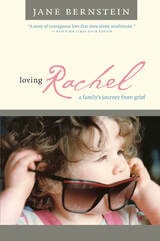
Loving Rachel
A Family's Journey from GriefJane Bernstein
University of Illinois Press, 2007
In 1983, Jane Bernstein had everything she ever wanted: a healthy four-year-old daughter, Charlotte; a happy marriage; a highly praised first novel; and a brand new baby, Rachel. But by the time Rachel was six weeks old,
a neuro-ophthalmologist told Jane and her husband that their baby was blind. Although there was some hope that Rachel might gain partial vision as she grew, her condition was one that often resulted in seizure disorders and intellectual impairment. So began a series of medical and emotional setbacks that were to plague Rachel and her parents and strain their marriage to the breaking point. Spanning the first four years of Rachel’s life, Loving Rachel is a heartbreaking chronicle of a marriage and a compelling story of parental love told with searing honesty and surprising humor.
Loving Sports When They Don't Love You Back
Dilemmas of the Modern FanBy Jessica Luther and Kavitha A. Davidson
University of Texas Press, 2020
Triumphant wins, gut-wrenching losses, last-second shots, underdogs, competition, and loyalty—it’s fun to be a fan. But when a football player takes a hit to the head after yet another study has warned of the dangers of CTE, or when a team whose mascot was born in an era of racism and bigotry takes the field, or when a relief pitcher accused of domestic violence saves the game, how is one to cheer? Welcome to the club for sports fans who care too much.
In Loving Sports When They Don’t Love You Back, acclaimed sports writers Jessica Luther and Kavitha A. Davidson tackle the most pressing issues in sports, why they matter, and how we can do better. For the authors, “sticking to sports” is not an option—not when our taxes are paying for the stadiums, and college athletes aren’t getting paid at all. But simply quitting a favorite team won’t change corrupt and deplorable practices, and the root causes of many of these problems are endemic in our wider society. An essential read for modern fans, Loving Sports When They Don’t Love You Back challenges the status quo and explores how we might begin to reconcile our conscience with our fandom.
Low-Wage America
How Employers Are Reshaping Opportunity in the WorkplaceEileen Appelbaum
Russell Sage Foundation, 2003
Lowering the Bar
Lawyer Jokes and Legal CultureMarc Galanter
University of Wisconsin Press, 2006
Lowrider Space
Aesthetics and Politics of Mexican American Custom CarsBy Ben Chappell
University of Texas Press, 2012
Loyal Subjects
Bonds of Nation, Race, and Allegiance in Nineteenth-Century AmericaDuquette, Elizabeth
Rutgers University Press, 2010
Loyal Subjects considers how the Civil War complicated the cultural value of emotion, especially the ideal of sympathy. Through an analysis of literary works written during and after the conflict-from Nathaniel Hawthorne's "Chiefly About War Matters" through Henry James's The Bostonians and Charles Chestnutt's "The Wife of His Youth," to the Pledge of Allegiance and W.E.B. Du Bois's John Brown, among many others-Duquette reveals that although American literary criticism has tended to dismiss the Civil War's impact, postwar literature was profoundly shaped by loyalty.
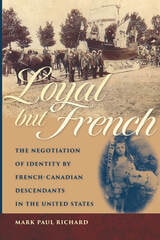
Loyal but French
The Negotiation of Identity by French-Canadian Descendants in the United StatesMark Paul Richard
Michigan State University Press, 2008
Richard’s work challenges prevailing notions of "assimilation." As he shows, “acculturation” better describes the roundabout process by which some ethnic groups join their host society. He argues that, for more than a century, the French- Canadians in Lewiston, Maine, pursued the twin objectives of ethnic preservation and acculturation. These were not separate goals but rather intertwined processes. Underscored with statistics compiled by the author, Loyal but French portrays the French-Canadian history of Lewiston, from the 1880s through the 1990s, in this light.

Loyalty and Liberty
American Countersubversion from World War 1 to the McCarthy EraAlex Goodall
University of Illinois Press, 2013
Identifying varied interest groups such as business tycoons, Christian denominations, and Southern Democrats, Goodall demonstrates how countersubversive politics was far from unified: groups often pursued clashing aims while struggling to balance the competing pulls of loyalty to the nation and liberty of thought, speech, and action. Meanwhile, the federal government pursued its own course, which alternately converged with and diverged from the paths followed by private organizations. By the end of World War II, alliances on the left and right had largely consolidated into the form they would keep during the Cold War. Anticommunists on the right worked to rein in the supposedly dictatorial ambitions of the Roosevelt administration, while New Deal liberals divided into several camps: the Popular Front, civil liberties activists, and embryonic Cold Warriors who struggled with how to respond to communist espionage in Washington and communist influence in politics more broadly.
Rigorous in its scholarship yet accessible to a wide audience, Goodall's masterful study shows how opposition to radicalism became a defining ideological question of American life.
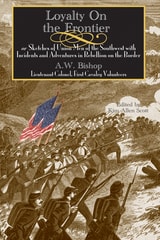
Loyalty on the Frontier
Sketches of Union Men of the South-West with Incidents and Adventures in Rebellion on the BorderA.W. Bishop
University of Arkansas Press, 2003
First published in 1863, this book has the immediacy, passion, and intimacy of its wartime context. It tells the remarkable story of Albert Webb Bishop, a New York lawyer turned Union soldier, who in 1862 accepted a commission as lieutenant colonel in a regiment of Ozark mountaineers. While maintaining Union control of northwest Arkansas, he collected stories of the social coercion, political secession, and brutal terrorism that scarred the region.
His larger goal, however, was to popularize and inspire sympathy for the South’s Unionists and to chronicle the triumph of Unionism in a Confederate state. His account points to the complex and divisive nature of Confederate society and in doing so provides a perspective that has long been absent from discussions of the Civil War
Lucius Fairchild
Civil War HeroStuart Stotts
Wisconsin Historical Society Press, 2010
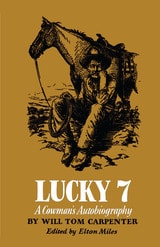
Lucky 7
A Cowman's AutobiographyBy Will Tom Carpenter
University of Texas Press, 1957
"No. 7"—as Carpenter, the youngest of seven children, called himself—was born in Missouri in 1854 and moved west with his family, first to Kansas, then to the settlements near Pikes Peak, and finally, in 1872, to Texas with his elder brother. From the time he made his first cattle drive, he wanted no other life but that of herding longhorns across the free and flat grasslands of the West. His schooling was the trail, the campfire, the saddle. In 1900, after a full and active life, he retired to his own ranch west of the Pecos. As the years passed, he sadly watched the fences go up and the free range disappear. Thus this book came to be written from the longing memory of a time-stranded cowman. He tells his story in the hard-punching, gritty language, direct humor, and attachment to bald fact and frank opinion that characterize the true Westerner.
Elton Miles has provided an introduction that fills in the details of Carpenter's life and completes a "vivid picture of the genuine old-time cowman," as Southwest Review observed.

Lucy Stone
Speaking Out for EqualityKerr, Andrea M
Rutgers University Press, 1992
Lucy Stone was a Massachusetts newspaper editor, abolitionist, and charismatic orator for the women's rights movement in the last half of the nineteenth century. She was deeply involved in almost every reform issue of her time. Charles Sumner, Frederick Douglass, William Lloyd Garrison, Julia Ward Howe, Horace Greeley, and Louisa May Alcott counted themselves among her friends. Through her public speaking and her newspaper, the Woman's Journal, Stone became the most widely admired woman's rights spokeswoman of her era. In the nineteenth century, Lucy Stone was a household name.
Kerr begins with Stone's early roots in a poor family in western Massachusetts. She eventually graduated from Oberlin College and then became a full-time public speaker for an anti-slavery society and for women's rights. Despite Stone's strident anti-marriage ideology, she eventually wed Henry Brown Blackwell, and had her first child at the age of thirty-nine.
Although Kerr tells us about Stone's public accomplishments, she emphasizes Stone's personal struggle for autonomy. "Lucy Stone (Only)" was Stone's trademark signature following her marriage. Her refusal to surrender her birth name was one example of her determination to retain her individuality in an era where a woman's right to a separate identity ended with marriage.
Of equal importance is Kerr's discussion of Stone's relationship with Susan B. Anthony and Elizabeth Cady Stanton, as well as her revisionist treatment of the schism which eventually divided Stone from Stanton and Anthony. Stone urged legislators not to ignore the need for women's suffrage as they rushed to enfranchise black males. Stanton and Anthony dwelt only on the need for women's suffrage, at the expense of black suffrage. Women's historians, the general reader, and historians of the family will appreciate the story of Stone's attempt to balance the conflicting demands of career and family.
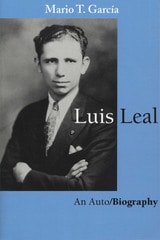
Luis Leal
An Auto/BiographyBy Mario T. García
University of Texas Press, 2000
Professor Luis Leal is one of the most outstanding scholars of Mexican, Latin American, and Chicano literatures and the dean of Mexican American intellectuals in the United States. He was one of the first senior scholars to recognize the viability and importance of Chicano literature, and, through his perceptive literary criticism, helped to legitimize it as a worthy field of study. His contributions to humanistic learning have brought him many honors, including Mexico's Aquila Azteca and the United States' National Humanities Medal.
In this testimonio or oral history, Luis Leal reflects upon his early life in Mexico, his intellectual formation at Northwestern University and the University of Chicago, and his work and publications as a scholar at the Universities of Illinois and California, Santa Barbara. Through insightful questions, Mario García draws out the connections between literature and history that have been a primary focus of Leal's work. He also elicits Leal's assessment of many of the prominent writers he has known and studied, including Mariano Azuela, William Faulkner, Octavio Paz, Carlos Fuentes, Juan Rulfo, Gabriel García Márquez, Jorge Luis Borges, Tomás Rivera, Rolando Hinojosa, Rudolfo Anaya, Elena Poniatowska, Sandra Cisneros, Richard Rodríguez, and Ana Castillo.
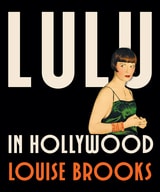
Lulu In Hollywood
Expanded EditionLouise Brooks
University of Minnesota Press, 2000
Essential writings by this icon of the silent era—rereleased in print and now available as an e-book 100 years after Louise Brooks arrived in Hollywood
Lulu in Hollywood is an intimate collection of eight autobiographical essays by Louise Brooks, silent film darling and icon of the flapper era. Ranging from her childhood in Kansas and her early days as a Denishawn and Ziegfeld Follies dancer to her friendships with Martha Graham, Charles Chaplin, W. C. Fields, Humphrey Bogart, William Paley, G. W. Pabst, and others, Brooks’s writing offers a rare glimpse into her extraordinary life. Including her revelatory “Why I Will Never Write My Memoirs,” Lulu in Hollywood also features Kenneth Tynan’s 1979 essay “The Girl in the Black Helmet,” which revived interest in Brooks’s work and was the best discussion of her film work to appear in her lifetime.
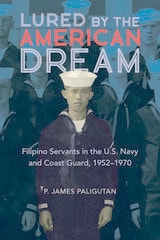
Lured by the American Dream
Filipino Servants in the U.S. Navy and Coast Guard, 1952-1970P. James Paligutan
University of Illinois Press, 2022
Insightful and dramatic, Lured by the American Dream is the untold story of how Filipino servicepersons overcame tradition and hierarchy in their quest for dignity.
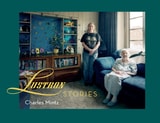
Lustron Stories
Charles Mintz
The Ohio State University Press, 2016
A remarkable cross section of individuals and families live in these modest (~1100 sq. ft.) homes. While certainly diverse in age and place in life, the homeowners are still firmly working class. Everyone who lives in a Lustron home has an opinion about it. The material is miserable to cut or drill into. Repairs are more about metalworking and enamel finishing than carpentry or house painting. And magnets tend to be a popular solution for hanging objects inside and outside the steel walls.
Four years ago, Charles Mintz set out to photograph the people living in these homes. The residents, owners, or both were photographed outside and occasionally inside. Mintz used a large format wooden camera and available light. This book features 65 of the resulting photographs and essays from Shannon Thomas Perich, Curator of the Photographic History Collection at Smithsonian’s National Museum of American History, and Jeffrey Head, author and architecture critic.
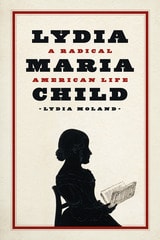
Lydia Maria Child
A Radical American LifeLydia Moland
University of Chicago Press, 2022
By 1830, Lydia Maria Child had established herself as something almost unheard of in the American nineteenth century: a beloved and self-sufficient female author. Best known today for the immortal poem “Over the River and through the Wood,” Child had become famous at an early age for spunky self-help books and charming children’s stories. But in 1833, Child shocked her readers by publishing a scathing book-length argument against slavery in the United States—a book so radical in its commitment to abolition that friends abandoned her, patrons ostracized her, and her book sales plummeted. Yet Child soon drew untold numbers to the abolitionist cause, becoming one of the foremost authors and activists of her generation.
Lydia Maria Child: A Radical American Life tells the story of what brought Child to this moment and the extraordinary life she lived in response. Through Child’s example, philosopher Lydia Moland asks questions as pressing and personal in our time as they were in Child’s: What does it mean to change your life when the moral future of your country is at stake? When confronted by sanctioned evil and systematic injustice, how should a citizen live? Child’s lifetime of bravery, conviction, humility, and determination provides a wealth of spirited guidance for political engagement today.
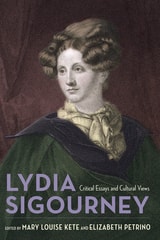
Lydia Sigourney
Critical Essays and Cultural ViewsMary Louise Kete
University of Massachusetts Press, 2018
During her lifetime, Lydia Sigourney was acclaimed as nineteenth-century America's most popular woman poet and published widely as a historian, travel writer, essayist, and educator. While serious critical attention to her work languished following her death and into the twentieth century, a growing number of critics and writers have reexamined Sigourney and her large body of writing and have given her a central place in the “new canon.”
This first collection of original essays devoted to the poet's work puts many of the best scholars on Sigourney together in one place and in conversation with one another. The volume includes critical essays examining her literary texts as well as essays that unpack Sigourney's participation in the cultural movements of her day. Holding powerful opinions about the role of women in society, Sigourney was not afraid to advocate against government policies that, in her view, undermined the promise of America, even as she was held up as a paragon of American womanhood and middle-class rectitude. The resulting portrait promises to engage readers who wish to know more about Sigourney's writing, her career, and the causes that inspired her.
Along with the volume editors, contributors include Ann Beebe, Paula Bernat Bennett, Janet Dean, Sean Epstein-Corbin, Annie Finch, Gary Kelly, Paul Lauter, Amy J. Lueck, Ricardo Miguel-Alfonso, Jennifer Putzi, Angela Sorby, Joan Wry, and Sandra Zagarell.
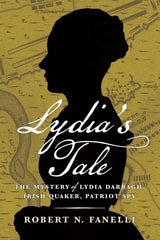
Lydia's Tale
The Mystery of Lydia Darragh, Irish Quaker, Patriot SpyRobert N. Fanelli
Westholme Publishing, 2025
Lydia’s Tale:The Mystery of Lydia Darragh, Irish Quaker, Patriot Spy by Robert N. Fanelli uncovers a myriad of previously unknown records, knitting together for the first time the life and experiences of this remarkable heroine of the American Revolution who lived in the heart of Philadelphia. Behind her story we find an assertive woman who took an active hand in the affairs of her family and her community. Drawing on genealogical sources, legal documents, and other correspondence, the author reconstructs Lydia Darragh’s early life in Dublin, her livelihood in Pennsylvania, and how the Revolution shaped her and her children’s lives. Exploring the context of Lydia’s tale sheds light on the activities of women in Revolutionary Philadelphia, reveals the complex issues faced by pacifist Quakers in a time of war, and brings to light the contributions of Irish immigrants in securing America’s freedom.
The author’s careful research reveals little known details and corrects historians’ common misapprehensions about the Revolutionary period. Along the way, we meet often overlooked figures, including diarist Christopher Marshall and his family, the irascible Quaker recluse Bathsheba Bowers, and Blair McClenachan, the wealthy Patriot financier who also served his adopted country as a common soldier. Lydia Darragh is frequently included among that small group of women cited as Revolutionary heroines. This detailed microhistory demonstrates how legend can inform the study of history, describing how one woman’s personal reminiscence morphed into a piece of American mythology, now recovered in the historical context it deserves.
Lying in the Middle
Musical Theater and Belief at the Heart of AmericaJake Johnson
University of Illinois Press, 2021
Vibrant and strikingly original, Lying in the Middle discovers some of the most potent musical theater taking place in the hoping, beating hearts of Americans.
Lying up a Nation
Race and Black MusicRonald M. Radano
University of Chicago Press, 2003
Lynching Beyond Dixie
American Mob Violence Outside the SouthEdited by Michael J. Pfeifer
University of Illinois Press, 2013
Lynching and Leisure
Race and the Transformation of Mob Violence in TexasTerry Anne Scott
University of Arkansas Press, 2022
Winner, 2022 Ottis Lock Endowment “Best Book” Award from the East Texas Historical Association
In Lynching and Leisure, Terry Anne Scott examines how white Texans transformed lynching from a largely clandestine strategy of extralegal punishment into a form of racialized recreation in which crowd involvement was integral to the mode and methods of the violence. Scott powerfully documents how lynchings came to function not only as tools for debasing the status of Black people but also as highly anticipated occasions for entertainment, making memories with friends and neighbors, and reifying whiteness. In focusing on the sense of pleasure and normality that prevailed among the white spectatorship, this comprehensive study of Texas lynchings sheds new light on the practice understood as one of the chief strategies of racial domination in the nineteenth- and twentieth-century South.
Lynching in Colorado, 1859-1919
Stephen J. Leonard
University Press of Colorado, 2022
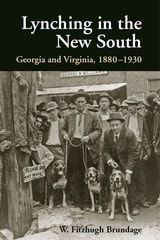
Lynching in the New South
Georgia and Virginia, 1880-1930W. Fitzhugh Brundage
University of Illinois Press, 1993
A groundbreaking study, Lynching in the New South is a classic portrait of the tradition of violence that poisoned American life.
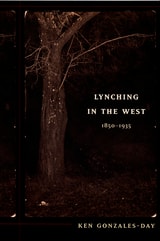
Lynching in the West
1850-1935Ken Gonzales-Day
Duke University Press, 2006
An artist and writer, Gonzales-Day began this study by photographing lynching sites in order to document the absences and empty spaces that are emblematic of the forgotten history of lynching in the West. Drawing on newspaper articles, periodicals, court records, historical photographs, and souvenir postcards, he attempted to reconstruct the circumstances surrounding the lynchings that had occurred in the spaces he was photographing. The result is an unprecedented textual and visual record of a largely unacknowledged manifestation of racial violence in the United States. Including sixteen color illustrations, Lynching in the West juxtaposes Gonzales-Day’s evocative contemporary photographs of lynching sites with dozens of historical images.
Gonzales-Day examines California’s history of lynching in relation to the spectrum of extra-legal vigilantism common during the nineteenth century—from vigilante committees to lynch mobs—and in relation to race-based theories of criminality. He explores the role of visual culture as well, reflecting on lynching as spectacle and the development of lynching photography. Seeking to explain why the history of lynching in the West has been obscured until now, Gonzales-Day points to popular misconceptions of frontier justice as race-neutral and to the role of the anti-lynching movement in shaping the historical record of lynching in the United States.
Lyric Interventions
Feminism, Experimental Poetry, DiscourseLinda A. Kinnahan
University of Iowa Press, 1998
Lyric Interventions explores linguistically innovative poetry by contemporary women in North America and Britain whose experiments give rise to fresh feminist readings of the lyric subject. The works discussed by Linda Kinnahan explore the lyric subject in relation to the social: an “I” as a product of social discourse and as a conduit for change.
Contributing to discussions of language-oriented poetries through its focus on women writers and feminist perspectives, this study of lyric experimentation brings attention to the cultural contexts of nation, gender, and race as they significantly shift the terms by which the “experimental” is produced, defined, and understood.
This study focuses upon lyric intervention in distinct but related spheres as they link public and ideological norms of identity. Firstly, lyric innovations with visual and spatial realms of cultural practice and meaning, particularly as they naturalize ideologies of gender and race in North America and the post-colonial legacies of the Caribbean, are investigated in the works of Barbara Guest, Kathleen Fraser, Erica Hunt, and M. Nourbese Philip. Secondly, experimental engagements with nationalist rhetorics of identity, marking the works of Carol Ann Duffy, Denise Riley, Wendy Mulford, and Geraldine Monk, are explored in relation to contemporary evocations of “self” in Britain. And thirdly, in discussions of all of the poets, but particularly accenuated in regard to Guest, Fraser, Riley, Mulford, and Monk, formal experimentation with the lyric “I” is considered through gendered encounters with critical and avant-garde discourses of poetics.
This fresh, energetic study will be of great interest to literary critics and womens studies scholars, as well as poets on both sides of the Atlantic.
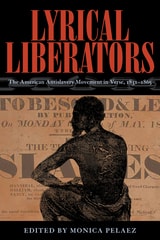
Lyrical Liberators
The American Antislavery Movement in Verse, 1831–1865Monica Pelaez
Ohio University Press, 2018
Before Black Lives Matter and Hamilton, there were abolitionist poets, who put pen to paper during an era when speaking out against slavery could mean risking your life. Indeed, William Lloyd Garrison was dragged through the streets by a Boston mob before a planned lecture, and publisher Elijah P. Lovejoy was fatally shot while defending his press from rioters. Since poetry formed a part of the cultural, political, and emotional lives of readers, it held remarkable persuasive power. Yet antislavery poems have been less studied than the activist editorials and novels of the time.
In Lyrical Liberators, Monica Pelaez draws on unprecedented archival research to recover these poems from the periodicals—Garrison’s Liberator, Frederick Douglass’s North Star, and six others—in which they originally appeared. The poems are arranged by theme over thirteen chapters, a number that represents the amendment that finally abolished slavery in 1865. The book collects and annotates works by critically acclaimed writers, commercially successful scribes, and minority voices including those of African Americans and women.
There is no other book like this. Sweeping in scope and passionate in its execution, Lyrical Liberators is indispensable for scholars and teachers of American literature and history, and stands as a testimony to the power of a free press in the face of injustice.
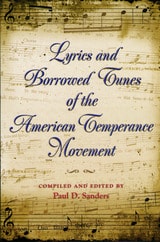
Lyrics and Borrowed Tunes of the American Temperance Movement
Edited & Compiled by Paul D. Sanders
University of Missouri Press, 2006
Cold water is the drink for me / Of all the drinks the best, sir; / Your grog, of whate’er name it be, / I dare not for to taste, sir.
Such a lyric, sung to the tune of “Yankee Doodle,” was typical ammunition in the temperance movement’s battle against alcohol. By the 1830s, Americans drank an average of 9.5 gallons of hard liquor each year. From the 1840s until the beginning of Prohibition, well over one hundred temperance songbooks were published in which inspirational lyrics were set to mostly borrowed tunes in the hope of persuading citizens to put down the bottle.