Results by title
22279 books match the query 'Social Science' and 714 start with l
Lulu Linear Punctated
Essays in Honor of George Irving QuimbyEdited by Robert C. Dunnell, Donald K. Grayson, and Walter N. Koelz
University of Michigan Press, 1983
Lumbar Breakdown Caused by Erect Posture in Man
Frederick P. Thieme
University of Michigan Press, 1950
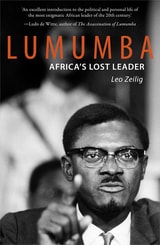
Lumumba
Africa’s Lost LeaderLeo Zeilig
Haus Publishing, 2008
This second edition of the only full biography of Lumumba presents his life and quest for the Congo’s liberation, which influenced how the Cold War would be fought in Africa and the nature of the independence granted to huge swaths of the globe after 1945. For those fighting for freedom, Lumumba became a figure of resistance against the imperial colonizers of the world. Including new archival material and information gained from British intelligence, this new edition is a valuable introduction to a pivotal figure of the twentieth century.
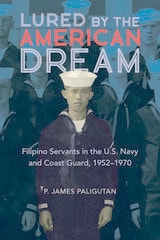
Lured by the American Dream
Filipino Servants in the U.S. Navy and Coast Guard, 1952-1970P. James Paligutan
University of Illinois Press, 2022
Insightful and dramatic, Lured by the American Dream is the untold story of how Filipino servicepersons overcame tradition and hierarchy in their quest for dignity.
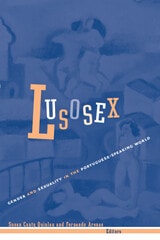
Lusosex
Gender And Sexuality In The Portuguese-Speaking WorldSusan Canty Quinlan
University of Minnesota Press, 2002
The first book to examine these essential issues in a Lusophone context.
Some of the most compelling theoretical debates in the humanities today center on representations of sexuality. This volume is the first to focus on the topic-in particular, the connections between nationhood, sex, and gender-in the lusophone, or Portuguese-speaking, world. Written by prominent scholars in Brazilian, Portuguese, and Lusophone African literary and cultural studies, the essays range across multiple discourses and cultural expressions, historical periods and theoretical approaches to offer a uniquely comprehensive perspective on the issues of sex and sexuality in the literature and culture of the Portuguese-speaking world that extends from Portugal to Brazil to Angola, Cape Verde, and Mozambique.
Through the critical lenses of gay and lesbian studies, queer theory, postcolonial studies, feminist theory, and postmodern theory, the authors consider the work of such influential literary figures as Clarice Lispector and Silviano Santiago. An important aspect of the volume is the publication of a newly discovered-and explicitly homoerotic-poem by Fernando Pessoa, published here for the first time in the original Portuguese and in English translation. Chapters take up questions of queer performativity and activism, female subjectivity and erotic desire, the sexual customs of indigenous versus European Brazilians, and the impact of popular music (as represented by Caetano Veloso and others) on interpretations of gender and sexuality. Challenging static notions of sexualities within the Portuguese-speaking world, these essays expand our understanding of the multiplicity of differences and marginalized subjectivities that fall under the intersections of sexuality, gender, and race.Contributors: Severino João Albuquerque, U of Wisconsin; Jossianna Arroyo, U of Michigan; César Braga-Pinto, Rutgers; Ana Paula Ferreira, U of California, Irvine; John Gledson, U of Liverpool; Russell G. Hamilton, Vanderbilt; André Torres Lepecki; Mário César Lugarinho, Universidade Federal Fluminense, Brazil; Phyllis Peres, U of Maryland; Ronald W. Sousa, U of Illinois; João Silvério Trevisan; Richard Zenith.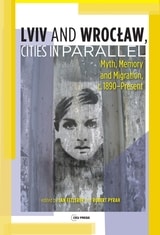
Lviv – Wroclaw, Cities in Parallel?
Myth, Memory and Migration, c. 1890-PresentJan Fellerer
Central European University Press, 2020
After World War II, Europe witnessed the massive redrawing of national borders and the efforts to make the population fit those new borders. As a consequence of these forced changes, both Lviv and Wrocław went through cataclysmic changes in population and culture. Assertively Polish prewar Lwów became Soviet Lvov, and then, after 1991, it became assertively Ukrainian Lviv. Breslau, the third largest city in Germany before 1945, was in turn "recovered" by communist Poland as Wrocław. Practically the entire population of Breslau was replaced, and Lwów's demography too was dramatically restructured: many Polish inhabitants migrated to Wrocław and most Jews perished or went into exile. The forced migration of these groups incorporated new myths and the construction of official memory projects.
The chapters in this edited book compare the two cities by focusing on lived experiences and "bottom-up" historical processes. Their sources and methods are those of micro-history and include oral testimonies, memoirs, direct observation and questionnaires, examples of popular culture, and media pieces. The essays explore many manifestations of the two sides of the same coin—loss on the one hand, gain on the other—in two cities that, as a result of the political reality of the time, are complementary.
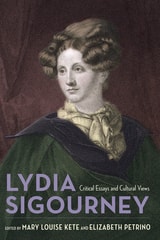
Lydia Sigourney
Critical Essays and Cultural ViewsMary Louise Kete
University of Massachusetts Press, 2018
During her lifetime, Lydia Sigourney was acclaimed as nineteenth-century America's most popular woman poet and published widely as a historian, travel writer, essayist, and educator. While serious critical attention to her work languished following her death and into the twentieth century, a growing number of critics and writers have reexamined Sigourney and her large body of writing and have given her a central place in the “new canon.”
This first collection of original essays devoted to the poet's work puts many of the best scholars on Sigourney together in one place and in conversation with one another. The volume includes critical essays examining her literary texts as well as essays that unpack Sigourney's participation in the cultural movements of her day. Holding powerful opinions about the role of women in society, Sigourney was not afraid to advocate against government policies that, in her view, undermined the promise of America, even as she was held up as a paragon of American womanhood and middle-class rectitude. The resulting portrait promises to engage readers who wish to know more about Sigourney's writing, her career, and the causes that inspired her.
Along with the volume editors, contributors include Ann Beebe, Paula Bernat Bennett, Janet Dean, Sean Epstein-Corbin, Annie Finch, Gary Kelly, Paul Lauter, Amy J. Lueck, Ricardo Miguel-Alfonso, Jennifer Putzi, Angela Sorby, Joan Wry, and Sandra Zagarell.
Lying On The Postcolonial Couch
The Idea Of IndifferenceRukmini Bhaya Nair
University of Minnesota Press, 2002
Exposes the complicity of language and its uses in the colonial project
A revealing look into the long afterlife of colonial conquest, Lying on the Postcolonial Couch offers an original, overarching concept that informs—and helps to explain—the workings of postcoloniality. This concept, "indifference," is a play on the key critical term "difference." Indifference is a cognitive stance invented during the colonial period for the purpose of organizing the complex domain of the Indian subcontinent, one that created its own brand of poetics. Considering postcoloniality as a symptomatic condition, this book proposes a cure involving a return to buried memories of colonial trauma before the phenomenon itself succumbs to the absolute indifference of the slowly gathering amnesia of the new millennium.
Rukmini Bhaya Nair traces a paper trail beginning in 1757 with the Battle of Plassey, winding through the contentious Mutiny of 1857, and ending with Salman Rushdie’s Satanic Verses predicament. Along this trail, she uncovers hidden residues of feeling, from guilt and mistrust to wonder and pleasure, and analyzes the linguistic pillars that hold up the institution of bureaucratic indifference that she exposes.
Lynching Beyond Dixie
American Mob Violence Outside the SouthEdited by Michael J. Pfeifer
University of Illinois Press, 2013
Lynching and Leisure
Race and the Transformation of Mob Violence in TexasTerry Anne Scott
University of Arkansas Press, 2022
Winner, 2022 Ottis Lock Endowment “Best Book” Award from the East Texas Historical Association
In Lynching and Leisure, Terry Anne Scott examines how white Texans transformed lynching from a largely clandestine strategy of extralegal punishment into a form of racialized recreation in which crowd involvement was integral to the mode and methods of the violence. Scott powerfully documents how lynchings came to function not only as tools for debasing the status of Black people but also as highly anticipated occasions for entertainment, making memories with friends and neighbors, and reifying whiteness. In focusing on the sense of pleasure and normality that prevailed among the white spectatorship, this comprehensive study of Texas lynchings sheds new light on the practice understood as one of the chief strategies of racial domination in the nineteenth- and twentieth-century South.
Lynching in Colorado, 1859-1919
Stephen J. Leonard
University Press of Colorado, 2022
Lynching in the West
1850-1935Ken Gonzales-Day
Duke University Press, 2006
An artist and writer, Gonzales-Day began this study by photographing lynching sites in order to document the absences and empty spaces that are emblematic of the forgotten history of lynching in the West. Drawing on newspaper articles, periodicals, court records, historical photographs, and souvenir postcards, he attempted to reconstruct the circumstances surrounding the lynchings that had occurred in the spaces he was photographing. The result is an unprecedented textual and visual record of a largely unacknowledged manifestation of racial violence in the United States. Including sixteen color illustrations, Lynching in the West juxtaposes Gonzales-Day’s evocative contemporary photographs of lynching sites with dozens of historical images.
Gonzales-Day examines California’s history of lynching in relation to the spectrum of extra-legal vigilantism common during the nineteenth century—from vigilante committees to lynch mobs—and in relation to race-based theories of criminality. He explores the role of visual culture as well, reflecting on lynching as spectacle and the development of lynching photography. Seeking to explain why the history of lynching in the West has been obscured until now, Gonzales-Day points to popular misconceptions of frontier justice as race-neutral and to the role of the anti-lynching movement in shaping the historical record of lynching in the United States.
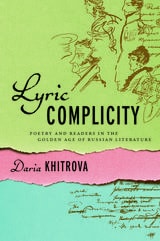
Lyric Complicity
Poetry and Readers in the Golden Age of Russian LiteratureDaria Khitrova
University of Wisconsin Press, 2019
Lyric Complicity helps modern readers recover Russian poetry’s former uses and functions—life situations that moved people to quote or perform a specific passage from a poem or a forgotten occasion that created unforgettable verse.
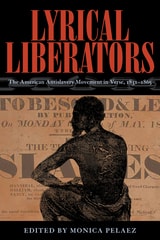
Lyrical Liberators
The American Antislavery Movement in Verse, 1831–1865Monica Pelaez
Ohio University Press, 2018
Before Black Lives Matter and Hamilton, there were abolitionist poets, who put pen to paper during an era when speaking out against slavery could mean risking your life. Indeed, William Lloyd Garrison was dragged through the streets by a Boston mob before a planned lecture, and publisher Elijah P. Lovejoy was fatally shot while defending his press from rioters. Since poetry formed a part of the cultural, political, and emotional lives of readers, it held remarkable persuasive power. Yet antislavery poems have been less studied than the activist editorials and novels of the time.
In Lyrical Liberators, Monica Pelaez draws on unprecedented archival research to recover these poems from the periodicals—Garrison’s Liberator, Frederick Douglass’s North Star, and six others—in which they originally appeared. The poems are arranged by theme over thirteen chapters, a number that represents the amendment that finally abolished slavery in 1865. The book collects and annotates works by critically acclaimed writers, commercially successful scribes, and minority voices including those of African Americans and women.
There is no other book like this. Sweeping in scope and passionate in its execution, Lyrical Liberators is indispensable for scholars and teachers of American literature and history, and stands as a testimony to the power of a free press in the face of injustice.