Results by title
28167 books match the query 'History' and 932 start with l
Locomotive to Aeromotive
Octave Chanute and the Transportation RevolutionSimine Short. Foreword by Tom D. Crouch
University of Illinois Press, 2014
Aviation researcher and historian Simine Short brings to light in colorful detail many previously overlooked facets of Chanute's professional and personal life. In the late nineteenth century, few considered engineering as a profession on par with law or medicine, but Chanute devoted much time and energy to the newly established professional societies that were created to set standards and serve the needs of civil engineers. Though best known for his aviation work, he became a key figure in the opening of the American continent by laying railroad tracks and building bridges, experiences that later gave him the engineering knowledge to build the first stable aircraft structure. Chanute also introduced a procedure to treat wooden railroad ties with an antiseptic that increased the wood’s lifespan in the tracks. Establishing the first commercial plants, he convinced railroad men that it was commercially feasible to make money by spending money on treating ties to conserve natural resources. He next introduced the date nail to help track the age and longevity of railroad ties.
A versatile engineer, Chanute was known as a kind and generous colleague during his career. Using correspondence and other materials not previously available to scholars and biographers, Short covers Chanute's formative years in antebellum America as well as his experiences traveling from New Orleans to New York, his apprenticeship on the Hudson River Railroad, and his early engineering successes. His multiple contributions to railway expansion, bridge building, and wood preservation established his reputation as one of the nation's most successful and distinguished civil engineers. Instead of retiring, he utilized his experiences and knowledge as a bridge builder in the development of motorless flight. Through the reflections of other engineers, scientists, and pioneers in various fields who knew him, Short characterizes Chanute as a man who believed in fostering and supporting people who were willing to learn. This well-researched biography cements Chanute's place as a preeminent engineer and mentor in the history of transportation in the United States and the development of the airplane.
Lodge of the Double-Headed Eagle
Two Centuries of Scottish Rite Freemasonry in America's Southern JurisdictionFOX WILLIAM
University of Arkansas Press, 1997
Logic and Automata
History and PerspectivesEdited by Jörg Flum, Erich Grädel, and Thomas Wilke
Amsterdam University Press, 2008

Logic and Sin in the Writings of Ludwig Wittgenstein
Philip R. Shields
University of Chicago Press, 1992
"Shields argues that the appearance throughout Wittgenstein's writings of such concepts as ritual, limit, transgression, a change of will, pride, temptation, and judgment implies a relation between religion and the logical aspects of Wittgenstein's philosophy."—Choice
"Of the many recent books about Wittgenstein, Logic and Sin is one of the very few that are well worth having"—Fergus Kerr, Modern Theology
"What Shields has uncovered in Wittgenstein's religious sensibility is something genuine and profound. . . . Shields has not just written an important book on Wittgenstein but an enlightening work that invites further reflection."—Eric O. Springsted, Cross Currents
Logic and the Art of Memory
The Quest for a Universal LanguagePaolo Rossi
University of Chicago Press, 2001
Based on comprehensive analyses of original texts, Rossi traces the development of this idea from late medieval thinkers such as Ramon Lull through Bruno, Bacon, Descartes, and finally Leibniz in the seventeenth century. The search for a symbolic mode of communication that would be intelligible to everyone was not a mere vestige of magical thinking and occult sciences, but a fundamental component of Renaissance and Enlightenment thought. Seen from this perspective, modern science and combinatorial logic represent not a break from the past but rather its full maturity.
Available for the first time in English, this book (originally titled Clavis Universalis) remains one of the most important contributions to the history of ideas ever written. In addition to his eagerly anticipated translation, Steven Clucas offers a substantial introduction that places this book in the context of other recent works on this fascinating subject. A rich history and valuable sourcebook, Logic and the Art of Memory documents an essential chapter in the development of human reason.
Logics of Empowerment
Development, Gender, and Governance in Neoliberal IndiaAradhana Sharma
University of Minnesota Press, 2008
A critical look at the globally dominant development strategy of “empowerment”
Celebratory news features about India’s thriving middle class tell only part of the story of the country’s recent economic rise, frequently glossing over the 300 million Indians who live on the margins and struggle to survive under economic liberalization. How do those cast out of their country’s successes perceive and respond to their position and mobilize against disempowerment?
In Logics of Empowerment, Aradhana Sharma takes up these questions, focusing on the work of an innovative women’s program called Mahila Samakhya that is part governmental and part nongovernmental and strives to empower those rural Indian women who have been pushed aside. She details the awkward ideological articulations and paradoxical outcomes of this unique activist-cum-government organizational structure and usage of empowerment. Bringing much-needed specificity to the study of neoliberalism, Logics of Empowerment fosters a deeper understanding of development and politics in contemporary India.
Logics of History
Social Theory and Social TransformationWilliam H. Sewell Jr.
University of Chicago Press, 2005
Renowned for his work at the crossroads of history, sociology, political science, and anthropology, Sewell argues that only by combining a more sophisticated understanding of historical time with a concern for larger theoretical questions can a satisfying social theory emerge. In Logics of History, he reveals the shape such an engagement could take, some of the topics it could illuminate, and how it might affect both sides of the disciplinary divide.
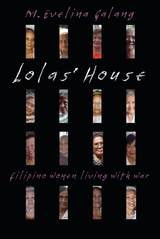
Lolas' House
Filipino Women Living with WarM. Evelina Galang
Northwestern University Press, 2017
During World War II more than one thousand Filipinas were kidnapped by the Imperial Japanese Army. Lolas’ House tells the stories of sixteen surviving Filipino “comfort women.”
M. Evelina Galang enters into the lives of the women at Lolas’ House, a community center in metro Manila. She accompanies them to the sites of their abduction and protests with them at the gates of the Japanese embassy. Each woman gives her testimony, and even though the women relive their horror at each telling, they offer their stories so that no woman anywhere should suffer wartime rape and torture.
Lolas’ House is a book of testimony, but it is also a book of witness, of survival, and of the female body. Intensely personal and globally political, it is the legacy of Lolas’ House to the world.
London Voices, 1820–1840
Vocal Performers, Practices, HistoriesEdited by Roger Parker and Susan Rutherford
University of Chicago Press, 2019
It is the London of this period that editors Roger Parker and Susan Rutherford pinpoint in this book, which chooses one broad musical category—voice—and engages with it through essays on music of the streets, theaters, opera houses, and concert halls; on the raising of voices in religious and sociopolitical contexts; and on the perception of voice in literary works and scientific experiments with acoustics. Emphasizing human subjects, this focus on voice allows the authors to explore the multifaceted issues that shaped London, from the anxiety surrounding the city’s importance in the musical world at large to the changing vocal imaginations that permeated the epoch. Capturing the breadth of sonic stimulations and cultures available—and sometimes unavoidable—to residents at the time, London Voices, 1820–1840 sheds new light on music in Britain and the richness of London culture during this period.

London and beyond
Essays in honour of Derek KeeneEdited by Matthew Davies and James A. Galloway
University of London Press, 2012
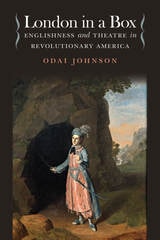
London in a Box
Englishness and Theatre in Revolutionary AmericaOdai Johnson
University of Iowa Press, 2017
If one went looking for the tipping point in the prelude to the American Revolution, it would not be the destruction of the tea in Boston Harbor, or the blockade of Boston by British warships, or even the gathering of the first Continental Congress; rather, it was the Congress’s decision in late October of 1774 to close the theatres. In this remarkable feat of historical research, Odai Johnson pieces together the surviving fragments of the story of the first professional theatre troupe based in the British North American colonies. In doing so, he tells the story of how colonial elites came to decide they would no longer style themselves British gentlemen, but instead American citizens.
London in a Box chronicles the enterprise of David Douglass, founder and manager of the American Theatre, from the 1750s to the climactic 1770s. The ambitious Scotsman’s business was teaching provincial colonials to dress and behave as genteel British subjects. Through the plays he staged, the scenery and costumes, and the bearing of his actors, he displayed London fashion and London manners. He counted among his patrons the most influential men in America, from British generals and governors to local leaders, including the avid theatre-goers George Washington and Thomas Jefferson. By 1774, Douglass operated a monopoly of theatres in six colonies and the Anglophone Caribbean, from Jamaica to Charleston and northward to New York City. (Boston remained an impregnable redoubt against theatre.)
How he built this network of patrons and theatres and how it all went up in flames as the revolution began is the subject of this witty history. A treat for anyone interested in the world of the American Revolution and an important study for historians of the period.
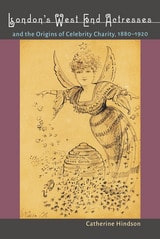
London's West End Actresses and the Origins of Celebrity Charity, 1880-1920
Catherine Hindson
University of Iowa Press, 2016
In the late nineteenth century, theatre’s fundraising for charitable causes shifted from male-dominated and private to female-directed and public. Although elite women had long been involved in such enterprises, they took on more authority in this period. At the same time, regular, high-profile public charity events became more important and much more visible than private philanthropy. Actresses became key figures in making the growing number of large and heavily publicized fundraisers successful. By 1920, the attitude was “Get an actress first. If you can’t get an actress, then get a duchess.” Actresses’ star power, their ability to orchestrate large events quickly, and their skill at performing a kind of genteel extortion made them essential to this model of charity. Actresses also benefited from this new role. Taking a prominent, public, offstage position was crucial in making them, individually and collectively, respectable professionals.
Author Catherine Hindson reveals this history by examining the major types of charity events at the turn of the twentieth century, including fundraising matinees, charity bazaars and costume parties, theatrical tea and garden parties, and benefit performances. Her study concludes with a look at the involvement of actresses in raising funds for British soldiers serving in the Anglo-Boer War and the First World War.
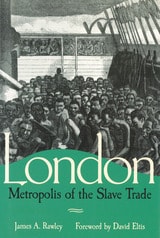
London, Metropolis of the Slave Trade
James A. Rawley & Foreword by David Eltis
University of Missouri Press, 2003
"The recognition that ordinary people could and did trade in slaves, as well as the fact that ordinary people became slaves, is, indeed, the beginning of comprehending the enormity of the forced migration of eleven million people and the attendant deaths of many more."
Rawley draws on material from the year 1700 to the American Civil War as he explores the role of London in the trade. He covers its activity as a port of departure for ships bound for Africa; its continuing large volume after the trade extended to Bristol and Liverpool; and the controversy between London’s parliamentary representatives, who defended the trade, and the abolitionist movement that was quartered there.
Sweeping in scope and thorough in its analysis, this collection of essays from a seasoned scholar will be welcomed by historians concerned with slavery and the slave trade, as well as by students just beginning their exploration of this subject.
London, Radical Culture, and the Making of the Dickensian Aesthetic
Sambudha Sen
The Ohio State University Press, 2012

London
Prints & Drawings before 1800Bernard Nurse
Bodleian Library Publishing, 2017
This book presents more than a hundred images of Greater London from before 1800, all from the Gough Collection of the Bodleian Library. We see prints of London before and after the Great Fire, images of the 1780 tornado, panoramas of the Thames, depictions of the building and destruction of landmark bridges, and much more. Making brilliant use of the most extensive collection of London images amassed by any private collector of the period, the book will be essential to anyone delving into the history of the city.
London
The Selden Map and the Making of a Global City, 1549-1689Robert K. Batchelor
University of Chicago Press, 2013

Lone Star Vistas
Travel Writing on Texas, 1821-1861By Astrid Haas
University of Texas Press, 2021
Every place is a product of the stories we tell about it—stories that do not merely describe but in fact shape geographic, social, and cultural spaces. Lone Star Vistas analyzes travelogues that created the idea of Texas. Focusing on the forty-year period between Mexico’s independence from Spain (1821) and the beginning of the US Civil War, Astrid Haas explores accounts by Anglo-American, Mexican, and German authors—members of the region’s three major settler populations—who recorded their journeys through Texas. They were missionaries, scientists, journalists, emigrants, emigration agents, and military officers and their spouses. They all contributed to the public image of Texas and to debates about the future of the region during a time of political and social transformation. Drawing on sources and scholarship in English, Spanish, and German, Lone Star Vistas is the first comparative study of transnational travel writing on Texas. Haas illuminates continuities and differences across the global encounter with Texas, while also highlighting how individual writers’ particular backgrounds affected their views on nature, white settlement, military engagement, Indigenous resistance, African American slavery, and Christian mission.

Lone Stars III
A Legacy of Texas Quilts, 1986-2011By Karoline Patterson Bresenhan and Nancy O'Bryant Puentes
University of Texas Press, 2011
From frontier times in the Republic of Texas until today, Texans have been making gorgeous quilts. Karoline Patterson Bresenhan and Nancy O'Bryant Puentes documented the first 150 years of the state's rich heritage of quilt art in Lone Stars: A Legacy of Texas Quilts, 1836–1936 and Lone Stars II: A Legacy of Texas Quilts, 1936–1986. Now in Lone Stars III, they bring the Texas quilt story into the twenty-first century, presenting two hundred traditional and art quilts that represent "the best of the best" quilts created since 1986.
The quilts in Lone Stars III display the explosion of creativity that has transformed quilting over the last quarter century. Some of the quilts tell stories, create landscapes, record events, and memorialize people. Others present abstract designs that celebrate form and color. Their makers have embraced machine quilting, as well as hand sewing, and they often embellish their quilts with buttons, beads, lace, ribbon, and even more exotic items. Each quilt is pictured in its entirely, and some entries also include photographs of quilt details. The accompanying text describes the quilt's creation, its maker, and its physical details.
With 16.3 million American quilters who spend $3.6 billion annually on their pastime, the quilting community has truly become a force to reckon with both artistically and socially. Lone Stars III is the perfect introduction to this world of creativity.
Lone Wolf Terror and the Rise of Leaderless Resistance
George Michael
Vanderbilt University Press, 2012
If Breivik did indeed act alone, he wouldn't be the first. Timothy McVeigh bombed a federal building in Oklahoma City based essentially on his own motivations. Eric Robert Rudolph embarked on a campaign of terror over several years, including the Centennial Park bombing at the 1996 Olympics. Ted Kaczynski was revealed to be the Unabomber that same year. And these are only the most notable examples. As George Michael demonstrates in Lone Wolf Terror and the Rise of Leaderless Resistance, they are not isolated cases. Rather, they represent the new way warfare will be conducted in the twenty-first century.
Lone Wolf Terror investigates the motivations of numerous political and ideological elements, such as right-wing individuals, ecoextremists, foreign jihadists, and even quasi-governmental entities. In all these cases, those carrying out destructive acts operate as "lone wolves" and small cells, with little or no connection to formal organizations. Ultimately, Michael suggests that leaderless resistance has become the most common tactical approach of political terrorists in the West and elsewhere.
Lonergan and Historiography
The Epistemological Philosophy of HistoryThomas J. McPartland
University of Missouri Press, 2010
Lonergan and the Philosophy of Historical Existence
Thomas J. McPartland
University of Missouri Press, 2001
Bernard Lonergan's ambitious study of human knowledge, based on his theory of consciousness, is among the major achievements of twentieth-century philosophy. He challenges the principles of contemporary intellectual culture by finding norms and standards not in external perceptions or reified concepts, but in the dynamism of consciousness itself.
Lonergan and the Philosophy of Historical Existence explores the implications of Lonergan's approach to the philosophy of history in a number of distinct but related contexts, covering a variety of intellectual disciplines. Each chapter can be read independently, but the series of chapters provides a coherent unfolding of Lonergan's case that the norms of inquiry endure as a standard of human thought and action amid continuous changes and fluctuations in politics, morals, religion, science, and scholarship. The book explains how Lonergan's idea of development follows from his theory of consciousness and how his treatment of human development inevitably focuses on historical development. The central theme of the book is that Lonergan's philosophy of history makes a pronounced distinction between historicity and historicism.
McPartland relates Lonergan's work to existentialist themes and, in the last chapters, to the work of Eric Voegelin. The book addresses the existentialist themes of dread, suffering, guilt, shame, and ressentiment—within overall themes of history, philosophy, and religion. McPartland argues that Lonergan's unique perspective on scientific method, epistemology, metaphysics, and critical theory can illuminate what seem to be the quite alien topics of reason as religious experience, the anxiety of existence, the existential roots of bias, and mythopoesis and mystery. Here there is a remarkable parallel to the philosophy of history of Eric Voegelin. The concluding chapters of the book show how the equivalence of the two philosophies offers a mutually enriching dialogue between Lonergan's critical realism and Voegelin's existential exegesis.

Lonesome Cowgirls and Honky-Tonk Angels
The Women of Barn Dance RadioKristine M. McCusker
University of Illinois Press, 2007
Drawing on personal interviews and rich archival material from the Grand Ole Opry, Kristine M. McCusker examines the gendered politics of the images through the lives and careers of six women performers: Linda Parker, the Girls of the Golden West (Milly and Dolly Good), Lily May Ledford, Minnie Pearl, and Rose Lee Maphis.
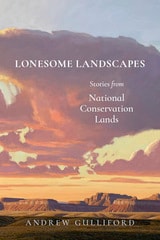
Lonesome Landscapes
Stories from National Conservation LandsAndrew Gulliford
University of Utah Press, 2026
While the National Park Service is widely known, far fewer Americans are familiar with the Bureau of Land Management’s vast National Conservation Lands—thirty-seven million acres spanning eleven western states and Alaska. Lonesome Landscapes is the first comprehensive history of this system from public domain lands to the designation of national monuments and conservation areas in the twenty-first century.
Drawing from archives, interviews, and field reporting, Gulliford reveals the unsung heroes who safeguarded these lands, from pioneering rangers to grassroots advocates in Native American and Hispanic communities. With vivid stories of explorers, cowboys, hermits, and even an alligator named Clem, this book blends scholarship with storytelling. Lonesome Landscapes is both a definitive history and a call to keep America’s wild places in public hands—an essential read for anyone passionate about the West.
Lonesome Roads and Streets of Dreams
Place, Mobility, and Race in Jazz of the 1930s and '40sAndrew S. Berish
University of Chicago Press, 2012
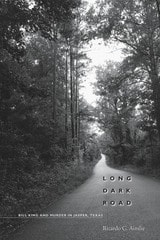
Long Dark Road
Bill King and Murder in Jasper, TexasBy Ricardo C. Ainslie
University of Texas Press, 2004
On a long dark road in deep East Texas, James Byrd Jr. was dragged to his death behind a pickup truck one summer night in 1998. The brutal modern-day lynching stunned people across America and left everyone at a loss to explain how such a heinous crime could possibly happen in our more racially enlightened times. Many eventually found an answer in the fact that two of the three men convicted of the murder had ties to the white supremacist Confederate Knights of America. In the ex-convict ringleader, Bill King, whose body was covered in racist and satanic tattoos, people saw the ultimate monster, someone so inhuman that his crime could be easily explained as the act of a racist psychopath. Few, if any, asked or cared what long dark road of life experiences had turned Bill King into someone capable of committing such a crime.
In this gripping account of the murder and its aftermath, Ricardo Ainslie builds an unprecedented psychological profile of Bill King that provides the fullest possible explanation of how a man who was not raised in a racist family, who had African American friends in childhood, could end up on death row for viciously killing a black man. Ainslie draws on exclusive in-prison interviews with King, as well as with Shawn Berry (another of the perpetrators), King's father, Jasper residents, and law enforcement and judicial officials, to lay bare the psychological and social forces—as well as mere chance—that converged in a murder on that June night. Ainslie delves into the whole of King's life to discover how his unstable family relationships and emotional vulnerability made him especially susceptible to the white supremacist ideology he adopted while in jail for lesser crimes.
With its depth of insight, Long Dark Road not only answers the question of why such a racially motivated murder happened in our time, but it also offers a frightening, cautionary tale of the urgent need to intervene in troubled young lives and to reform our violent, racist-breeding prisons. As Ainslie chillingly concludes, far from being an inhuman monster whom we can simply dismiss, "Bill King may be more like the rest of us than we care to believe."
Long Is the Way and Hard
One Hundred Years of the NAACPKevern Verney
University of Arkansas Press, 2009
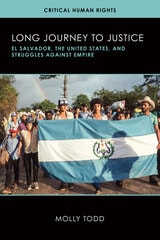
Long Journey to Justice
El Salvador, the United States, and Struggles against EmpireMolly Todd
University of Wisconsin Press, 2023
Drawing on two decades of work with former refugees from El Salvador as well as unprecedented access to private archives and oral histories, Molly Todd’s compelling history provides the first in-depth look at “grassroots sistering.” This model of citizen diplomacy emerged in the mid-1980s out of relationships between a few repopulated villages in Chalatenango, El Salvador, and US cities.
Todd shows how the leadership of Salvadorans and left-leaning activists in the US concerned with the expansion of empire as well as the evolution of human rights–related discourses and practices created a complex dynamic of cross-border activism that continues today.
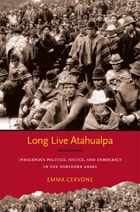
Long Live Atahualpa
Indigenous Politics, Justice, and Democracy in the Northern AndesEmma Cervone
Duke University Press, 2012
Cervone describes how the Inca Atahualpa contested racial subordination by intervening in matters of resource distribution, justice, and cultural politics. Considering local indigenous politics and indigenous mobilization at the national and international levels, she explains how, beginning in the 1960s, state-led modernization created political openings by generating new economic formations and social categories. Long Live Atahualpa sheds new light on indigenous peoples operating at the crossroads of global capitalism and neoliberal reforms as they redefine historically rooted relationships of subordination.
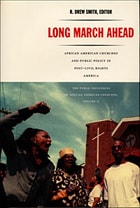
Long March Ahead
African American Churches and Public Policy in Post-Civil Rights AmericaR. Drew Smith ed.
Duke University Press, 2004
Long March Ahead emphasizes the need for African American churches to complement the excellent work they do in implementing policies set by others by getting more involved in shaping public policy. The contributors explore the efficacy of different means of public policy advocacy and social service delivery, including faith-based initiatives. At the same time, they draw attention to trends that have constrained political involvement by African American churches: the increased professionalization of policy advocacy and lobbying, the underdevelopment of church organizational structures devoted to policy work, and tensions between religious imperatives and political activism. Long March Ahead takes an important look at the political role of African American churches after the great policy achievements of the civil rights era.
Contributors
Cathy J. Cohen
Megan McLaughlin
Columba Aham Nnorum
Michael Leo Owens
Desiree Pedescleaux
Barbara D. Savage
R. Drew Smith
Emilie Townes
Christopher Winship

Long Road to Harpers Ferry
The Rise of the First American LeftMark A. Lause
Pluto Press, 2018
Offering new and fascinating insights into the cast of characters who created a homegrown socialist movement in America—from Thomas Paine’s revolution to Robert Owen’s utopianism, and from Thomas Skidmore’s agrarianism to George Henry Evans’s industrial workers’ reforms—Long Road to Harpers Ferry captures the spirit of the times. Showing how class solidarity and consciousness became more important to a generation of workers than notions of American citizenship, the book offers a fascinating historical background to help us understand the rise of radicalism in the United States today.

Long Ships Passing
The Story Of The Great LakesWalter Havighurst
University of Minnesota Press, 2002
A dramatic account of three centuries of people and ships that sailed the Great Lakes
A popular history of navigation on the Great Lakes and life on their shores, The Long Ships Passing brings us aboard the crafts that have plowed the waves of the treacherous "five sisters" carrying the grain, lumber, and minerals that fed and built the cities of America. Walter Havighurst paints vivid pictures of life—and death—on the lakes, mysterious accounts of wooden ships and iron men that sank to freshwater graves, especially along the immigrant route where the wrecks lie thick. In rich and marvelous detail, this classic history recounts the saga of an inland marine empire.
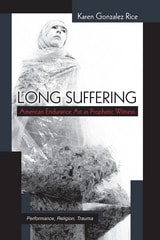
Long Suffering
American Endurance Art as Prophetic WitnessKaren Gonzalez Rice
University of Michigan Press, 2016

Long Walk Home
Reflections on Bruce SpringsteenJonathan D. Cohen
Rutgers University Press, 2019
Contributors to Long Walk Home include novelists like Richard Russo, rock critics like Greil Marcus and Gillian Gaar, and other noted Springsteen scholars and fans such as A. O. Scott, Peter Ames Carlin, and Paul Muldoon. They reveal how Springsteen’s albums served as the soundtrack to their lives while also exploring the meaning of his music and the lessons it offers its listeners. The stories in this collection range from the tale of how “Growin’ Up” helped a lonely Indian girl adjust to life in the American South to the saga of a group of young Australians who turned to Born to Run to cope with their country’s 1975 constitutional crisis. These essays examine the big questions at the heart of Springsteen’s music, demonstrating the ways his songs have resonated for millions of listeners for nearly five decades.
Commemorating the Boss’s seventieth birthday, Long Walk Home explores Springsteen’s legacy and provides a stirring set of testimonials that illustrate why his music matters.
Long Way Round
Through the Heartland by RiverJohn Hildebrand
University of Wisconsin Press, 2022
Wisconsin is in the midst of an identity crisis, torn by new political divisions and the old gulf between city and countryside. Cobbling rivers together, from the burly Mississippi to the slender wilds of Tyler Forks, Hildebrand navigates the beautiful but complicated territory of home. In once prosperous small towns, he discovers unsung heroes—lockmasters, river rats, hotelkeepers, mechanics, environmentalists, tribal leaders, and perennial mayors—struggling to keep their communities afloat.
While history doesn't flow in a circle, it doesn't always move in a straight line either. Hildebrand charts the improbable ox-bows along its course. Long Way Round shows us the open road as a river with possibility around the next bend.
Longships and Sod Houses
A Thousand-Year Journey from Viking Iceland to the Dakota PlainsGary Goodman
University of Minnesota Press, 2026
A direct descendant of a tenth-century Viking marauder traces his lineage from medieval Iceland to the Dakota plains
Gary Goodman first heard that his 24x great-grandfather was a tenth-century Viking pirate and mercenary at a family reunion, when a cousin told him that they were the direct descendants of an Icelandic poet and cold-blooded killer named Egil Skallagrímsson. Also known as “Egil the Bastard,” Goodman’s forefather was the subject of Egil’s Saga, one of the great Icelandic epics of the early Middle Ages. Spurred by this revelation of his family’s lineage, Goodman set out to discover the route his ancestors had traveled from medieval Iceland to the North Dakota plains in the later 1800s.
Drawing on Egil’s Saga, family records, and travels through Iceland, England, and Ireland, Goodman traces his ancestral line from Iceland—the family’s homeland for over a thousand years until a volcanic eruption forced them to migrate—to the hardscrabble plains of the Dakota Territory. His panoramic view ranges from the Viking invasion of England in the early Middle Ages to the disappearance of a short-lived Icelandic settlement on the Mouse River in North Dakota in the late 1800s. Along the way, Goodman sketches the highlights of Egil’s Saga, making the centuries-old epic accessible to today’s readers.
With candor, dry wit, and some bemusement, Goodman shares his trip through history from the perspective of a descendant of an original Viking marauder. An innovative, time-bending family history, Longships and Sod Houses is a noteworthy saga in its own right.
Retail e-book files for this title are screen-reader friendly with images accompanied by short alt text and/or extended descriptions.
Look Away!
The U.S. South in New World StudiesJon Smith and Deborah Cohn, eds.
Duke University Press, 2004
Look Away! presents work by respected scholars in comparative literature, American studies, and Latin American studies. The contributors analyze how writers—including the Martinican Edouard Glissant, the Cuban-American Gustavo Pérez Firmat, and the Trinidad-born, British V. S. Naipaul—have engaged with the southern United States. They explore William Faulkner’s role in Latin American thought and consider his work in relation to that of Gabriel García Márquez and Jorge Luis Borges. Many essays re-examine major topics in southern U.S. culture—such as race, slavery, slave resistance, and the legacies of the past—through the lens of postcolonial theory and postmodern geography. Others discuss the South in relation to the U.S.–Mexico border. Throughout the volume,the contributors consistently reconceptualize U.S. southern culture in a way that acknowledges its postcolonial status without diminishing its distinctiveness.
Contributors. Jesse Alemán, Bob Brinkmeyer, Debra Cohen, Deborah Cohn, Michael Dash, Leigh Anne Duck, Wendy Faris, Earl Fitz, George Handley, Steve Hunsaker, Kirsten Silva Gruesz, Dane Johnson, Richard King, Jane Landers, John T. Matthews, Stephanie Merrim, Helen Oakley, Vincent Pérez, John-Michael Rivera, Scott Romine, Jon Smith, Ilan Stavans, Philip Weinstein, Lois Parkinson Zamora
Look Out Below! A Story of the Airborne by a Paratrooper Padre
Francis L. Sampson
Catholic University of America Press, 2023
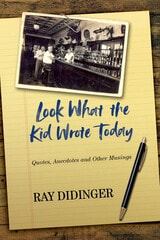
Look What the Kid Wrote Today
Quotes, Anecdotes and Other MusingsRay Didinger
Temple University Press, 2026
When Ray Didinger was a young sports columnist, his proud grandfather would tape his articles on the mirror of his Southwest Philadelphia bar and tell his customers, “Look what the kid wrote today.” That phrase is now the title of Didinger’s latest book, a fond look back on his award-winning career.
In Look What the Kid Wrote Today, Didinger reflects on walking the historic Merion golf course with Jack Nicklaus, shooting pool with Mean Joe Greene, touring Foxcatcher Farms with John du Pont and hanging out with Mark Wahlberg on the set of Invincible. He also writes about helping to heal the rift between the Philadelphia Eagles and arguably their greatest player, Chuck Bednarik. It is a story that went untold until now.
Didinger takes the reader through the many stages of his fifty-plus years in sports media, from his time as an Emmy Award-winning producer at NFL Films, which involved writing scripts for the likes of Tom Selleck, Gary Busey, and Oscar winner James Coburn. Now a playwright, Didinger also devotes a chapter to the 2025 premiere of his critically acclaimed production Spinner.
Candid and insightful, Look What the Kid Wrote Today is Didinger at his best.
Looking Back on the Vietnam War
Twenty-first-Century PerspectivesBoyle, Brenda M
Rutgers University Press, 2016

Looking Back through Our Identities
Itihasa PuranaAloka Parasher Sen
Seagull Books, 2025
Looking Back through Our Identities explores the intricate relationship between myth and history in shaping the identities of diverse Indian communities. Through a meticulous analysis of ancient texts and oral traditions, Aloka Parasher Sen examines how the past is interpreted and navigated by groups like the Chenchus, an indigenous people from southern and eastern India. Sen discusses the role of myth in providing alternative histories and challenging linear, elite-centric historical narratives.
Sen also addresses the significance of memory and visual representation in preserving history, advocating for a broader understanding that encompasses multiple perspectives and identities. Looking Back through Our Identities offers a comprehensive and inclusive view of India's cultural heritage.
Looking Beneath the Surface
The Story of Archaeology in New JerseyMounier, R. Alan
Rutgers University Press, 2002
For more than ten thousand years, humans have lived in New Jersey. From Summit to Cape May, from Trenton to the Jersey Shore, the state is a treasure trove of archaeological artifacts, revealing much about those who occupied the region prior to European settlement. As a rule, only the most durable of human creations¾items of stone and pottery¾survive the ravages of time. To complicate matters, the onslaught of our own culture and the indiscriminate looting of sites by greedy collectors have further diminished the cultural materials left behind. The task of the archaeologist is to gather and interpret these scraps for the benefit of science and the public. But digging up relics is a trivial pursuit if the only outcome is a collection of artifacts, however attractive or valuable they may be. Understanding what those relics mean in human terms is crucial.
In Looking beneath the Surface, R. Alan Mounier looks at the human past of New Jersey. With particular focus on the ancient past and native cultures, the author tells the story of archaeology in the state as it has unfolded, and as it continues to unfold. New investigations and discoveries continually change our views and interpretations of the past. In jargon-free language, Mounier provides an in-depth introduction offering information to understand general archaeological practices as well as research in New Jersey. Subsequent chapters describe artifact types, archaeological settlements, and burial practices in detail. He concludes with vignettes of twenty-one archaeological investigations throughout the state to illustrate the variability of sites and the accomplishments of dedicated archaeologists, both professional and amateur.
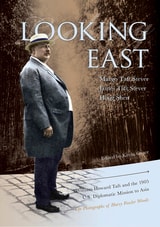
Looking East
William Howard Taft and the 1905 U.S. Diplomatic Mission to Asia: the Photographs of Harry Fowler WoodsMargo Taft Stever, James Taft Stever, and Hong Shen
University of Minnesota Press, 2015
Since the mid-19th century, relations between the United States in the West and Asian countries in the East have been an aggregate of diplomatic miscues and achievements, of trade policy successes and failures, and of cultural chasms and bridges. From the Treaty of Wangxia in 1844 that provided America with trading rights in China on a par with European countries to the contemporary political debates and educational partnerships in nations like Japan, Vietnam, India, and China, the element of understanding and appreciating differences has been paramount.
A singular event in this heritage of almost 150 years in the 1905 mission that sent William Howard Taft on a combination trade and culture junket to Asian countries. Occurring just a few years after U.S. Secretary of State's John Hay's 1899 Open Door Note that sought to keep China open to equitable trade with all countries, the Taft delegation primarily visited China, Japan, and the Philippines to shore up America's interests and to learn more about their emerging partners in the new century.
In Looking East, authors Margo Taft Stever, James Taft Stever, and Hong Shen explore this journey not only by an assiduous use of archives and historical analyses, but especially through the extraordinary images captured by photographer Harry Fowler Woods. Both Taft and Woods are ancestors of two of the authors so there is a particular interest on their part. With scholar Shen, they uncovered these photos and created exhibitions and published the initial Chinese-language edition of this volume by Zhejiang University Press in 2012. In this new, English-language edition, William Howard Taft's 1905 endeavors in Asia are freshly accorded the insight and appreciation they deserve in American diplomatic history.
Looking Forward
Prediction and Uncertainty in Modern AmericaJamie L. Pietruska
University of Chicago Press, 2017
Pietruska argues that this late nineteenth-century quest for future certainty had an especially ironic consequence: it led Americans to accept uncertainty as an inescapable part of both forecasting and twentieth-century economic and cultural life. Drawing together histories of science, technology, capitalism, environment, and culture, Looking Forward explores how forecasts functioned as new forms of knowledge and risk management tools that sometimes mitigated, but at other times exacerbated, the very uncertainties they were designed to conquer. Ultimately Pietruska shows how Americans came to understand the future itself as predictable, yet still uncertain.

Looking Like the Enemy
Japanese Mexicans, the Mexican State, and US Hegemony, 1897–1945Jerry García
University of Arizona Press, 2014
Japanese citizens were initially lured to Mexico with promises of cheap and productive land in Chiapas. Many of the promises were false, and the immigrants were forced to fan out across the country, especially to the lands along the US border. As Jerry García reveals, they were victims of discrimination based on “difference,” but they also displayed “markers of whiteness” that linked them positively to Europeans and Americans, who were perceived as powerful and socially advanced. And, García reports, many Mexicans looked favorably on the Japanese as hardworking and family-centered.
The book delves deeply into the experiences of the Japanese on both sides of the border during World War II, illuminating the similarities and differences in their treatment. Although some Japanese Mexicans were eventually interned (at the urging of the US government), in general the fear and vitriol that Japanese Americans encountered never reached the same levels in Mexico.
Looking Like the Enemy is an ambitious study of a tumultuous half-century in Mexico. It is a significant contribution to our understanding of the immigrant experience in the Western Hemisphere and to the burgeoning field of borderlands studies.
Looking Past the Screen
Case Studies in American Film History and MethodJon Lewis and Eric Smoodin, eds.
Duke University Press, 2007
Focusing on Hollywood cinema from the teens to the 1970s, these case studies show the value of this extraordinary range of historical materials in developing interdisciplinary approaches to film stardom, regulation, reception, and production. The contributors examine State Department negotiations over the content of American films shown abroad; analyze the star image of Clara Smith Hamon, who was notorious for having murdered her lover; and consider film journalists’ understanding of the arrival of auteurist cinema in Hollywood as it was happening during the early 1970s. One contributor chronicles the development of film studies as a scholarly discipline; another offers a sociopolitical interpretation of the origins of film noir. Still another brings to light Depression-era film reviews and Production Code memos so sophisticated in their readings of representations of sexuality that they undermine the perception that queer interpretations of film are a recent development. Looking Past the Screen suggests methods of historical research, and it encourages further thought about the modes of inquiry that structure the discipline of film studies.
Contributors. Mark Lynn Anderson, Janet Bergstrom, Richard deCordova, Kathryn Fuller-Seeley, Sumiko Higashi, Jon Lewis, David M. Lugowski, Dana Polan, Eric Schaefer, Andrea Slane, Eric Smoodin, Shelley Stamp
Looking South
The Evolution of Latin Americanist Scholarship in the United States, 1850-1975Helen Delpar
University of Alabama Press, 2007
The definitive history of how Latin American studies became a major field in American scholarship.
Looking South: The Evolution of Latin Americanist Scholarship in the United States, 1850-1975 is the first comprehensive history of the development of Latin American studies as a field of academic inquiry in the United States. In this ambitious and insightful work, historian Helen Delpar traces more than a century of intellectual engagement with Latin America, revealing how generations of historians, anthropologists, geographers, economists, sociologists, and political scientists shaped American understandings of the region and transformed Latin American studies into a recognized academic discipline.
A central contribution of the book lies in its exploration of the relationship between scholarship and historical context. Delpar demonstrates that academic interest in Latin America was never isolated from larger political, economic, and cultural developments in the United States. The expansion of hemispheric trade, the Good Neighbor era, World War II, the Cold War, and the Cuban Revolution all influenced how American scholars approached the region and what questions they considered important. By examining these intersections, she reveals how academic knowledge is shaped by changing national priorities, international events, and institutional support networks.
Beyond its contributions to Latin American history, Looking South is a major work of intellectual and academic history. It offers a compelling account of how scholarly fields are created, how academic communities develop, and how knowledge about world regions is produced, organized, and disseminated. Delpar's careful attention to both individual scholars and larger institutional structures makes the book an essential resource for understanding the history of area studies, the social sciences, and higher education in the United States.
Looking South remains an indispensable guide to the origins and evolution of Latin Americanist scholarship. It is essential reading for historians, Latin Americanists, anthropologists, political scientists, educators, and anyone interested in the intellectual history of the Americas and the development of knowledge across national and cultural boundaries.
Looking for America on the New Jersey Turnpike
Gillespie, Angus K
Rutgers University Press, 1992
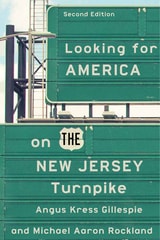
Looking for America on the New Jersey Turnpike, Second Edition
Angus Kress Gillespie
Rutgers University Press, 2024
When Angus Gillespie and Michael Rockland wrote Looking for America on the New Jersey Turnpike in 1989, they simply wanted to express their fascination with a road that many commuters regarded with annoyance or indifference. Little did they expect that it would be hailed as a classic, listed by the state library alongside works by Whitman and Fitzgerald as one of the ten best books ever written about New Jersey or by a New Jerseyan.
Now Looking for America on the New Jersey Turnpike is back in a special updated and expanded edition, examining how this great American motorway has changed over the past thirty-five years. You’ll learn how the turnpike has become an icon inspiring singers and poets. And you’ll meet the many people it has affected, including the homeowners displaced by its construction, the highway patrol and toll-takers who work on it, and the drivers who speed down its lanes every day.
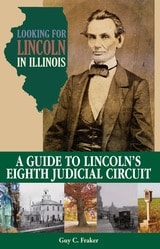
Looking for Lincoln in Illinois
A Guide to Lincoln's Eighth Judicial CircuitGuy C. Fraker
Southern Illinois University Press, 2017
For twenty-three years Abraham Lincoln practiced law on the Eighth Judicial Circuit in east central Illinois, and his legal career is explored in Looking for Lincoln in Illinois: A Guide to Lincoln’s Eighth Judicial Circuit. Guy C. Fraker directs readers and travelers through the prairies to the towns Lincoln visited regularly. Twice a year, spring and fall, Lincoln’s work took him on a journey covering more than four hundred miles. As his stature as a lawyer grew, east central Illinois grew in population and influence, and the Circuit provided Lincoln with clients, friends, and associates who became part of the network that ultimately elevated him to the presidency.
This guidebook to the Circuit features Illinois courthouses, Looking for Lincoln Wayside Exhibits, and other Lincoln points of interest. Fraker guides travelers down the long stretches of quiet country roads that gave Lincoln time to read and think to the locations where Lincoln’s broad range of cases expanded his sense of the economic and social forces changing America.