Results by title
8642 books match the query '20th Century' and 251 start with l
Late Colonial Sublime
Neo-Epics and the End of RomanticismG. S. Sahota
Northwestern University Press, 2018
By bringing together distinct literary canons—both metropolitan and colonial, hegemonic and subaltern, Western and Eastern, all of which took shape upon the common realities of imperial capitalism—Late Colonial Sublime takes an original dialectical approach. It experiments with fragments, parallaxes, and constellational form to explore the aporias of modernity as well as the possible futures they may signal in our midst. A bold intervention into contemporary debates that synthesizes a wealth of sources, this book will interest readers and scholars in world literature, critical theory, postcolonial criticism, and South Asian studies.
Latent Destinies
Cultural Paranoia and Contemporary U.S. NarrativePatrick O Donnell
Duke University Press, 2000
O’Donnell argues that paranoia on the broadly cultural level is essentially a narrative process in which history and postmodern identity are negotiated simultaneously. The result is an erasure of historical temporality—the past and future become the all-consuming, self-aware present. To explain and exemplify this, O’Donnell looks at such books and films as Libra, JFK, The Crying of Lot 49, The Truman Show, Reservoir Dogs, Empire of the Senseless, Oswald’s Tale, The Executioner’s Song, Underworld, The Killer Inside Me, and Groundhog Day. Organized around the topics of nationalism, gender, criminality, and construction of history, Latent Destinies establishes cultural paranoia as consonant with our contradictory need for multiplicity and certainty, for openness and secrecy, and for mobility and historical stability.
Demonstrating how imaginative works of novels and films can be used to understand the postmodern historical condition, this book will interest students and scholars of American literature and cultural studies, postmodern theory, and film studies.
Latin America's New Historical Novel
By Seymour Menton
University of Texas Press, 1993
Beginning with the 1979 publication of Alejo Carpentier's El arpa y la sombra, the New Historical Novel has become the dominant genre within Latin American fiction. In this at-times tongue-in-cheek postmodern study, Seymour Menton explores why the New Historical Novel has achieved such popularity and offers discerning readings of numerous works.
Menton argues persuasively that the proximity of the Columbus Quincentennial triggered the rise of the New Historical Novel. After defining the historical novel in general, he identifies the distinguishing features of the New Historical Novel.
Individual chapters delve deeply into such major works as Mario Vargas Llosa's La guerra del fin del mundo, Abel Posse's Los perros del paraíso, Gabriel García Márquez's El general en su laberinto, and Carlos Fuentes' La campaña. A chapter on the Jewish Latin American novel focuses on several works that deserve greater recognition, such as Pedro Orgambide's Aventuras de Edmund Ziller en tierras del Nuevo Mundo, Moacyr Scliar's A estranha nação de Rafael Mendes, and Angelina Muñiz's Tierra adentro.
Latin American Literature at the Millennium
Local Lives, Global SpacesCecily Raynor
Bucknell University Press, 2021
Latin American Novels of the Conquest
Reinventing the New WorldKimberle S. López
University of Missouri Press, 2002
Latin American Politics
A Theoretical ApproachBy Torcuato S. Di Tella
University of Texas Press, 2001
First published in English in 1990 as Latin American Politics: A Theoretical Framework, a translation of Torcuato S. Di Tella's original Sociología de los procesos políticos, this new edition also focuses on the prerequisites for democracy in any society and on the role of the popular classes in social change. Di Tella draws on the work of Montesquieu, Burke, Tocqueville, Marx, Weber, and Durkheim in formulating his explanatory theories. These theories are then tested against crucial events in Latin American history—from the rebellions of the eighteenth century to the caudillos of the nineteenth century and the militarism of the twentieth century.
This edition is more attuned to an English-speaking audience, with a new chapter addressing the historical process in Argentina from the 1930s to 2000. Latin American Politics is written in a style easily accessible to the general reader or student, while its emphasis on the growth of democracy in Latin America makes it particularly timely.
Latin Americanism
Roman De La Campa
University of Minnesota Press, 1999
Analyzes the way North American academics have constructed Latin America.
In this timely book, Román de la Campa asks to what degree the Latin America studied in U.S. academies is actually an entity “made in the U.S.A.” He argues that there is an ever-increasing gap between the political, theoretical, and financial pressures affecting the U.S. academy and Latin America’s own cultural, political, and literary practices, and considers what this new Latin Americanism has to say about the claims of poststructuralism, postmodern theory, and deconstruction.
De la Campa focuses on the conduct of Latin American literary criticism in U.S. universities and compares this with the “Latin Americanism” of Latin America itself. He examines the translation of Latin American works into English, the careerism of U.S. intellectuals, the conduct of Latin American literary criticism in English, and the diaspora of Third World intellectuals. In a reconsideration of the vogue in Latin American literature and magical realism in light of new work by theorists residing in Latin America, he contrasts this work with critiques of Latin American discourses in the United States.A critique of postmodern and postcolonial constructions as articulated differently in the United States and Latin America, this hard-hitting but fair-minded book provides a postdeconstructive perspective on culture and literature. ISBN 0-8166-3116-6 Cloth £00.00 $47.95xxISBN 0-8166-3117-4 Paper £00.00 $18.95x224 Pages 5 7/8 x 9 JuneCultural Studies of the Americas Series, volume 3Translation inquiries: University of Minnesota Press
Latin Letters of C.S. Lewis
C.S. Lewis and Don Giovanni Calabria
St. Augustine's Press, 1999
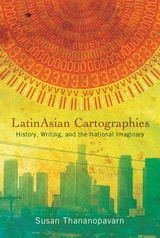
LatinAsian Cartographies
History, Writing, and the National ImaginaryThananopavarn, Susan
Rutgers University Press, 2018
Thananopavarn creates a new “LatinAsian” view of the United States that emphasizes previously suppressed aspects of national history, including imperialism, domestic racism during World War II, Cold War operations in Latin America and Asia, and the politics of borders in an age of globalization. LatinAsian Cartographies ultimately reimagines national narratives in a way that transforms dominant ideas of what it means to be American.
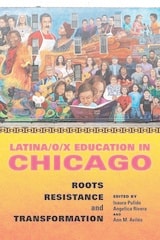
Latina/o/x Education in Chicago
Roots, Resistance, and TransformationEdited by Isaura Pulido, Angelica Rivera, and Ann M. Aviles
University of Illinois Press, 2022
Insightful and enlightening, Latina/o/x Education in Chicago brings to light the ongoing struggle for educational equity in the Chicago Public Schools.
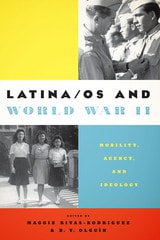
Latina/os and World War II
Mobility, Agency, and IdeologyEdited by Maggie Rivas-Rodriguez and B.V. Olguín
University of Texas Press, 2014
The first book-length study of Latina/o experiences in World War II over a wide spectrum of identities and ancestries—from Cuban American, Spanish American, and Mexican American segments to the under-studied Afro-Latino experience—Latina/os and World War II probes the controversial aspects of Latina/o soldiering and citizenship in the war, the repercussions of which defined the West during the twentieth century. The editors also offer a revised, more accurate tabulation of the number of Latina/os who served in the war.
Spanning imaginative productions, such as vaudeville and the masculinity of the soldado razo theatrical performances; military segregation and the postwar lives of veterans; Tejanas on the homefront; journalism and youth activism; and other underreported aspects of the wartime experience, the essays collected in this volume showcase rarely seen recollections. Whether living in Florida in a transformed community or deployed far from home (including Mexican Americans who were forced to endure the Bataan Death March), the men and women depicted in this collection yield a multidisciplinary, metacritical inquiry. The result is a study that challenges celebratory accounts and deepens the level of scholarly inquiry into the realm of ideological mobility for a unique cultural crossroads. Taking this complex history beyond the realm of war narratives, Latina/os and World War II situates these chapters within the broader themes of identity and social change that continue to reverberate in postcolonial lives.
Latinas/os in New Jersey
Histories, Communities, and CulturesAldo A. Lauria Santiago
Rutgers University Press, 2025
Contributors: Yamil Avivi; Jennifer Ayala; Ulla D. Berg; Giovani Burgos; Elsa Candelario; Laura Curran; Lilia Fernández; Ismael García Colón; Olga Jiménez de Wagenheim; Benjamin Lapidus; Aldo A. Lauria Santiago; Johana Londoño; Kathleen Lopez; Giancarlo Muschi; Melanie Z. Plasencia; Ana Y. Ramos-Zayas; Elena Sabogal; Raymond Sanchez Mayers; William Suárez Gómez; Alex F. Trillo; Daniela Valdez; Anil Venkatesh; Lyna L. Wiggins
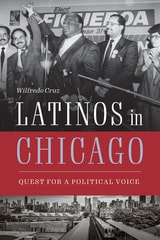
Latinos in Chicago
Quest for a Political VoiceWilfredo Cruz
Southern Illinois University Press, 2022
The path to political power for Latinos in Chicago
In the Midwest’s largest city, Latinos have been fighting for political representation for more than half a century. In this exploration of urban politics in Chicago, Wilfredo Cruz shows for the first time how Latinos went from being ignored by the Irish-controlled political machine to becoming a respected constituency.
Beginning with the Latino community’s first attempt to acquire a political voice in Chicago politics in 1911 and continuing through Latino officeholders of the early twenty-first century, Cruz surveys not only the struggles of this community—specifically the two largest Latino groups in the city, Mexicans and Puerto Ricans—but also the ways in which Chicago’s Latinos overcame those challenges to gain their political voice.
For most of the twentieth century, Chicago politicians ignored the growing Latino community. This disregard changed with the 1983 election of Mayor Harold Washington, an African American who defied the political machine and actively recruited Latinos to his administration and helped them win city and statewide political offices. His actions opened the doors of government for Latinos in Chicago. Subsequent mayors, seeing the political success of Washington’s move, continued his policies.
Many up-and-coming Latino politicians making strides in Chicago, including state representative Aarón Ortíz, Alderman Andre Vasquez, and Alderman Rossana Rodríguez-Sanchez, contribute their takes on the struggle for political power and the challenges facing the rising new generation of elected officials. With this book, Cruz asks and answers this question: What does the future hold for Latinos politically in Chicago?
Latinx Theater in the Times of Neoliberalism
Patricia A. Ybarra
Northwestern University Press, 2018
Patricia A. Ybarra examines IMF interventions, NAFTA, shifts in immigration policy, the escalation of border industrialization initiatives, and austerity programs. She demonstrates how these policies have created the conditions for many of the most tumultuous events in the Americas in the last forty years, including dictatorships in the Southern Cone; the 1994 Cuban Rafter Crisis; femicides in Juárez, Mexico; the Zapatista uprising in Chiapas, Mexico; and the rise of narcotrafficking as a violent and vigorous global business throughout the Americas.
Latinx artists have responded to these crises by writing and developing innovative theatrical modes of representation about neoliberalism. Ybarra analyzes the work of playwrights María Irene Fornés, Cherríe Moraga, Michael John Garcés, Caridad Svich, Quiara Alegría Hudes, Victor Cazares, Jorge Ignacio Cortiñas, Tanya Saracho, and Octavio Solis. In addressing histories of oppression in their home countries, these playwrights have newly imagined affective political and economic ties in the Americas. They also have rethought the hallmark movements of Latin politics in the United States—cultural nationalism, third world solidarity, multiculturalism—and their many discontents.

Lavender Sounds
From Lesbian Radio to Queer Feminist SoundworkStacey Copeland
University of Michigan Press, 2026
Stacey Copeland’s Lavender Sounds explores lesbian radio history and its evolution into queer feminist podcasting today, exploring the politics, aesthetics, and cultural activism embedded in queer feminist soundwork. Through deeply personal and archival explorations, Stacey Copeland traces the emergence of queer feminist soundwork—a unique blend of community-led storytelling, political resistance, and creative expression rooted in feminist and LGBTQ+ activism. At the heart of the book lies a powerful idea: sound is not just heard but felt, connecting generations through shared voices and struggles. In conversation with award-winning and cutting-edge queer and feminist podcast producers from across Canada and the U.S., Lavender Sounds invites us to turn a feminist-embodied ear to the past to uncover the ways gender, race, and sexual orientations are embedded in our everyday media listening practices. From pioneering Canadian radio shows like Vancouver's The Lesbian Show and Montreal's Dykes on Mykes to today’s queer chumcasts and audio documentary, Lavender Sounds is a journey through auditory landscapes where joy, protest, intimacy, and identity intersect. This book opens a vibrant conversation about how radio and podcasting are vital tools for marginalized communities to connect, create, and claim space in the media world.

Law and Justice in the 1950s
Case Studies From a Neglected DecadeEdited by Fiona Cownie and Rosemary Auchmuty
University of London Press, 2026
The 1950s were a decade of considerable legal development in England and Wales, despite often being regarded as very conservative in contrast to the more radical 1960s and 1970s. This collection illustrates the breadth of those developments, providing a sociolegal perspective on a range of topics across criminal, property, family, commercial, environmental, and public law, as well as legal education.
Drawing on case studies from the Great London Smog in 1952, the treatment of women in the Wolfenden Report, divorce law reform, the takeover battle for the Savoy Hotel in 1953, law on the radio, and more, this book throws new light on current debates about the relationship between law and issues of justice, inclusion, and equality in different spheres of activity.
Written for historians and legal specialists alike, Law and Justice in the 1950s explores the stories behind the laws in this neglected decade. In revealing the historical context, arguments, and controversies raised at the time and the different perspectives of the parties involved, it offers a greater understanding of why we have the law we have now and of these issues as they continue to be played out in the early twenty-first century.
Law and the Gay Rights Story
The Long Search for Equal Justice in a Divided DemocracyFrank, Walter
Rutgers University Press, 2014
In his gripping new book, Walter Frank offers an in-depth look at the court cases that were pivotal in establishing gay rights. But he also tells the story of those individuals who were willing to make waves by fighting for those rights, taking enormous personal risks at a time when the tide of public opinion was against them. Frank’s accessible style brings complex legal issues down to earth but, as a former litigator, never loses sight of the law’s human dimension and the context of the events occurring outside the courtroom.
Chronicling the past half-century of gay and lesbian history, Law and the Gay Rights Story offers a unique perspective on familiar events like the Stonewall Riots, the AIDS crisis, and the repeal of “Don’t Ask, Don’t Tell.” Frank pays special attention to the constitutional issues surrounding same-sex marriage and closely analyzes the two recent Supreme Court cases addressing the issue. While a strong advocate for gay rights, Frank also examines critiques of the movement, including some coming from the gay community itself. Comprehensive in coverage, the book explains the legal and constitutional issues involved in each of the major goals of the gay rights movement: a safe and healthy school environment, workplace equality, an end to anti-gay violence, relationship recognition, and full integration into all the institutions of the larger society, including marriage and military service. Drawing from extensive archival research and from decades of experience as a practicing litigator, Frank not only provides a vivid history, but also shows where the battle for gay rights might go from here.

Laws of Chance
Brazil's Clandestine Lottery and the Making of Urban Public LifeAmy Chazkel
Duke University Press, 2011
Lawyers of the Right
Professionalizing the Conservative CoalitionAnn Southworth
University of Chicago Press, 2008
Drawing on in-depth interviews with more than seventy lawyers who represent conservative and libertarian nonprofit organizations, Ann Southworth explores their values and identities and traces the implications of their shared interest in promoting political strategies that give lawyers leading roles. She goes on to illuminate the function of mediator organizations—such as the Heritage Foundation and the Federalist Society for Law and Public Policy—that have succeeded in promoting cooperation among different factions of conservative lawyers. Such cooperation, she finds, has aided efforts to drive law and the legal profession politically rightward and to give lawyers greater prominence in the conservative movement. Southworth concludes, though, that tensions between the conservative law movement’s elite and populist elements may ultimately lead to its undoing.

Le Maya Q’atzij / Our Maya Word
Emil’ Keme
University of Minnesota Press, 2021
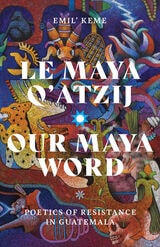
Le Maya Q’atzij/Our Maya Word
Poetics of Resistance in GuatemalaEmil’ Keme
University of Minnesota Press, 2021
Bringing to the fore the voices of Maya authors and what their poetry tells us about resistance, sovereignty, trauma, and regeneration
In 1954, Guatemala suffered a coup d’etat, resulting in a decades-long civil war. During this period, Indigenous Mayans were subject to displacement, disappearance, and extrajudicial killing. Within the context of the armed conflict and the postwar period in Guatemala, K’iche’ Maya scholar Emil’ Keme identifies three historical phases of Indigenous Maya literary insurgency in which Maya authors use poetry to dignify their distinct cultural, political, gender, sexual, and linguistic identities.
Le Maya Q’atzij / Our Maya Word employs Indigenous and decolonial theoretical frameworks to critically analyze poetic works written by ten contemporary Maya writers from five different Maya nations in Iximulew/Guatemala. Similar to other Maya authors throughout colonial history, these authors and their poetry criticize, in their own creative ways, the continuing colonial assaults to their existence by the nation-state. Throughout, Keme displays the decolonial potentialities and shortcomings proposed by each Maya writer, establishing a new and productive way of understanding Maya living realities and their emancipatory challenges in Iximulew/Guatemala.
This innovative work shows how Indigenous Maya poetics carries out various processes of decolonization and, especially, how Maya literature offers diverse and heterogeneous perspectives about what it means to be Maya in the contemporary world.
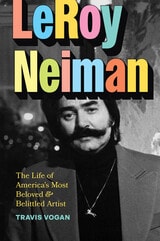
LeRoy Neiman
The Life of America’s Most Beloved and Belittled ArtistTravis Vogan
University of Chicago Press, 2024
LeRoy Neiman—the cigar-smoking and mustachioed artist famous for his Playboy illustrations, sports paintings, and brash interviews—stood among the twentieth century’s most famous, wealthy, and polarizing artists. His stylish renderings of musicians, athletes, and sporting events captivated fans but baffled critics, who accused Neiman of debasing art with popular culture. Neiman cashed in on the controversy, and his extraordinary popularity challenged the norms of what art should be, where it belongs, and who should have access to it.
The story of a Depression-era ragamuffin–turned–army chef–turned–celebrity artist, Neiman’s biography is a rollicking ride through twentieth-century American history, punctuated by encounters with the likes of Muhammad Ali, Frank Sinatra, Joe Namath, and Andy Warhol. In the whirlwind of his life, Neiman himself once remarked that even he didn’t know who he really was—but, he said, the fame and money that came his way made it all worth it. In this first biography of the captivating and infamous man, Travis Vogan hunts for the real Neiman amid the America that made him.
.
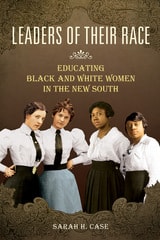
Leaders of Their Race
Educating Black and White Women in the New SouthSarah Case
University of Illinois Press, 2017
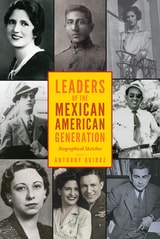
Leaders of the Mexican American Generation
Biographical EssaysAnthony Quiroz
University Press of Colorado, 2016
Leaders of the Mexican American Generation explores the lives of a wide range of influential members of the US Mexican American community between 1920 and 1965 who paved the way for major changes in their social, political, and economic status within the United States.
Including feminist Alice Dickerson Montemayor, to San Antonio attorney Gus García, and labor activist and scholar Ernesto Galarza, the subjects of these biographies include some of the most prominent idealists and actors of the time. Whether debating in a court of law, writing for a major newspaper, producing reports for governmental agencies, organizing workers, holding public office, or otherwise shaping space for the Mexican American identity in the United States, these subjects embody the core values and diversity of their generation.
More than a chronicle of personalities who left their mark on Mexican American history, Leaders of the Mexican American Generation cements these individuals as major players in the history of activism and civil rights in the United States. It is a rich collection of historical biographies that will enlighten and enliven our understanding of Mexican American history.
Learning Democracy
Citizen Engagement and Electoral Choice in Nicaragua, 1990-2001Leslie E. Anderson and Lawrence C. Dodd
University of Chicago Press, 2005
By analyzing nationwide surveys conducted during the 1990, 1996, and 2001 Nicaraguan presidential elections, Leslie E. Anderson and Lawrence C. Dodd provide insight into one of the most unexpected and intriguing recent advancements in third world politics. They offer a balanced account of the voting patterns and forward-thinking decisions that led Nicaraguans to first support the reformist Sandinista revolutionaries only to replace them with a conservative democratic regime a few years later. Addressing issues largely unexamined in Latin American studies, Learning Democracy is a unique and probing look at how the country's mass electorate moved beyond revolutionary struggle to establish a more stable democratic government by realizing the vital role of citizens in democratization processes.
Learning by Heart
Contemporary American Poetry about SchoolMaggie Anderson
University of Iowa Press, 1999
Learning by Heart brings together a unique and diverse collection of poems about the experience of school as seen through the eyes of America's best contemporary poets. These poets capture the educational process not only in the classroom but as it takes place in libraries and hallways, on playing fields and at dances. Alternately joyous and defiant, they demonstrate how it is that young people come to find their place in the world.
Most of the poems in this anthology were written between 1970 and 1995, a period that encompasses both the halcyon years of poets-in-the-schools programs and the primary and secondary school years of many of the poets included. Their poems define school in that most contemporary sense — “with a multitude of voices”—reflecting perspectives from African American, Hispanic American, Asian American, and Native American as well as Anglo American backgrounds, from both public and private schools in rural and urban environments.
Learning by Heart offers a profound and timely statement about schools and learning as well as the role of art in education. Finally, these poems validate that most important lesson: even the most common of experiences is worthy of creative expression.
Learning from Birmingham
A Journey into History and HomeJulie Buckner Armstrong
University of Alabama Press, 2023
A steel town daughter’s search for truth and beauty in Birmingham, Alabama
“As Birmingham goes, so goes the nation,” Fred Shuttlesworth observed when he invited Martin Luther King Jr. to the city for the transformative protests of 1963. From the height of the Civil Rights Movement through its long aftermath, images of police dogs, fire hoses and four girls murdered when Ku Klux Klan members bombed the Sixteenth Street Baptist Church have served as an uncomfortable racial mirror for the nation. Like many white people who came of age in the Civil Rights Movement’s wake, Julie Buckner Armstrong knew little about this history. Only after moving away and discovering writers like Toni Morrison and Alice Walker did she realize how her hometown and family were part of a larger, ongoing story of struggle and injustice.
When Armstrong returned to Birmingham decades later to care for her aging mother, Shuttlesworth’s admonition rang in her mind. By then an accomplished scholar and civil rights educator, Armstrong found herself pondering the lessons Birmingham holds for a twenty-first century America. Those lessons extended far beyond what a 2014 Teaching Tolerance report describes as the common distillation of the Civil Rights Movement into “two names and four words: Martin Luther King Jr, Rosa Parks, and ‘I have a dream.’” Seeking to better understand a more complex local history, its connection to broader stories of oppression and resistance, and her own place in relation to it, Armstrong embarked on a journey to unravel the standard Birmingham narrative to see what she would find.
Beginning at the center, with her family’s 1947 arrival to a housing project near the color line, within earshot of what would become known as Dynamite Hill, Armstrong works her way over time and across the map. Weaving in stories of her white working-class family, classmates, and others not traditionally associated with Birmingham’s civil rights history, including members of the city’s LGBTQ community, she forges connections between the familiar and lesser-known. The result is a nuanced portrait of Birmingham--as seen in public housing, at old plantations, in segregated neighborhoods, across contested boundary lines, over mountains, along increasingly polluted waterways, beneath airport runways, on highways cutting through town, and under the gaze of the iconic statue of Vulcan.
In her search for truth and beauty in Birmingham, Armstrong draws on the powers of place and storytelling to dig into the cracks, complicating easy narratives of civil rights progress. Among the discoveries she finds in America’s racial mirror is a nation that has failed to recognize itself in the horrific images from Birmingham’s past and to acknowledge the continuing inequalities that make up the Civil Right’s Movement’s unfinished business. Learning from Birmingham reminds us that stories of civil rights, structural oppression, privilege, abuse, race and gender bias, and inequity are difficult and complicated, but their telling, especially from multiple stakeholder perspectives, is absolutely necessary.
Learning to Change
The Experience of Transforming Education in South East EuropeTerrice Bassler
Central European University Press, 2005

Leaving Science
Anne E. Preston
Russell Sage Foundation, 2004
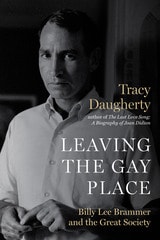
Leaving the Gay Place
Billy Lee Brammer and the Great SocietyBy Tracy Daugherty
University of Texas Press, 2018
Acclaimed by critics as a second F. Scott Fitzgerald, Billy Lee Brammer was once one of the most engaging young novelists in America. “Brammer’s is a new and major talent, big in scope, big in its promise of even better things to come,” wrote A. C. Spectorsky, a former staffer at the New Yorker. When he published his first and only novel, The Gay Place, in 1961, literary luminaries such as David Halberstam, Willie Morris, and Gore Vidal hailed his debut. Morris deemed it “the best novel about American politics in our time.” Halberstam called it “a classic . . . [a] stunning, original, intensely human novel inspired by Lyndon Johnson. . . . It will be read a hundred years from now.” More recently, James Fallows, Gary Fisketjon, and Christopher Lehmann have affirmed The Gay Place’s continuing relevance, with Lehmann asserting that it is “the one truly great modern American political novel.”
Leaving the Gay Place tells a sweeping story of American popular culture and politics through the life and work of a writer who tragically exemplifies the highs and lows of the country at mid-century. Tracy Daugherty follows Brammer from the halls of power in Washington, DC, where he worked for Senate majority leader Johnson, to rock-and-roll venues where he tripped out with Janis Joplin, and ultimately to back alleys of self-indulgence and self-destruction. Constantly driven to experiment with new ways of being and creating—often fueled by psychedelics—Brammer became a cult figure for an America on the cusp of monumental change, as the counterculture percolated through the Eisenhower years and burst out in the sixties. In Daugherty’s masterful recounting, Brammer’s story is a quintessential American story, and Billy Lee is our wayward American son.
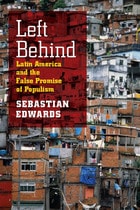
Left Behind
Latin America and the False Promise of PopulismSebastian Edwards
University of Chicago Press, 2010
The political and economic history of Latin America has been marked by great hopes and even greater disappointments. Despite abundant resources—and a history of productivity and wealth—in recent decades the region has fallen further and further behind developed nations, surpassed even by other developing economies in Southeast Asia and elsewhere.
In Left Behind, Sebastian Edwards explains why the nations of Latin America have failed to share in the fruits of globalization and forcefully highlights the dangers of the recent turn to economic populism in the region. He begins by detailing the many ways Latin American governments have stifled economic development over the years through excessive regulation, currency manipulation, and thoroughgoing corruption. He then turns to the neoliberal reforms of the early 1990s, which called for the elimination of deficits, lowering of trade barriers, and privatization of inefficient public enterprises—and which, Edwards argues, held the promise of freeing Latin America from the burdens of the past. Flawed implementation, however, meant the promised gains of globalization were never felt by the mass of citizens, and growing frustration with stalled progress has led to a resurgence of populism throughout the region, exemplified by the economic policies of Venezuela’sHugo Chávez. But such measures, Edwards warns, are a recipe for disaster; instead, he argues, the way forward for Latin America lies in further market reforms, more honestly pursued and fairly implemented. As an example of the promise of that approach, Edwards points to Latin America's giant, Brazil, which under the successful administration of President Luis Inácio da Silva (Lula) has finally begun to show signs of reaching its true economic potential.
As the global financial crisis has reminded us, the risks posed by failing economies extend far beyond their national borders. Putting Latin America back on a path toward sustained growth is crucial not just for the region but for the world, and Left Behind offers a clear, concise blueprint for the way forward.
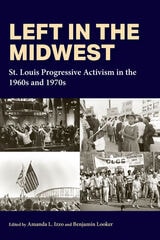
Left in the Midwest
St. Louis Progressive Activism in the 1960s and 1970sAmanda L. Izzo
University of Missouri Press, 2023
Despite St. Louis’s mid-twentieth-century reputation as a conservative and sleepy midwestern metropolis, the city and its surrounding region have long played host to dynamic forms of social-movement organizing. This was especially the case during the 1960s and 1970s, when a new generation of local activists lent their energies to the ongoing struggles for Black freedom, lesbian and gay liberation, feminist social transformations, environmental protection, an end to the Vietnam War, and more. This volume, the first of its kind, offers fifteen scholarly contributions that together bring into focus the exceptional range of progressive activist projects that took shape in a single midwestern city during these tumultuous decades.
In contrast to scholarship that seeks to interpret the era’s social-movement initiatives in a primarily national context, the works presented in this expansive collection emphasize the importance of locality, neighborhood, community institutions, and rooted social networks. Documenting wrenching forces of metropolitan change as well as grassroots resilience, Left in the Midwest shows us how place powerfully shaped agendas, worldviews, and opportunities for the disparate groups that dedicated themselves to progressive visions for their city. By revising our sense of the region’s past, this volume also expands our sense of the possibilities that the future may hold for activist movements seeking change in St. Louis and beyond.
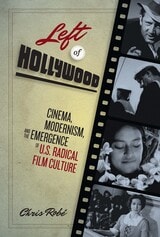
Left of Hollywood
Cinema, Modernism, and the Emergence of U.S. Radical Film CultureBy Chris Robé
University of Texas Press, 2010
In the 1930s as the capitalist system faltered, many in the United States turned to the political Left. Hollywood, so deeply embedded in capitalism, was not immune to this shift. Left of Hollywood offers the first book-length study of Depression-era Left film theory and criticism in the United States. Robé studies the development of this theory and criticism over the course of the 1930s, as artists and intellectuals formed alliances in order to establish an engaged political film movement that aspired toward a popular cinema of social change. Combining extensive archival research with careful close analysis of films, Robé explores the origins of this radical social formation of U.S. Left film culture.
Grounding his arguments in the surrounding contexts and aesthetics of a few films in particular—Sergei Eisenstein's Que Viva Mexico!, Fritz Lang's Fury, William Dieterle's Juarez, and Jean Renoir's La Marseillaise—Robé focuses on how film theorists and critics sought to foster audiences who might push both film culture and larger social practices in more progressive directions. Turning at one point to anti-lynching films, Robé discusses how these movies united black and white film critics, forging an alliance of writers who championed not only critical spectatorship but also the public support of racial equality. Yet, despite a stated interest in forging more egalitarian social relations, gender bias was endemic in Left criticism of the era, and female-centered films were regularly discounted. Thus Robé provides an in-depth examination of this overlooked shortcoming of U.S. Left film criticism and theory.
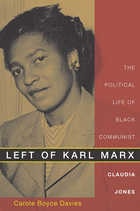
Left of Karl Marx
The Political Life of Black Communist Claudia JonesCarole Boyce Davies
Duke University Press, 2007
Claudia Cumberbatch Jones was born in Trinidad. In 1924, she moved to New York, where she lived for the next thirty years. She was active in the Communist Party from her early twenties onward. A talented writer and speaker, she traveled throughout the United States lecturing and organizing. In the early 1950s, she wrote a well-known column, “Half the World,” for the Daily Worker. As the U.S. government intensified its efforts to prosecute communists, Jones was arrested several times. She served nearly a year in a U.S. prison before being deported and given asylum by Great Britain in 1955. There she founded The West Indian Gazette and Afro-Asian Caribbean News and the Caribbean Carnival, an annual London festival that continues today as the Notting Hill Carnival. Boyce Davies examines Jones’s thought and journalism, her political and community organizing, and poetry that the activist wrote while she was imprisoned. Looking at the contents of the FBI file on Jones, Boyce Davies contrasts Jones’s own narration of her life with the federal government’s. Left of Karl Marx establishes Jones as a significant figure within Caribbean intellectual traditions, black U.S. feminism, and the history of communism.
Legacy of a False Promise
A Daughter's ReckoningMargaret Fuchs Singer
University of Alabama Press, 2009
Margaret Fuchs was thirteen in June 1955 when she learned that her parents had been Communists while working for the U.S. government in the 1930s and '40s. This book chronicles the years during which her parents were exposed and her father was subpoenaed before the House Un-American Activities Committee. Eventually he named names, and subsequently lost his job as a law professor at American University, and was blacklisted from teaching ever again. Legacy of a False Promise also details the author's quest as an adult to learn whether or not her parents ever spied for the Soviet Union.
Based on eight years of research using family records, FBI files, American University archives, personal interviews, and the recently declassified Venona cables, Legacy of a False Promise offers unique insights into the McCarthy Era. Most "red-diaper babies" who have written on the subject had parents who refused to give in to HUAC's demands. Singer's work instead recounts the shame and series of betrayals that her father's decision to name names brought to her family. Furthermore, it explores the campaign of the liberal anti-Communist movement to publicize its political position while defending a fired ex-Communist professor, the nature and activities of secret Communist underground cells, and the motivation of New Deal government workers who spied for the Soviets.
This is a poignant meditation on family secrets, father-daughter relationships in times of crisis, teenage loneliness in the midst of trauma, and the effects of parents' actions on the lives of their children. It also serves as a timely reminder of the dangers of sacrificing civil liberties in the name of national security.

Legends of the Slow Explosion
Eleven Modern LivesBaron Wormser
Tupelo Press, 2018
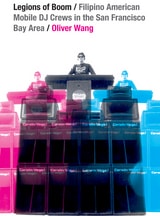
Legions of Boom
Filipino American Mobile DJ Crews in the San Francisco Bay AreaOliver Wang
Duke University Press, 2015
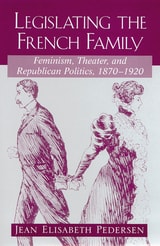
Legislating the French Family
Feminism, Theater, and Republican Politics: 1870-1920Jean Elisabeth Pedersen
Rutgers University Press, 2003
Lenore Tawney
Mirror of the UniverseEdited by Karen Patterson
University of Chicago Press, 2019
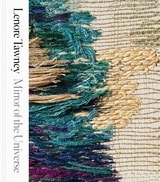
Raised and trained in Chicago before she moved to New York, Tawney had a storied career. She was known for employing an ancient Peruvian gauze weave technique to create a painterly effect that appeared to float in space rather than cling to the wall, as well as for being one of the first artists to blend sculptural techniques with weaving practices and, in the process, pioneered a new direction in fiber art. Despite her prominence on the New York art scene, however, she has only recently begun to receive her due from the greater art world. Accompanying a retrospective at the John Michael Kohler Arts Center, this catalog features a comprehensive biography of Tawney, additional essays on her work, and two hundred full-color illustrations, making it of interest to contemporary artists, art historians, and the growing audience for fiber art.
Copublished with the John Michael Kohler Arts Center.
Leo Strauss and the Rediscovery of Maimonides
Kenneth Hart Green
University of Chicago Press, 2013
An invaluable companion to Green’s comprehensive collection of Strauss’s writings on Maimonides, this volume shows how Strauss confronted the commonly accepted approaches to the medieval philosopher, resulting in both a new understanding of Maimonides and a new depth and direction for his own thought. It will be welcomed by anyone engaged with the work of either philosopher.
Leon Bibel
Forgotten Artist of the New DealRichard Haw
Rutgers University Press, 2025
Honorable Mention for the 2025 New Deal Book Award
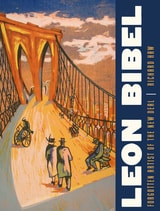
Leon Bibel (1913–1995) was a prolific modern American artist who painted, printed, stamped, etched, sketched, and carved. He produced pieces that ranged from social realism to dreamy expressionism and was an aesthetic experimentalist, never working for too long in any medium or style. And despite Bibel's obvious talent, his work would have languished in obscurity were it not for the New Deal programs like the Federal Art Project and Public Works of Art Project.
Leon Bibel, the first biography of this eclectic artist, recounts his life from his birth in Szczebrzeszyn, Poland, in 1913, to his death in New Jersey in 1995. After immigrating to the United States in the 1920s, Bibel came of age during the Great Depression, when New Deal agencies recognized his abilities and supported his artistic endeavors. Working-class artists faced challenges after these programs folded, and Bibel would later spend twenty years as a New Jersey chicken farmer before resurrecting his art career in the 1960s.
Historian Richard Haw shows how Bibel's life was defined by the New Deal, his visionary artwork shaped by the era's commitment to social and economic justice. With reproductions of more than 240 of Bibel's works, most in vivid color, this book reveals how he depicted everything from the trauma of unemployment to the dignity of work, from the horrors of lynching to the pleasures of everyday life.
Leon Uris
Life of a Best SellerBy Ira B. Nadel
University of Texas Press, 2010
As the best-selling author of Exodus, Mila 18, QB VII, and Trinity, Leon Uris blazed a path to celebrity with books that readers could not put down. Uris's thirteen novels sold millions of copies, spent months on the best-seller lists, appeared in fifty languages, and have been adapted into equally popular movies and TV miniseries. Few other writers equaled Uris's fame in the mid-twentieth century. His success fueled the rise of mass-market paperbacks, movie tie-ins, and celebrity author tours. Beloved by the public, Uris was, not surprisingly, dismissed by literary critics. Until now, his own life—as full of drama as his fiction—has never been the subject of a book.
In Leon Uris: Life of a Best Seller, Ira Nadel traces Uris from his disruptive youth to his life-changing experiences as a marine in World War II. These experiences, coupled with Uris's embrace of his Judaism and desire to write, led to his unprecedented success and the lavish excesses of a career as a best-selling author. Nadel reveals that Uris lived the adventures he described, including his war experiences in the Pacific (Battle Cry), life-threatening travels in Israel (Exodus), visit to Communist Poland (Mila 18), libel trial in Britain (QB VII), and dangerous sojourn in fractious Northern Ireland and the Irish Republic (Trinity). Nadel also demonstrates that Uris's talent for writing action-packed, yet thoroughly researched, novels meshed perfectly with the public's desire to revisit and understand the tumultuous events of recent history. This made him far more popular (and wealthy) than more literary authors, while paving the way for writers such as Irving Wallace and Tom Clancy.

Leon and Louise
Alex Capus
Haus Publishing, 2011

Leonard Bernstein and the Language of Jazz
Katherine Baber
University of Illinois Press, 2019

Leopold and Loeb
THE CRIME OF THE CENTURYHal Higdon
University of Illinois Press, 1975
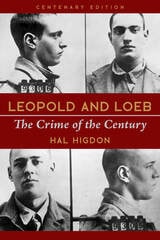
Leopold and Loeb
The Crime of the CenturyHal Higdon
University of Illinois Press, 2024
The 1924 murder of fourteen-year-old Bobby Franks by Nathan Leopold and Richard Loeb shocked the nation. One hundred years later, the killing and its aftermath still reverberate through popular culture and the history of American crime.
Hal Higdon’s true crime classic offers an unprecedented examination of the case. Higdon details Leopold and Loeb’s journey from privilege and promise to the planning and execution of their monstrous vision of the perfect crime. Drawing on secret testimony, Higdon follows the police investigation through the pair’s confessions of guilt and recreates the sensational hearing where Clarence Darrow, the nation’s most famous attorney, saved the pair from the death penalty.
In-depth and definitive, Leopold and Loeb tells the dramatic story of a notorious crime and its long afterlife in the American imagination.

Les Paul
Guitar WizardBob Jacobson
Wisconsin Historical Society Press, 2012
This addition to the Badger Biographies series for young readers tells the story of Les Paul, the legendary “Wizard of Waukesha,” who pioneered the solid body electric guitar, multi-track recording, and many other musical inventions. Fascinated since boyhood with musical technology, the young Les moved from experimenting with his mother’s player piano and phonograph to developing his own amplifier and tinkering with crystal radios.
After leaving his hometown of Waukesha at age 17 to pursue a musical career—a decision his mother supported—the budding jazz guitarist lived in Chicago, New York, and Los Angeles, in each city finding a new audience and new musical partnerships. A regular on the radio, Les became a fixture in early television, appearing on the Ed Sullivan Show, and later, a show of his own with partner Mary Ford. Along the way, he overcame numerous physical challenges, including recovery from electric shock and rehabilitation after a horrific car accident—both of which threatened his musical career. And yet, Les Paul pushed musical technology forward more than any other musician of the twentieth century. This Grammy Hall of Fame inductee died in 2009, making Les Paul: Guitar Wizard a timely addition to the series. This lively story is rounded out with sidebars on radio call letters and how an electric guitar works, a full discography, and over 60 historic photographs.

Lesbian Empire
Radical Crosswriting in the TwentiesGay Wachman
Rutgers University Press, 2001
Wachman places at the center of this tradition Sylvia Townsend Warner's achievement in undermining the inhibitions that faced women writing about forbidden love. She discusses Warner's use of crosswriting to transpose the otherwise unrepresentable lives of invisible lesbians into narratives about gay men, destabilizing the borders of race, class, and gender and challenging the codes of expression on which imperialist patriarchy and capitalism depended.
Lesbian Potentiality and Feminist Media in the 1970s
Jed Samer
Duke University Press, 2022
Lessons and Legacies I
The Meaning of the Holocaust in a Changing WorldPeter Hayes
Northwestern University Press, 1991