Results by title
975 books match the query 'Case studies' and 56 start with l
Locating Filipino Americans
Rick Bonus
Temple University Press, 2000
Locating Filipino Americans, an ethnographic study of Filipino American communities in Los Angeles and San Diego, present a multi-disciplinary cultural analysis of the relationship between ethnic identity and social space. Author Rick Bonus argues that alternative community spaces enable Filipino Americans to respond to and resist the ways in which the larger society has historically and institutionally rendered them invisible, silenced, and racialized. Bonus focuses on the "Oriental" stores, the social halls and community centers, and the community newspapers to demonstrate how ethnic identities are publicly constituted and communities are transformed. Delineating the spaces formed by diasporic consciousness, Bonus shows how community members appropriate elements from their former homeland and from their new settlements in ways defined by their critical stances against racism, homogenization, complete assimilation, and exclusionary citizenship. Locating Filipino Americans is one of the few books that offers a grounded approach to theoretical analyses of ethnicity and contemporary culture in the U.S.

Lone Star Vistas
Travel Writing on Texas, 1821-1861By Astrid Haas
University of Texas Press, 2021
Every place is a product of the stories we tell about it—stories that do not merely describe but in fact shape geographic, social, and cultural spaces. Lone Star Vistas analyzes travelogues that created the idea of Texas. Focusing on the forty-year period between Mexico’s independence from Spain (1821) and the beginning of the US Civil War, Astrid Haas explores accounts by Anglo-American, Mexican, and German authors—members of the region’s three major settler populations—who recorded their journeys through Texas. They were missionaries, scientists, journalists, emigrants, emigration agents, and military officers and their spouses. They all contributed to the public image of Texas and to debates about the future of the region during a time of political and social transformation. Drawing on sources and scholarship in English, Spanish, and German, Lone Star Vistas is the first comparative study of transnational travel writing on Texas. Haas illuminates continuities and differences across the global encounter with Texas, while also highlighting how individual writers’ particular backgrounds affected their views on nature, white settlement, military engagement, Indigenous resistance, African American slavery, and Christian mission.
Lone Wolf Terror and the Rise of Leaderless Resistance
George Michael
Vanderbilt University Press, 2012
If Breivik did indeed act alone, he wouldn't be the first. Timothy McVeigh bombed a federal building in Oklahoma City based essentially on his own motivations. Eric Robert Rudolph embarked on a campaign of terror over several years, including the Centennial Park bombing at the 1996 Olympics. Ted Kaczynski was revealed to be the Unabomber that same year. And these are only the most notable examples. As George Michael demonstrates in Lone Wolf Terror and the Rise of Leaderless Resistance, they are not isolated cases. Rather, they represent the new way warfare will be conducted in the twenty-first century.
Lone Wolf Terror investigates the motivations of numerous political and ideological elements, such as right-wing individuals, ecoextremists, foreign jihadists, and even quasi-governmental entities. In all these cases, those carrying out destructive acts operate as "lone wolves" and small cells, with little or no connection to formal organizations. Ultimately, Michael suggests that leaderless resistance has become the most common tactical approach of political terrorists in the West and elsewhere.
Long Way Home
A Young Man Lost in the System and the Two Women Who Found HimLaura Caldwell
Northwestern University Press, 2012
By all accounts, Jovan Mosley was a good kid. He was working on a way out of his tough Chicago neighborhood and had been accepted at Ohio State University when he was forced to confess to a murder he did not commit. He then spent five years and ten months in jail without a trial. His efforts to exonerate himself got him nowhere until he happened to meet a successful criminal defense lawyer, Catharine O’Daniel. She became convinced of his innocence and took him on as her first pro bono client. Along with Laura Caldwell, she decided to fight to free Jovan. Against enormous odds, they finally won some measure of justice. In this affecting memoir, Caldwell tells the unforgettable story of a breakdown in the criminal justice system and what it took to free an innocent man.
Looking Past the Screen
Case Studies in American Film History and MethodJon Lewis and Eric Smoodin, eds.
Duke University Press, 2007
Focusing on Hollywood cinema from the teens to the 1970s, these case studies show the value of this extraordinary range of historical materials in developing interdisciplinary approaches to film stardom, regulation, reception, and production. The contributors examine State Department negotiations over the content of American films shown abroad; analyze the star image of Clara Smith Hamon, who was notorious for having murdered her lover; and consider film journalists’ understanding of the arrival of auteurist cinema in Hollywood as it was happening during the early 1970s. One contributor chronicles the development of film studies as a scholarly discipline; another offers a sociopolitical interpretation of the origins of film noir. Still another brings to light Depression-era film reviews and Production Code memos so sophisticated in their readings of representations of sexuality that they undermine the perception that queer interpretations of film are a recent development. Looking Past the Screen suggests methods of historical research, and it encourages further thought about the modes of inquiry that structure the discipline of film studies.
Contributors. Mark Lynn Anderson, Janet Bergstrom, Richard deCordova, Kathryn Fuller-Seeley, Sumiko Higashi, Jon Lewis, David M. Lugowski, Dana Polan, Eric Schaefer, Andrea Slane, Eric Smoodin, Shelley Stamp
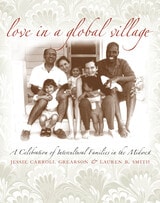
Love in a Global Village
A Celebration of Intercultural Families in the MidwestJessie Carroll Grearson
University of Iowa Press, 2000
In praise of diversity, Jessie Grearson and Lauren Smith offer Love in a Global Village: A Celebration of Intercultural Families in the Midwest, an account of the triumphs of fifteen intercultural families and the perseverance of their relationships in midwestern America. The couples recount their courtships, their adventures and difficulties, and their individual choices to create families and build lives together despite differences of race, language, religion, and culture.
Welcomed into homes in towns like Kalona, Iowa, and Springfield, Missouri, Grearson and Smith introduce readers to unexpected fusions of culture in middle America. By focusing on small communities where intercultural relationships are exceptions rather than the norm, Smith and Grearson offer affirmation that multicultural households can endure and flourish almost anywhere.