Results by title
2646 books match the query 'History & Criticism' and 75 start with l
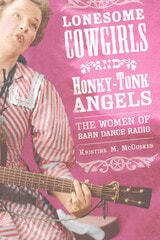
Lonesome Cowgirls and Honky-Tonk Angels
The Women of Barn Dance RadioKristine M. McCusker
University of Illinois Press, 2007
Drawing on personal interviews and rich archival material from the Grand Ole Opry, Kristine M. McCusker examines the gendered politics of the images through the lives and careers of six women performers: Linda Parker, the Girls of the Golden West (Milly and Dolly Good), Lily May Ledford, Minnie Pearl, and Rose Lee Maphis.
Lonesome Roads and Streets of Dreams
Place, Mobility, and Race in Jazz of the 1930s and '40sAndrew S. Berish
University of Chicago Press, 2012
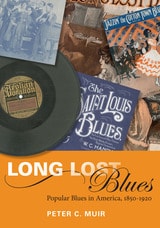
Long Lost Blues
Popular Blues in America, 1850-1920Peter C. Muir
University of Illinois Press, 2010
Long Lost Blues exposes for the first time the full scope and importance of early popular blues to mainstream American culture in the early twentieth century. Closely analyzing sheet music and other print sources that have previously gone unexamined, Muir revises our understanding of the evolution and sociology of blues at its inception.

Long Steel Rail
Norm Cohen
University of Illinois Press, 2000
Long Suffering
American Endurance Art as Prophetic WitnessKaren Gonzalez Rice
University of Michigan Press, 2016
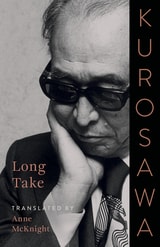
Long Take
Akira Kurosawa
University of Minnesota Press, 2025
A multifaceted portrait of the great Japanese director
For years, Akira Kurosawa resisted writing about himself. “It would turn out to be nothing but talk about movies,” he said. “In other words, take myself, subtract movies, and the result is zero.” The memoir he finally started serializing in 1978, Something like an Autobiography, ended with Rashomon, the film that launched him on the world’s stage in 1950. Long Take, first published in Japan shortly after Kurosawa’s death in 1998, at last tells the story of the rest of his life.
By turns intimate, provocative, and revealing, Long Take creates a dynamic portrait of Kurosawa from his own writings; his conversations with writer Inoue Hisashi and director Yamada Yōji; and essays by his daughter and colleague Kurosawa Kazuko, who details the collaborative history of the “Kurosawa crew.” It features a wealth of industry lore, cultural reference points, inside jokes with other filmmakers and writers, and backstories for his own productions, from the earliest to the last. Of particular interest to all cinephiles is an annotated list of Kurosawa’s 100 favorite films.
A survey of Kurosawa’s prodigious career, this book situates the visionary in the media milieu of his youth, in the literature and performing arts of twentieth-century Japan and Hollywood, and among the myriad films he loved, admired, and referenced, including Japanese silent film and comedy as well as productions from India, Iran, and Soviet-era Russia. Now available to English readers for the first time, Long Take offers a lasting picture of the peerless filmmaker in his element.
Look Closer
Suburban Narratives and American Values in Film and TelevisionCoon, David R
Rutgers University Press, 2013
In recent years, the media landscape in the United States has followed a pattern similar to that of the physical landscape by becoming increasingly suburbanized. Although it is a far cry from reality, the fantasy of a perfect suburban life still exists in the collective imagination of millions of Americans. This dream of suburban perfection is built around a variety of such ideologically conservative values and ideals as the importance of tradition, the centrality of the nuclear family, the desire for a community of like-minded neighbors, the need for clearly defined gender roles, and the belief that with hard work and determination, anyone can succeed.
Building on the relationships between suburban life and American identity, Look Closer examines and interprets recent narratives that challenge the suburban ideal to reveal how directors and producers are mobilizing the spaces of suburbia to tell new kinds of stories about America. David R. Coon argues that the myth of suburban perfection, popularized by postwar sitcoms and advertisements, continues to symbolize a range of intensely debated issues related to tradition, family, gender, race, and citizenship. Through close examinations of such films as American Beauty, The Truman Show, and Mr. & Mrs. Smith as well as such television series as Desperate Housewives, Weeds, and Big Love, the book demonstrates how suburbia is used to critique the ideologies that underpin the suburban American Dream.
Looking Past the Screen
Case Studies in American Film History and MethodJon Lewis and Eric Smoodin, eds.
Duke University Press, 2007
Focusing on Hollywood cinema from the teens to the 1970s, these case studies show the value of this extraordinary range of historical materials in developing interdisciplinary approaches to film stardom, regulation, reception, and production. The contributors examine State Department negotiations over the content of American films shown abroad; analyze the star image of Clara Smith Hamon, who was notorious for having murdered her lover; and consider film journalists’ understanding of the arrival of auteurist cinema in Hollywood as it was happening during the early 1970s. One contributor chronicles the development of film studies as a scholarly discipline; another offers a sociopolitical interpretation of the origins of film noir. Still another brings to light Depression-era film reviews and Production Code memos so sophisticated in their readings of representations of sexuality that they undermine the perception that queer interpretations of film are a recent development. Looking Past the Screen suggests methods of historical research, and it encourages further thought about the modes of inquiry that structure the discipline of film studies.
Contributors. Mark Lynn Anderson, Janet Bergstrom, Richard deCordova, Kathryn Fuller-Seeley, Sumiko Higashi, Jon Lewis, David M. Lugowski, Dana Polan, Eric Schaefer, Andrea Slane, Eric Smoodin, Shelley Stamp
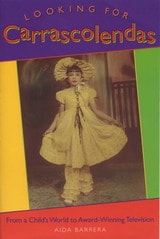
Looking for Carrascolendas
From a Child's World to Award-Winning TelevisionBy Aida Barrera
University of Texas Press, 2001
If your childhood friends were Agapito, the bombastic, bilingual lion; Campamocha, the fix-it man; Caracoles, the restaurant owner; Uncle Andy, the shoe seller; Berta and Dyana, the life-size dolls; and Señorita Barrera, then you grew up watching Carrascolendas. This award-winning show, which originally aired on PBS in the 1970s and was subsequently broadcasted throughout the country in the 1980s and 1990s, was the first Spanish and English children's educational television program broadcast to national audiences in the United States.
In this engagingly written memoir, creator-producer Aida Barrera describes how the mythical world of Carrascolendas grew out of her real-life experiences as a Mexican American child growing up in the Valley of South Texas. She recalls how she drew on those early experiences to create television programming that specifically addressed the needs of Hispanic children, even as it remained accessible and entertaining to children of other cultural backgrounds.
In addition to her personal story, Barrera recounts the long-term struggles for network acceptance and funding that made the production of Carrascolendas something of a miracle. This off-camera story adds an important chapter to the history of Anglo-Mexican cultural politics during the 1970s. Given the fact that Latino characters are still under- and stereotypically represented on network television, Carrascolendas remains an important reminder of what is possible and what has been lost in authentically multicultural television programming.
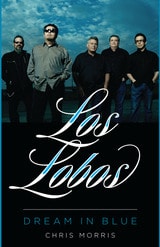
Los Lobos
Dream in BlueBy Chris Morris
University of Texas Press, 2015
Los Lobos leaped into the national spotlight in 1987, when their cover of “La Bamba” became a No. 1 hit. But what looked like an overnight achievement to the band’s new fans was actually a way station in a long musical journey that began in East Los Angeles in 1973 and is still going strong. Across four decades, Los Lobos (Cesar Rosas, Conrad Lozano, David Hidalgo, Louie Pérez, and Steve Berlin) have ranged through virtually the entire breadth of American vernacular music, from rockabilly to primal punk rock, R&B to country and folk, Mexican son jarocho to Tex-Mex conjunto and Latin American cumbia. Their sui generis sound has sold millions of albums and won acclaim from fans and critics alike, including three Grammy Awards.
Los Lobos, the first book on this unique band, traces the entire arc of the band’s career. Music journalist Chris Morris draws on new interviews with Los Lobos members and their principal collaborators, as well as his own reporting since the early 1980s, to recount the evolution of Los Lobos’s music. He describes the creation of every album, lingering over highlights such as How Will the Wolf Survive?, La Pistola y El Corazon, and Kiko, while following the band’s trajectory from playing Mexican folk music at weddings and dances in East L.A. to international stardom and major-label success, as well as their independent work in the new millennium. Giving one of the longest-lived and most-honored American rock bands its due, Los Lobos celebrates the expansive reach and creative experimentalism that few other bands can match.
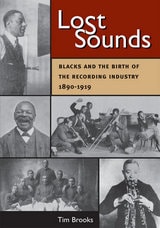
Lost Sounds
Blacks and the Birth of the Recording Industry, 1890-1919Tim Brooks
University of Illinois Press, 2004
Drawing on more than thirty years of scholarship, Tim Brooks identifies key black recording artists and profiles forty audio pioneers. Brooks assesses the careers and recordings of George W. Johnson, Bert Williams, George Walker, Noble Sissle, Eubie Blake, the Fisk Jubilee Singers, W. C. Handy, James Reese Europe, Wilbur Sweatman, Harry T. Burleigh, Roland Hayes, Booker T. Washington, and boxing champion Jack Johnson, plus a host of lesser-known voices. Many of these pioneers struggled to be heard in an era of rampant discrimination. Their stories detail the forces––black and white––that gradually allowed African Americans to enter the mainstream entertainment industry.
Lost Sounds includes Brooks's selected discography of CD reissues and an appendix by Dick Spottswood describing early recordings by black artists in the Caribbean and South America.
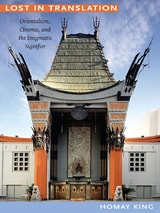
Lost in Translation
Orientalism, Cinema, and the Enigmatic SignifierHomay King
Duke University Press, 2010
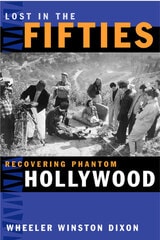
Lost in the Fifties
Recovering Phantom HollywoodWheeler Winston Dixon
Southern Illinois University Press, 2005
Lost in the Fifties: Recovering Phantom Hollywood reveals two 1950s: an era glorified in Hollywood movies and a darker reality reflected in the esoteric films of the decade. Renowned film scholar Wheeler Winston Dixon turns to the margins—the television shows and films of a hidden Hollywood—to offer an authentic view of the 1950s that counters the Tinsel-town version. Dixon examines the lost films and directors of the decade. Contrasting traditional themes of love, marriage, and family, Dixon’s 1950s film world unveils once-taboo issues of rape, prostitution, and gangs. Television shows such as Captain Midnight and Ramar of the Jungle are juxtaposed with the cheerful world of I Love Lucy and Howdy Doody. Highlighting directors including Herbert L. Strock, Leslie Martinson, Arnold Laven, and Charles Haas, Dixon provides new insights on the television series Racket Squad, Topper, and The Rifleman and the teen films I Was a Teenage Werewolf and High School Confidential.
Geared for scholars and students of film and pop culture, Lost in the Fifties includes twenty-five photos—many previously unpublished—and draws on rare interviews with key directors, actors, and producers. The volume provides the first detailed profile of the most prolific producer in Hollywood history, Sam Katzman, and his pop culture classics Rock Around the Clock and Earth vs. The Flying Saucers. Dixon profiles, for the first time, B-movie phenomenon Fred F. Sears, who directed more than fifty touchstone films of a generation, including the noir thriller Chicago Syndicate, the criminal career story Cell 2455 Death Row, and the 3-D color western The Nebraskan. Also profiled is Ida Lupino, the only woman to direct in Hollywood in the 1950s, who tackled issues of bigamy, teenage pregnancy, and sports corruption in The Bigamist, The Hitch-Hiker, Outrage, Never Fear, Not Wanted, and Hard, Fast and Beautiful, when no major studio would touch such controversial topics. Dixon also looks at the era’s social guidance films, which instructed adolescents in acceptable behavior, proper etiquette, and healthy hygiene.
Lothario's Corpse
Libertine Drama and the Long-Running Restoration, 1700-1832Daniel Gustafson
Bucknell University Press, 2020
Published by Bucknell University Press. Distributed worldwide by Rutgers University Press.
Louis Sébastien Mercier
Revolution and Reform in Eighteenth-Century ParisMichael J. Mulryan
Bucknell University Press, 2023
Louise Brooks
A BiographyBarry Paris
University of Minnesota Press, 2000
The long-awaited republication of this captivating account of the star’s life.
Louise Brooks left Wichita, Kansas, for New York City at age fifteen and lived the kind of life of which legends are made. From her beginnings as a dancer to her years in Hollywood, Berlin, and beyond, she was hailed and reviled as a new type of woman: independent, intellectually daring, and sexually free. In this widely acclaimed, first and only comprehensive biography, Barry Paris traces Brooks’s trajectory from her childhood through her fall into obscurity and subsequent "resurrection" as a brilliant writer and enduring film icon.
Lourdes Portillo
The Devil Never Sleeps and Other FilmsEdited by Rosa Linda Fregoso
University of Texas Press, 2001
Filmmaker Lourdes Portillo sees her mission as "channeling the hopes and dreams of a people." Clearly, political commitment has inspired her choice of subjects. With themes ranging from state repression to AIDS, Portillo's films include: Después del Terremoto, the Oscar-nominated Las Madres: The Mothers of the Plaza de Mayo,La Ofrenda: The Days of the Dead,The Devil Never Sleeps, and Corpus: A Home Movie for Selena.
The first study of Portillo and her films, this collection is collaborative and multifaceted in approach, emphasizing aspects of authorial creativity, audience reception, and production processes typically hidden from view. Rosa Linda Fregoso, the volume editor, has organized the book into three parts: interviews (by Fregoso and Kathleen Newman and B. Ruby Rich); critical perspectives (essays by Fregoso, Yvonne Yarbro-Bejarano, Sylvie Thouard, Norma Iglesias, and Barbara McBane); and production materials (screenplays, script notes, storyboards, etc.).
This innovative collection provides "inside" information on the challenges of making independent films. By describing the production constraints Portillo has surmounted, Fregoso deepens our appreciation of this gifted filmmaker's life, her struggles, and the evolution of her art.
Lovers of Cinema
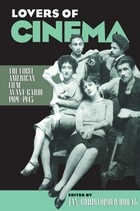
The First American Film Avant-Garde, 1919–1945Jan-Christopher Horak
University of Wisconsin Press, 1998
Also included in the book is a listing of all American avant-garde films produced in the years before World War II as well as a bibliography of the most relevant criticism, literature, and news accounts.
Lowering the Boom
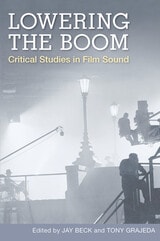
Critical Studies in Film SoundEdited by Jay Beck and Tony Grajeda
University of Illinois Press, 2007
As the first collection of new work on sound and cinema in over a decade, Lowering the Boom addresses the expanding field of film sound theory and its significance in rethinking historical models of film analysis. The contributors consider the ways in which musical expression, scoring, voice-over narration, and ambient noise affect identity formation and subjectivity. Lowering the Boom also analyzes how shifting modulation of the spoken word in cinema results in variations in audience interpretation. Introducing new methods of thinking about the interaction of sound and music in films, this volume also details avant-garde film sound, which is characterized by a distinct break from the narratively based sound practices of mainstream cinema. This interdisciplinary, global approach to the theory and history of film sound opens the eyes and ears of film scholars, practitioners, and students to film's true audio-visual nature.
Contributors are Jay Beck, John Belton, Clark Farmer, Paul Grainge, Tony Grajeda, David T. Johnson, Anahid Kassabian, David Laderman, James Lastra, Arnt Maasø, Matthew Malsky, Barry Mauer, Robert Miklitsch, Nancy Newman, Melissa Ragona, Petr Szczepanik, Paul Théberge, and Debra White-Stanley.
Lucrecia Martel
Gerd Gemünden
University of Illinois Press, 2019
Lulu In Hollywood
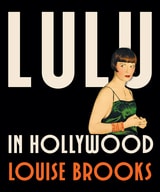
Expanded EditionLouise Brooks
University of Minnesota Press, 2000
Essential writings by this icon of the silent era—rereleased in print and now available as an e-book 100 years after Louise Brooks arrived in Hollywood
Lulu in Hollywood is an intimate collection of eight autobiographical essays by Louise Brooks, silent film darling and icon of the flapper era. Ranging from her childhood in Kansas and her early days as a Denishawn and Ziegfeld Follies dancer to her friendships with Martha Graham, Charles Chaplin, W. C. Fields, Humphrey Bogart, William Paley, G. W. Pabst, and others, Brooks’s writing offers a rare glimpse into her extraordinary life. Including her revelatory “Why I Will Never Write My Memoirs,” Lulu in Hollywood also features Kenneth Tynan’s 1979 essay “The Girl in the Black Helmet,” which revived interest in Brooks’s work and was the best discussion of her film work to appear in her lifetime.
Lusophone Africa
Beyond IndependenceFernando Arenas
University of Minnesota Press, 2010
Exploring the evolving relationship of Lusophone Africa with Portugal, its former colonial power, and Brazil, Fernando Arenas situates the countries on the geopolitical map of contemporary global forces. Drawing from popular music, film, literature, cultural history, geopolitics, and critical theory to investigate the postcolonial condition of Portuguese-speaking Africa, Arenas offers an entirely original discussion of world music phenomenon Cesária Évora, as well as the most thorough examination to date of Lusophone African cinema and of Angolan post-civil-war fiction.
Throughout, Arenas evokes the rich multidimensionality of this community of African nations as a whole and of its individual parts: Angola, Cape Verde, Guinea-Bissau, and Mozambique, and São Tomé and Príncipe since they gained their independence in the mid-1970s. In doing so, he puts forth a conceptual framework for understanding, for the first time, recent cultural and historical developments in Portuguese-speaking Africa.
Lying up a Nation
Race and Black MusicRonald M. Radano
University of Chicago Press, 2003
Lyric Personhood
On the Aesthetics of Being Someone in the WestDan Wang
University of Chicago Press, 2025
What does it mean to be a person? One might think of the possession of certain rights, having the capacity for love, or being self-determined. But if words like “person” or “love” seem to carry an internal meaning, where does this meaningfulness come from? Lyric Personhood contends that to be encultured in the modern West is to learn, on top of everything else, an unspoken and mostly felt sense of what it means to be someone, a sense transmitted not only in language but also through encounters with aesthetic form. Through close readings that span nineteenth-century European opera, commercial cinema, and amateur YouTube proposal videos, Dan Wang shows that a “person” has become an aesthetic concept—and not just a legal, moral, political, or philosophical one—in the last two hundred years of Western culture.
It’s hard to let go of the organizing promise of romantic love, the dream of therapeutic “health,” and the aspiration to belong to national culture, Wang argues, because these longings have been shaped by an archive of sentimental and melodramatic works that trains people's expectations for life, genre, and even the knowing promised in theory itself. Tracing a surprisingly continuous imagination of personhood through opera and film aesthetics, Lyric Personhood introduces modes of reading audiovisual works that allow a longer story to be told about the forms that make personhood sensible in the West.
Lyrics and Borrowed Tunes of the American Temperance Movement
Edited & Compiled by Paul D. Sanders
University of Missouri Press, 2006
Cold water is the drink for me / Of all the drinks the best, sir; / Your grog, of whate’er name it be, / I dare not for to taste, sir.
Such a lyric, sung to the tune of “Yankee Doodle,” was typical ammunition in the temperance movement’s battle against alcohol. By the 1830s, Americans drank an average of 9.5 gallons of hard liquor each year. From the 1840s until the beginning of Prohibition, well over one hundred temperance songbooks were published in which inspirational lyrics were set to mostly borrowed tunes in the hope of persuading citizens to put down the bottle.