Results by title
642 books match the query 'Linguistics' and 65 start with l
Linguistics and Computation
Edited by Jennifer S. Cole, Georgia M. Green, and Jerry L. Morgan
CSLI, 1995
Linguistics of American Sign Language Text, 3rd Edition
An IntroductionClayton Valli
Gallaudet University Press, 2001
Linguistics of American Sign Language
An Introduction, 5th Ed.Clayton Valli
Gallaudet University Press, 2011
Completely reorganized to reflect the growing intricacy of the study of ASL linguistics, the 5th edition presents 26 units in seven parts. Part One: Introduction presents a revision of Defining Language and an entirely new unit, Defining Linguistics. Part Two: Phonology has been completely updated with new terminology and examples. The third part, Morphology, features units on building new signs, deriving nouns from verbs, compounds, fingerspelling, and numeral incorporation. Part Four: Syntax includes units on basic sentence types, lexical categories, word order, time and aspect, verbs, and the function of space. The fifth part, Semantics, offers updates on the meanings of individual signs and sentences.
Part Six: Language in Use showcases an entirely new section on Black ASL in the unit on Variation and Historical Change. The units on bilingualism and language and ASL discourse have been thoroughly revised and updated, and the Language as Art unit has been enhanced with a new section on ASL in film. Two new readings update Part Seven, and all text illustrations have been replaced by video stills from the expanded video content. Also, signs described only with written explanations in past editions now have both photographic samples in the text and full demonstrations in the video.
*** You can find the supplemental video content on the Gallaudet University Press YouTube channel. ***

Linguistics of American Sign Language
An Introduction, 6th Ed.Julie A. Hochgesang
Gallaudet University Press, 2026
Grounded in the scholarship and reflecting contemporary developments in the field of signed language linguistics, the sixth edition of Linguistics of American Sign Language provides a clear, comprehensive, and fresh introduction to the structure of ASL. Focusing on language in everyday contexts, this new edition treats ASL as a dynamic system shaped by the diversity of its communities.
Organized into two parts, Linguistics of American SignLanguage begins by exploring fundamental concepts of language within communities, addressing language features, registers, variation and historical change, multilingualism, ideologies, and discourse. This first section sets the stage for in-depth analysis into core areas of linguistic study: syntax, phonology, and morphology. New content provides depth, exploring topics such as the representation of signed languages in texts, corpus linguistics, heritage-language signers, and Black ASL. To show how language is used by multilingual and multimodal individuals within their communities, the book pairs discussion with “grounding texts,” videos of ASL within varied authentic settings.
Linguistics of American Sign Language is supported by a companion website that provides access to the grounding texts and supplementary materials, including downloadable resources for hands-on analysis such as annotated videos and readings. Designed for readers with no background in linguistics, each unit opens with guided questions to prompt reflection and concludes with exercises and recommended readings.
Refining the standard for sign language scholarship, the sixth edition of Linguistics of American Sign Language guides readers beyond technical analysis to explore ASL as a vibrant system rooted in community, culture, and language.
Linguistics, Philosophy, and Montague Grammar
Edited by Steven Davis and Marianne Mithun
University of Texas Press, 1979
This volume presents significant developments in the field of Montague Grammar and outlines its past and future contributions to philosophy and linguistics. The contents are as follows:
Introduction by Steven Davis and Marianne Mithun
Emmon Bach, "Montague Grammar and Classical Transformational Grammar"
Barbara H. Partee, "Constraining Transformational Montague Grammar: A Framework and a Fragment"
James D. McCawley, "Helpful Hints to the Ordinary Working Montague Grammarian"
Terence Parsons, "Type Theory and Ordinary Language"
David R. Dowty, "Dative 'Movement' and Thomason's Extensions of Montague Grammar"
Muffy E. A. Siegel, "Measure Adjectives in Montague Grammar"
Michael Bennett, "Mass Nouns and Mass Terms in Montague Grammar"
Jeroen Groenendijk and Martin Stokhof, "Infinitives and Context in Montague Grammar"
James Waldo, "A PTQ Semantics for Sortal Incorrectness"
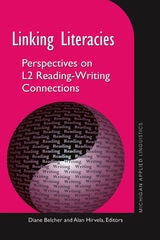
Linking Literacies
Perspectives on L2 Reading-Writing ConnectionsDiane Belcher and Alan Hirvela, Editors
University of Michigan Press, 2001
Linking Literacies provides the most up to date theoretical overview of the connection between reading and writing in second language acquisition. Belcher and Hirvela have brought together the definitive collection of developments in reading-writing relations research and pedagogy. Papers are organized into these parts:
Ground Practice: Theory, Research, and History
In the Classroom: Teaching Reading as Writing and Writing as Reading
(E)Merging Literacies and the Challenge of Textual Ownership
Technology-Assisted Reading and Writing.
In addition to examining the ways in which L1 influences have affected the development of L2 reading-writing theory and pedagogy, Linking Literacies looks at how L2 reading-writing scholarship has created an identity separate of an L1 framework. Linking Literacies examines a broad range of questions and concerns within the structure of L2 reading-writing connections and L2 academic literacy through discussions of theory, research, and
Linking by Types in the Hierarchical Lexicon
Anthony R. Davis
CSLI, 2001
Many previous approaches to this problem have employed a set of thematic roles, such as agent and patient, to classify varieties of participants. The alternative developed here fits within the framework of Head-Driven Phrase Structure Grammar while utilizing typed feature structures, certain basic features of verb meaning, a hierarchical classification of verb meanings, and constraints from more general to more specific word classes. Relying on no special mechanisms or components of grammar, this book is unique in its ability to account for the observed range of verb types in human languages with a simple yet widely applicable set of principles.
Lives in Two Languages
An Exploration of Identity and CultureLinda Watkins-Goffman
University of Michigan Press, 2001
Lives in Two Languages focuses on the experience of multicultural authors--like Richard Rodriguez, Amy Tan, Eva Hoffman, Chang-rae Lee, and Julia Alvarez--whose experiences can be related to anyone who has moved from one culture or subculture to another. As such, this text is an excellent comprehensive introduction to the multicultural experience for teachers and educators in all disciplines, as well as of interest to anyone interested in language culture and psychological process of identity.
Local Constraints vs. Economy
David E. Johnson and Shalom Lappin
CSLI, 1999
Logic and Representation
Robert C. Moore
CSLI, 1993
Logic, Information and Agency
Johan van Benthem
CSLI, 2025
Everything we do is driven by information, but the dynamic process of acquiring information and adjusting our views based on it has seldom been put at the center place in logic, and there are few textbooks introducing readers to this line of work. The present book introduces the reader to major logical techniques for studying information dynamics and interaction between agents, based on a variety of intuitive scenarios as well as recent research. Readers will learn styles of modeling, as well as the basic features of the new logical systems emanating from this line of work. All the separate strands in the book are brought together in a comprehensive study of information flow and action in games, forming a logic-based complement to standard perspectives in game theory.
Logic, Language and Computation
Edited by Jerry Seligman and Dag Westerståhl
CSLI, 1996
Logic, Language and Computation, Volume 3
Edited by Patrick Blackburn, Nick Braisby, Lawrence Cavedon, and Atsushi Shimoji
CSLI, 2001
The book contains contributions to a general theory of information, while also tackling specific problems from artificial intelligence, formal semantics, cognitive psychology, and the philosophy of mind. There is focus on the dynamics of information flow, and also a consideration of static approaches to information content; both quantitative and qualitative approaches are represented.
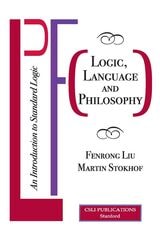
Logic, Language and Philosophy
An Introduction to Standard LogicFenrong Liu and Martin Stokhof
CSLI, 2024
This book explores the systematic and formal study of reasoning. It introduces the core systems of logic, discusses a portion of its extensions, and illustrates the application of logic in philosophy and linguistics utilizing classical and contemporary sources. In doing so, it provides the students with a rich set of tools along with first-hand experience regarding their applications in the study of rationality and meaning. With lots of exercises, and study and discussion questions, it provides a complete set of materials for courses for a variety of audiences at different levels.
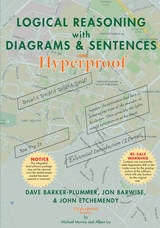
Logical Reasoning with Diagrams and Sentences
Using HyperproofDave Barker-Plummer, Jon Barwise, and John Etchemendy
CSLI, 2016
Unlike traditional formal treatments of reasoning, this package uses both graphical and sentential representations to reflect common situations in everyday reasoning where information is expressed in many forms, such as finding your way to a location using a map and an address. It also teaches students how to construct and check the logical validity of a variety of proofs—of consequence and non-consequence, consistency and inconsistency, and independence—using an intuitive proof system which extends standard proof treatments with sentential, graphical, and heterogeneous inference rules, allowing students to focus on proof content rather than syntactic structure. Building upon the widely used Tarski’s World and Language, Proof and Logic courseware packages, Logical Reasoning with Diagrams and Sentences contains more than three hundred exercises, most of which can be assessed by the Grade Grinder online assessment service; is supported by an extensive website through which students and instructors can access online video lectures by the authors; and allows instructors to create their own exercises and assess their students’ work.
Logical Reasoning with Diagrams and Sentences is an expanded revision of the Hyperproof courseware package.