Results by title
4531 books match the query 'Cultural & Ethnic Studies' and 166 start with l
Life Writing in the Long Run
A Smith and Watson Autobiography Studies ReaderSidonie Smith and Julia Watson
Michigan Publishing Services, 2016
Available in print, eBook, and open access versions, this collection captures decades of exciting developments in the field, making it indispensable reading for courses on modes and media of self-presentation in cultural, gender, and literary studies and feminist theory.
Life beside Bars
Confinement and Capital in an American Prison TownHeath Pearson
Duke University Press, 2024
Life between Two Deaths, 1989-2001
U.S. Culture in the Long NinetiesPhillip E. Wegner
Duke University Press, 2009
Wegner shows how phenomena including the debate on globalization, neoliberal notions of the end of history, the explosive growth of the Internet, the efflorescence of new architectural and urban planning projects, developments in literary and cultural production, new turns in theory and philosophy, and the rapid growth of the antiglobalization movement came to characterize the long nineties. He offers readings of some of the most interesting cultural texts of the era: Don DeLillo’s White Noise; Joe Haldeman’s Forever trilogy; Octavia Butler’s Parable novels; the Terminator films; the movies Fight Club, Independence Day, Cape Fear, and Ghost Dog; and the television series Buffy the Vampire Slayer. In so doing, he illuminates fundamental issues concerning narrative, such as how beginnings and endings are recognized and how relationships between events are constructed.

Life in Oil
Cofán Survival in the Petroleum Fields of AmazoniaBy Michael L. Cepek, Photographs by Bear Guerra
University of Texas Press, 2018
Oil is one of the world’s most important commodities, but few people know how its extraction affects the residents of petroleum-producing regions. In the 1960s, the Texaco corporation discovered crude in the territory of Ecuador’s indigenous Cofán nation. Within a decade, Ecuador had become a member of OPEC, and the Cofán watched as their forests fell, their rivers ran black, and their bodies succumbed to new illnesses. In 1993, they became plaintiffs in a multibillion-dollar lawsuit that aims to compensate them for the losses they have suffered. Yet even in the midst of a tragic toxic disaster, the Cofán have refused to be destroyed. While seeking reparations for oil’s assault on their lives, they remain committed to the survival of their language, culture, and rainforest homeland.
Life in Oil presents the compelling, nuanced story of how the Cofán manage to endure at the center of Ecuadorian petroleum extraction. Michael L. Cepek has lived and worked with Cofán people for more than twenty years. In this highly accessible book, he goes well beyond popular and academic accounts of their suffering to share the largely unknown stories that Cofán people themselves create—the ones they tell in their own language, in their own communities, and to one another and the few outsiders they know and trust. Their words reveal that life in oil is a form of slow, confusing violence for some of the earth’s most marginalized, yet resilient, inhabitants.

Life in a Cambodian Orphanage
A Childhood Journey for New OpportunitiesKathie Carpenter
Rutgers University Press, 2021

Life on the Hyphen
The Cuban-American WayBy Gustavo Pérez Firmat
University of Texas Press, 2012
An expanded, updated edition of the classic study of Cuban-American culture, this engaging book, which mixes the author’s own story with his reflections as a trained observer, explores how both famous and ordinary members of the “1.5 Generation” (Cubans who came to the United States as children or teens) have lived “life on the hyphen”—neither fully Cuban nor fully American, but a fertile hybrid of both. Offering an in-depth look at Cuban-Americans who have become icons of popular and literary culture—including Desi Arnaz, Oscar Hijuelos, musician Pérez Prado, and crossover pop star Gloria Estefan, as well as poets José Kozer and Orlando González Esteva, performers Willy Chirino and Carlos Oliva, painter Humberto Calzada, and others—Gustavo Pérez Firmat chronicles what it means to be Cuban in America.
The first edition of Life on the Hyphen won the Eugene M. Kayden National University Press Book Award and received honorable mentions for the Modern Language Association’s Katherine Singer Kovacs Prize and the Latin American Studies Association’s Bryce Wood Book Award.
Lift Every Voice
African American Oratory, 1787-1901Philip S. Foner
University of Alabama Press, 1997
The essential collection of African American voices that shaped the struggle for freedom, equality, and citizenship.
Lift Every Voice is a completely revised, updated, and expanded version of Philip Foner's 1972 classic Voice of Black America, which Library Journal hailed as "indispensable.""This well-edited and
richly inclusive work," wrote Benjamin Quarles, "unveils the full sweep of Black expression as found in platform addresses" by "men and women who join eloquence with reason in articulating their
grievances and their aspirations and in arousing their listeners with their ringing and prophetic challenges." This new collection includes over 60 additional texts and revised and expanded introductory essays that provide historical, biographical, and critical information for each speech.
For Americans of the 19th century, as W. E. B. Du Bois observed, eloquent speeches were 'the shining lights of civilization' that both expressed and sought to improve the lives and communities from which they sprang. Through political speeches, sermons, lectures, oral testimonies, and ceremonial addresses, African Americans offered diverse responses to the issues and events of their times, including not only slavery and racial equality but also women's rights, education, religion, immigration, socialism, war, Indian policy, and labor organization, among others. The speeches in this
collection are among the most powerful expressions of African American opinions on these issues and were delivered on occasions and before audiences where the speakers believed their words might be transformative.
Containing more than 150 speeches, this anthology represents the most extensive and diverse collection of African American oratory of the 18th and 19th centuries ever published. Lift Every Voice makes readily accessible not only the classic orations of such well-known figures as Frederick Douglass, Sojourner Truth, and Booker T. Washington but also dozens of lesser-known but important speeches deserving greater recognition and study. Many of these speeches are previously unpublished, uncollected, or long out of print.
Lifting the Shadow
Reshaping Memory, Race, and Slavery in U.S. MuseumsAmy Sodaro
Rutgers University Press, 2025
Light in the Dark/Luz en lo Oscuro
Rewriting Identity, Spirituality, RealityGloria E. Anzaldua
Duke University Press, 2015
Limits to Liberation after Apartheid
Citizenship, Governance, & CultureSteven L. Robins
Ohio University Press, 2005
Lincoln and Emancipation
Edna Greene Medford
Southern Illinois University Press, 2015
In this succinct study, Edna Greene Medford examines the ideas and events that shaped President Lincoln’s responses to slavery, following the arc of his ideological development from the beginning of the Civil War, when he aimed to pursue a course of noninterference, to his championing of slavery’s destruction before the conflict ended. Throughout, Medford juxtaposes the president’s motivations for advocating freedom with the aspirations of African Americans themselves, restoring African Americans to the center of the story about the struggle for their own liberation.
Lincoln and African Americans, Medford argues, approached emancipation differently, with the president moving slowly and cautiously in order to save the Union while the enslaved and their supporters pressed more urgently for an end to slavery. Despite the differences, an undeclared partnership existed between the president and slaves that led to both preservation of the Union and freedom for those in bondage. Medford chronicles Lincoln’s transition from advocating gradual abolition to campaigning for immediate emancipation for the majority of the enslaved, a change effected by the military and by the efforts of African Americans. The author argues that many players—including the abolitionists and Radical Republicans, War Democrats, and black men and women—participated in the drama through agitation, military support of the Union, and destruction of the institution from within. Medford also addresses differences in the interpretation of freedom: Lincoln and most Americans defined it as the destruction of slavery, but African Americans understood the term to involve equality and full inclusion into American society. An epilogue considers Lincoln’s death, African American efforts to honor him, and the president’s legacy at home and abroad.
Both enslaved and free black people, Medford demonstrates, were fervent participants in the emancipation effort, showing an eagerness to get on with the business of freedom long before the president or the North did. By including African American voices in the emancipation narrative, this insightful volume offers a fresh and welcome perspective on Lincoln’s America.
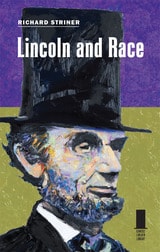
Lincoln and Race
Richard Striner
Southern Illinois University Press, 2012
Named on the 2013 list of University Press Books for Public and Secondary Schools
Abraham Lincoln is known as the Great Emancipator, yet his personal views on race have long been debated. Since his death, his legend has been shadowed by the mystery of his true stance toward non-whites. While Lincoln took many actions to fight slavery throughout his political career, his famously crafted speeches can be interpreted in different ways: at times his words suggest personal bigotry, but at other times he sounds like an enemy of racists. In Lincoln and Race, Richard Striner takes on one of the most sensitive subjects of Abraham Lincoln’s legacy, exploring in depth Lincoln’s mixed record and writings on the issue of race.
Striner gives fair hearing to two prevailing theories about Lincoln’s seemingly contradictory words and actions: Did Lincoln fight a long-term struggle to overcome his personal racism? Or were his racist comments a calculated act of political deception? Beginning with an exploration of the historical context of Lincoln’s attitudes toward race in the years before his presidency, Striner details the ambiguity surrounding the politician’s participation in the Free Soil Movement and his fight to keep slavery from expanding into the West. He explores Lincoln’s espousal of colonization—the controversial idea that freed slaves should be resettled in a foreign land—as a voluntary measure for black people who found the prospect attractive. The author analyzes some of Lincoln’s most racially charged speeches and details Lincoln’s presidential words and policies on race and the hotbed issue of voting rights for African Americans during the last years of the president’s life.
A brief but comprehensive look into one of the most contentious quandaries about Abraham Lincoln, Lincoln and Race invites readers to delve into the mind, heart, and motives of one of America’s most fascinating and complex leaders.
University Press Books for Public and Secondary Schools 2013 edition
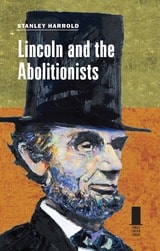
Lincoln and the Abolitionists
Stanley Harrold
Southern Illinois University Press, 2018
Abraham Lincoln has often been called the “Great Emancipator.” But he was not among those Americans who, decades before the Civil War, favored immediate emancipation of all slaves inside the United States. Those who did were the abolitionists—the men and women who sought freedom and equal rights for all African Americans. Stanley Harrold traces how, despite Lincoln’s political distance from abolitionists, they influenced his evolving political orientation before and during the Civil War.
While explaining how the abolitionist movement evolved, Harrold also clarifies Lincoln’s connections with and his separation from this often fiery group. For most of his life Lincoln regarded abolitionists as dangerous fanatics. Like many northerners during his time, Lincoln sought compromise with the white South regarding slavery, opposed abolitionist radicalism, and doubted that free black people could have a positive role in America. Yet, during the 1840s and 1850s, conservative northern Democrats as well as slaveholders branded Lincoln an abolitionist because of his sympathy toward black people and opposition to the expansion of slavery.
Lincoln’s election to the presidency and the onslaught of the Civil War led to a transformation of his relationship with abolitionists. Lincoln’s original priority as president had been to preserve the Union, not to destroy slavery. Nevertheless many factors—including contacts with abolitionists—led Lincoln to favor ending slavery. After Lincoln issued the Emancipation Proclamation in 1863 and raised black troops, many, though not all, abolitionists came to view him more favorably.
Providing insight into the stressful, evolving relationship between Lincoln and the abolitionists, and also into the complexities of northern politics, society, and culture during the Civil War era, this concise volume illuminates a central concern in Lincoln’s life and presidency.
Lincoln and the U.S. Colored Troops
John David Smith
Southern Illinois University Press, 2013
Though scholars have written much on emancipation and the USCT, Smith’s work frames the evolution of Lincoln’s ideas on emancipation and arming blacks within congressional actions, explaining how, when, and why the president seemed to be so halting in his progression to military emancipation. After tracing Lincoln’s evolution from opposing to supporting emancipation as a necessary war measure and to championing the recruitment of black troops for the Union Army, Smith details the creation, mobilization, and diverse military service of the USCT. He assesses the hardships under which the men of the USCT served, including the multiple forms of discrimination from so-called friends and foes alike, and examines the broad meaning of Lincoln’s military emancipation project and its place in African American historical memory.
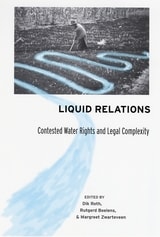
Liquid Relations
Contested Water Rights and Legal ComplexityRoth, Dik
Rutgers University Press, 2005
Water management plays an increasingly critical role in national and international policy agendas. Growing scarcity, overuse, and pollution, combined with burgeoning demand, have made socio-political and economic conflicts almost unavoidable. Proposals to address water shortages are usually based on two key assumptions: (1) water is a commodity that can be bought and sold and (2) “states,” or other centralized entities, should control access to water.
Liquid Relations criticizes these assumptions from a socio-legal perspective. Eleven case studies examine laws, distribution, and irrigation in regions around the world, including the United States, Nepal, Indonesia, Chile, Ecuador, India, and South Africa. In each case, problems are shown to be both ecological and human-made. The essays also consider the ways that gender, ethnicity, and class differences influence water rights and control.
In the concluding chapter, the editors draw on the essays’ findings to offer an alternative approach to water rights and water governance issues. By showing how issues like water scarcity and competition are embedded in specific resource use and management histories, this volume highlights the need for analyses and solutions that are context-specific rather than universal.
Listening in Detail
Performances of Cuban MusicAlexandra T. Vazquez
Duke University Press, 2013
Listening to Images
Tina M. Campt
Duke University Press, 2017
Listening to the Lomax Archive
The Sonic Rhetorics of African American Folksong in the 1930sJonathan W. Stone
University of Michigan Press, 2021
In 1933, John A. Lomax and his son Alan set out as emissaries for the Library of Congress to record the folksong of the “American Negro” in several southern African-American prisons. Listening to the Lomax Archive: The Sonic Rhetorics of African American Folksong in the 1930s asks how the Lomaxes’ field recordings—including their prison recordings and a long-form oral history of jazz musician Jelly Roll Morton—contributed to a new mythology of Americana for a nation in the midst of financial, social, and identity crises. Jonathan W. Stone argues that folksongs communicate complex historical experiences in a seemingly simple package, and can thus be a key element—a sonic rhetoric—for interpreting the ebb and flow of cultural ideals within contemporary historical moments. He contends that the Lomaxes, aware of the power folk music, used the folksongs they collected to increase national understanding of and agency for the subjects of their recordings (including the reconstitution of prevailing stereotypes about African American identity) even as they used the recordings to advance their own careers. Listening to the Lomax Archive gives readers the opportunity to listen in on these seemingly contradictory dualities, demonstrating that they are crucial to the ways that we remember and write about the subjects of the Lomaxes archive and other repositories of historicized sound.

Listening with a Feminist Ear
Soundwork in Bombay CinemaPavitra Sundar
University of Michigan Press, 2023
Honorable Mention of the 2023 MLA Aldo and Jeanne Scaglione Prize for South Asian Studies
- Longlist Finalist of the 2024 Kraszna-Krausz Foundation Moving Image Book Award
Listening with a Feminist Ear is a study of the cultural politics and possibilities of sound in cinema. Eschewing ocularcentric and siloed disciplinary formations, the book takes seriously the radical theoretical and methodological potential of listening. It models a feminist interpretive practice that is not just attuned to how power and privilege are materialized in sound, but that engenders new, counter-hegemonic imaginaries.
Focusing on mainstream Bombay cinema, Sundar identifies singing, listening, and speaking as key sites in which gendered notions of identity and difference take form. Charting new paths through seven decades of film, media, and cultural history, Sundar identifies key shifts in women’s playback voices and the Islamicate genre of the qawwali. She also conceptualizes spoken language as sound, and turns up the volume on a capacious, multilingual politics of belonging that scholarly and popular accounts of nation typically render silent. All in all, Listening with a Feminist Ear offers a critical sonic sensibility that reinvigorates debates about the gendering of voice and body in cinema, and the role of sound and media in conjuring community.
Literary Gestures
The Aesthetic in Asian American Writingedited by Rocío G. Davis and Sue-Im Lee
Temple University Press, 2005

Literature for Change
The Case for Literary Research Across Languages and CulturesEdited by Charles Burdett, Joseph Ford, Godela Weiss-Sussex, and Naomi Wells
University of London Press, 2026
Highlighting efforts to address today’s most pressing social challenges through the study of texts in languages other than English.
Literature for Change examines how the study, production, circulation, and reception of literary texts in languages other than English contribute to addressing contemporary social challenges. Through eleven case studies across diverse languages and cultures, it analyzes the real-world impact of literary research, showing its relevance to sectors such as museums and heritage, the environmental and medical humanities, and the digital sphere. Combining hermeneutic and aesthetic approaches, the chapters demonstrate the value of varied methods, including theoretically grounded creative inquiry, and the connections between literary studies and other disciplines. The book affirms the importance of the field of modern languages and the continuing role of literary texts in shaping social and cultural life.
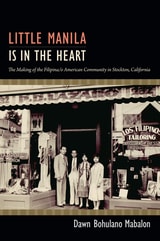
Little Manila Is in the Heart
The Making of the Filipina/o American Community in Stockton, CaliforniaDawn Bohulano Mabalon
Duke University Press, 2013
Mabalon draws on oral histories, newspapers, photographs, personal archives, and her own family's history in Stockton. She reveals how Filipina/o immigrants created a community and ethnic culture shaped by their identities as colonial subjects of the United States, their racialization in Stockton as brown people, and their collective experiences in the fields and in the Little Manila neighborhood. In the process, Mabalon places Filipinas/os at the center of the development of California agriculture and the urban West.

Little Saigons
Staying Vietnamese in AmericaKarin Aguilar–San Juan
University of Minnesota Press, 2009
Karin Aguilar-San Juan examines the contradictions of Vietnamese American community and identity in two emblematic yet different locales: Little Saigon in suburban Orange County, California (widely described as the capital of Vietnamese America) and the urban "Vietnamese town" of Fields Corner in Boston, Massachusetts. Their distinctive qualities challenge assumptions about identity and space, growth amid globalization, and processes of Americanization.
With a comparative and race-cognizant approach, Aguilar-San Juan shows how places like Little Saigon and Fields Corner are sites for the simultaneous preservation and redefinition of Vietnamese identity. Intervening in debates about race, ethnicity, multiculturalism, and suburbanization as a form of assimilation, this work elaborates on the significance of place as an integral element of community building and its role in defining Vietnamese American-ness.
Staying Vietnamese, according to Aguilar-San Juan, is not about replicating life in Viet Nam. Rather, it involves moving toward a state of equilibrium that, though always in flux, allows refugees, immigrants, and their U.S.-born offspring to recalibrate their sense of self in order to become Vietnamese anew in places far from their presumed geographic home.
Little Tools of Knowledge
Historical Essays on Academic and Bureaucratic PracticesPeter Becker and William Clark, Editors
University of Michigan Press, 2001
Live Dead
The Grateful Dead, Live Recordings, and the Ideology of LivenessJohn Brackett
Duke University Press, 2023
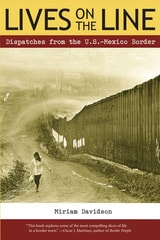
Lives on the Line
Dispatches from the U.S.-Mexico BorderMiriam Davidson
University of Arizona Press, 2000
In Lives on the Line, Miriam Davidson tells five true stories from these border cities to show the real-life effects that the maquiladora boom and the law enforcement crackdown have had on the people of "Ambos (Both) Nogales." Readers will meet Yolanda Sánchez, a single mother who came to work in the factories; Jimmy Teyechea, a cancer victim who became an outspoken environmental activist; Dario Miranda Valenzuela, an undocumented immigrant who was shot and killed by a U.S. Border Patrol agent; Cristina, a "tunnel kid" who aspired to flee the gang lifestyle; and Hope Torres and Tom Higgins, maquiladora managers who have made unique contributions to the community.
In sharing these stories of people transformed by love and faith, by pain and loss, Davidson relates their experiences to larger issues and shows that, although life on the border is tough, it is not without hope.
Lives on the Line is an impassioned look at the changes that have swept the U.S.-Mexico border: the rising tension concerning free trade and militarization, the growing disparity between the affluent and the impoverished. At the same time, the book highlights the positive aspects of change, revealing challenges and opportunities not only for the people who live on the border but for all Americans.
Living Black
Social Life in an African American NeighborhoodMark S. Fleisher
University of Wisconsin Press, 2015
Mark S. Fleisher offers a window into daily life in this neighborhood, particularly through the stories of Mo and Memphis Washington, who fight to sustain a stable home for their children, and of Burpee, a local man who has returned to the North End to rebuild his life after years of crime and punishment in Chicago.
“Outstanding” books for public & secondary school libraries from university presses, American Library Association

Living Class in Urban India
Dickey, Sara
Rutgers University Press, 2016
Many Americans still envision India as rigidly caste-bound, locked in traditions that inhibit social mobility. In reality, class mobility has long been an ideal, and today globalization is radically transforming how India’s citizens perceive class. Living Class in Urban India examines a nation in flux, bombarded with media images of middle-class consumers, while navigating the currents of late capitalism and the surges of inequality they can produce.
This book is also freely available online as an open-access digital edition, published with the support of the National Endowment for the Humanities.
Living Color
Race and Television in the United StatesSasha Torres, ed.
Duke University Press, 1998
Ranging across television genres, historical periods, and racial formations, Living Color—as it positions race as a key element of television’s cultural influence—moves the discussion out of a black-and-white binary and illustrates how class, gender, and sexuality interact with images of race. In addition to essays on representations of "Oriental" performers and African Americans in the early years of television, this collection also examines how the celebrity of the late MTV star Pedro Zamora countered racist and homophobic discourses; reveals how news coverage on drug use shifted from the white middle-class cocaine user in the early 1980s to the black "crack mother" of the 1990s; and takes on TV coverage of the Rodney King beating and the subsequent unrest in Los Angeles. Other essays consider O.J. Simpson’s murder trial, comparing television’s treatment of Simpson to that of Michael Jackson, Magic Johnson, Michael Jordan, and Clarence Thomas and look at the racism directed at Asian Americans by the recurring "Dancing Itos" on Jay Leno’s Tonight Show.
Living Ideology in Cuba
Socialism in Principle and PracticeKatherine A. Gordy
University of Michigan Press, 2015
Living Ruins
Native Engagements with Past Materialities in Contemporary Mesoamerica, Amazonia, and the AndesPhilippe Erikson
University Press of Colorado, 2022
Ten case studies from the Maya region, Amazonia, and the Andes detail and contextualize narratives, rituals, and a range of practices and attitudes toward different kinds of vestiges. The chapters engage with recently debated issues such as regimes of historicity and knowledge, cultural landscapes, conceptions of personhood and ancestrality, artifacts, and materiality. They focus on Indigenous perspectives rather than mainstream narratives such as those mediated by UNESCO, Hollywood, travel agents, and sometimes even academics. The contributions provide critical analyses alongside a multifaceted account of how people relate to the place/time nexus, expanding our understanding of different ontological conceptualizations of the past and their significance in the present.
Living Ruins adds to the lively body of work on the invention of tradition, Indigenous claims on their lands and history, “retrospective ethnogenesis,” and neo-Indianism in a world where tourism, NGOs, and Western essentialism are changing Indigenous attitudes and representations. This book is significant to anyone interested in cultural heritage studies, Amerindian spirituality, and Indigenous engagement with archaeological sites in Latin America.
Contributors: Cedric Becquey, Laurence Charlier Zeineddine, Marie Chosson, Pablo Cruz, Philippe Erikson, Antoinette Molinié, Fernando Santos-Granero, Emilie Stoll, Valentina Vapnarsky, Pirjo Kristiina Virtanen
Living a Feminist Life
Sara Ahmed
Duke University Press, 2017
Living and Dying in São Paulo
Immigrants, Health, and the Built Environment in BrazilJeffrey Lesser
Duke University Press, 2025
Living beyond the Pale
Environmental Justice and the Roma MinorityRichard Filcák
Central European University Press, 2012
Living for the Revolution
Black Feminist Organizations, 1968–1980Kimberly Springer
Duke University Press, 2005
The organizations that Springer examines were the first to explicitly use feminist theory to further the work of previous black women’s organizations. As she describes, they emerged in response to marginalization in the civil rights and women’s movements, stereotyping in popular culture, and misrepresentation in public policy. Springer compares the organizations’ ideologies, goals, activities, memberships, leadership styles, finances, and communication strategies. Reflecting on the conflicts, lack of resources, and burnout that led to the demise of these groups, she considers the future of black feminist organizing, particularly at the national level. Living for the Revolution is an essential reference: it provides the history of a movement that influenced black feminist theory and civil rights activism for decades to come.
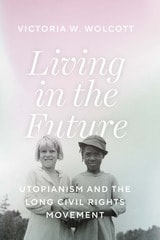
Living in the Future
Utopianism and the Long Civil Rights MovementVictoria W. Wolcott
University of Chicago Press, 2022
Utopian thinking is often dismissed as unrealistic, overly idealized, and flat-out impractical—in short, wholly divorced from the urgent conditions of daily life. This is perhaps especially true when the utopian ideal in question is reforming and repairing the United States’ bitter history of racial injustice. But as Victoria W. Wolcott provocatively argues, utopianism is actually the foundation of a rich and visionary worldview, one that specifically inspired the major figures of the Civil Rights Movement in ways that haven’t yet been fully understood or appreciated.
Wolcott makes clear that the idealism and pragmatism of the Civil Rights Movement were grounded in nothing less than an intensely utopian yearning. Key figures of the time, from Martin Luther King Jr. and Pauli Murray to Father Divine and Howard Thurman, all shared a belief in a radical pacificism that was both specifically utopian and deeply engaged in changing the current conditions of the existing world. Living in the Future recasts the various strains of mid-twentieth-century civil rights activism in a utopian light, revealing the power of dreaming in a profound and concrete fashion, one that can be emulated in other times that are desperate for change, like today.
Living in the Future
Utopianism and the Long Civil Rights MovementVictoria W. Wolcott
University of Chicago Press, 2022
This is an auto-narrated audiobook edition of this book.
Living in the Future reveals the unexplored impact of utopian thought on the major figures of the Civil Rights Movement.
Utopian thinking is often dismissed as unrealistic, overly idealized, and flat-out impractical—in short, wholly divorced from the urgent conditions of daily life. This is perhaps especially true when the utopian ideal in question is reforming and repairing the United States’ bitter history of racial injustice. But as Victoria W. Wolcott provocatively argues, utopianism is actually the foundation of a rich and visionary worldview, one that specifically inspired the major figures of the Civil Rights Movement in ways that haven’t yet been fully understood or appreciated.
Wolcott makes clear that the idealism and pragmatism of the Civil Rights Movement were grounded in nothing less than an intensely utopian yearning. Key figures of the time, from Martin Luther King Jr. and Pauli Murray to Father Divine and Howard Thurman, all shared a belief in a radical pacificism that was both specifically utopian and deeply engaged in changing the current conditions of the existing world. Living in the Future recasts the various strains of mid-twentieth-century civil rights activism in a utopian light, revealing the power of dreaming in a profound and concrete fashion, one that can be emulated in other times that are desperate for change, like today.
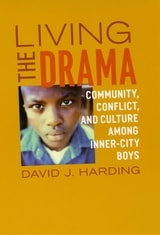
Living the Drama
Community, Conflict, and Culture among Inner-City BoysDavid J. Harding
University of Chicago Press, 2010
David J. Harding studied sixty adolescent boys growing up in two very poor areas and one working-class area. In the first two, violence and neighborhood identification are inextricably linked as rivalries divide the city into spaces safe, neutral, or dangerous. Consequently, Harding discovers, social relationships are determined by residential space. Older boys who can navigate the dangers of the streets serve as role models, and friendships between peers grow out of mutual protection. The impact of community goes beyond the realm of same-sex bonding, Harding reveals, affecting the boys’ experiences in school and with the opposite sex. A unique glimpse into the world of urban adolescent boys, Living the Drama paints a detailed, insightful portrait of life in the inner city.
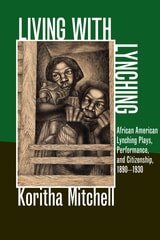
Living with Lynching
African American Lynching Plays, Performance, and Citizenship, 1890-1930Koritha Mitchell
University of Illinois Press, 2012
In closely analyzing the political and spiritual uses of black theatre during the Progressive Era, Mitchell demonstrates that audiences were shown affective ties in black families, a subject often erased in mainstream images of African Americans. Examining lynching plays as archival texts that embody and reflect broad networks of sociocultural activism and exchange in the lives of black Americans, Mitchell finds that audiences were rehearsing and improvising new ways of enduring in the face of widespread racial terrorism. Images of the black soldier, lawyer, mother, and wife helped readers assure each other that they were upstanding individuals who deserved the right to participate in national culture and politics. These powerful community coping efforts helped African Americans band together and withstand the nation's rejection of them as viable citizens.
The Left of Black interview with author Koritha Mitchell begins at 14:00.
An interview with Koritha Mitchell at The Ohio Channel.
Living with Stories
Telling, Re-telling, and RememberingSchneider, William
Utah State University Press, 2008
Local Governments and Rural Development
Comparing Lessons from Brazil, Chile, Mexico, and PeruKrister Andersson, Gustavo Gordillo de Anda, and Frank van Laerhoven
University of Arizona Press, 2009
Based on interviews with more than 1,200 mayors, local officials, and farmers in 390 municipal territories in four Latin American nations, the authors analyze the ways in which different forms of decentralization affect the governance arrangements for rural development “on the ground.” Their comparative analysis suggests that rural development outcomes are systemically linked to locally negotiated institutional arrangements—formal and informal—between government officials, NGOs, and farmer groups that operate in the local sphere. They find that local-government actors contribute to public services that better assist the rural poor when local actors cooperate to develop their own institutional arrangements for participatory planning, horizontal learning, and the joint production of services.
This study brings substantive data and empirical analysis to a discussion that has, until now, more often depended on qualitative research in isolated cases. With more than 60 percent of Latin America’s rural population living in poverty, the results are both timely and crucial.
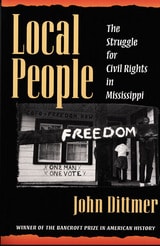
Local People
The Struggle for Civil Rights in MississippiJohn Dittmer
University of Illinois Press, 1994
Publication of this book was supported by a grant from DePauw University, Greencastle, Indiana.
Locating Filipino Americans
Rick Bonus
Temple University Press, 2000
Locating Filipino Americans, an ethnographic study of Filipino American communities in Los Angeles and San Diego, present a multi-disciplinary cultural analysis of the relationship between ethnic identity and social space. Author Rick Bonus argues that alternative community spaces enable Filipino Americans to respond to and resist the ways in which the larger society has historically and institutionally rendered them invisible, silenced, and racialized. Bonus focuses on the "Oriental" stores, the social halls and community centers, and the community newspapers to demonstrate how ethnic identities are publicly constituted and communities are transformed. Delineating the spaces formed by diasporic consciousness, Bonus shows how community members appropriate elements from their former homeland and from their new settlements in ways defined by their critical stances against racism, homogenization, complete assimilation, and exclusionary citizenship. Locating Filipino Americans is one of the few books that offers a grounded approach to theoretical analyses of ethnicity and contemporary culture in the U.S.
Lone Pursuit
Distrust and Defensive Individualism Among the Black PoorSandra Susan Smith
Russell Sage Foundation, 2007
Long Is the Way and Hard
One Hundred Years of the NAACPKevern Verney
University of Arkansas Press, 2009
Long March Ahead
African American Churches and Public Policy in Post-Civil Rights AmericaR. Drew Smith ed.
Duke University Press, 2004
Long March Ahead emphasizes the need for African American churches to complement the excellent work they do in implementing policies set by others by getting more involved in shaping public policy. The contributors explore the efficacy of different means of public policy advocacy and social service delivery, including faith-based initiatives. At the same time, they draw attention to trends that have constrained political involvement by African American churches: the increased professionalization of policy advocacy and lobbying, the underdevelopment of church organizational structures devoted to policy work, and tensions between religious imperatives and political activism. Long March Ahead takes an important look at the political role of African American churches after the great policy achievements of the civil rights era.
Contributors
Cathy J. Cohen
Megan McLaughlin
Columba Aham Nnorum
Michael Leo Owens
Desiree Pedescleaux
Barbara D. Savage
R. Drew Smith
Emilie Townes
Christopher Winship
Look Away!
The U.S. South in New World StudiesJon Smith and Deborah Cohn, eds.
Duke University Press, 2004
Look Away! presents work by respected scholars in comparative literature, American studies, and Latin American studies. The contributors analyze how writers—including the Martinican Edouard Glissant, the Cuban-American Gustavo Pérez Firmat, and the Trinidad-born, British V. S. Naipaul—have engaged with the southern United States. They explore William Faulkner’s role in Latin American thought and consider his work in relation to that of Gabriel García Márquez and Jorge Luis Borges. Many essays re-examine major topics in southern U.S. culture—such as race, slavery, slave resistance, and the legacies of the past—through the lens of postcolonial theory and postmodern geography. Others discuss the South in relation to the U.S.–Mexico border. Throughout the volume,the contributors consistently reconceptualize U.S. southern culture in a way that acknowledges its postcolonial status without diminishing its distinctiveness.
Contributors. Jesse Alemán, Bob Brinkmeyer, Debra Cohen, Deborah Cohn, Michael Dash, Leigh Anne Duck, Wendy Faris, Earl Fitz, George Handley, Steve Hunsaker, Kirsten Silva Gruesz, Dane Johnson, Richard King, Jane Landers, John T. Matthews, Stephanie Merrim, Helen Oakley, Vincent Pérez, John-Michael Rivera, Scott Romine, Jon Smith, Ilan Stavans, Philip Weinstein, Lois Parkinson Zamora
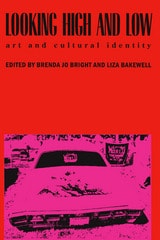
Looking High and Low
Art and Cultural IdentityBrenda Jo Bright
University of Arizona Press, 1995
Arguing that art is constituted across cultural boundaries rather than merely inside them, the contributors explore the relations between art, cultural identity, and the social languages of evaluation—among artists, art critics, art institutions, and their audiences—in the Southwest and in Mexico. The authors use anthropological methods in art communities to uncover compelling evidence of how marginalized populations make meaning for themselves, how images of ethnicity function in commercial culture, how Native populations must negotiate sentimental marketing and institutional appropriation of their art work, and how elite populations use culture and ritual in ways that both reveal and obscure their power and status. The authors make dramatic revelations concerning the construction and contestation of ideas of art as they circulate between groups where notions of what art "should" be are often at odds with each other.
This volume challenges conventional modes of analyzing art. Its ethnographic explorations illuminate the importance of art as a cultural force while creating a greater awareness of the roles that scholars, museum curators, and critics play in the evaluation of art.
Contents
Introduction: Art Hierarchies, Cultural Boundaries, and Reflexive Analysis, Brenda Jo Bright
Bellas Artes and Artes Populares: The Implications of Difference in the Mexico City Art World, Liza Bakewell
Space, Power, and Youth Culture: Mexican American Graffiti and Chicano Murals in East Los Angeles, 1972-1978, Marcos Sanchez-Tranquilino
Remappings: Los Angeles Low Riders, Brenda Jo Bright
Marketing Maria: The Tribal Artist in the Age of Mechanical Reproduction, Barbara Babcock
Aesthetics and Politics: Zuni War God Repatriation and Kachina Representation, Barbara Tedlock
Middlebrow into Highbrow at the J. Paul Getty Trust, Los Angeles, George E. Marcus
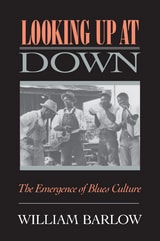
Looking Up at Down
The Emergence of Blues CultureWilliam Barlow
Temple University Press, 1990
More than just a history of a musical genre, Looking Up at Down traces the evolution of the various strands of blues music within the broader context of the culture on which it commented, and discusses its importance as a form of cultural resistance and identity for Afro-Americans. William Barlow explores the lyrics, describes the musical styles, and portrays the musicians and performers who created this uniquely American music. He describes how the blues sound—with its recognizable dissonance and African musical standards—and the blues text, which provided a bottom up view of American society, became bulwarks of cultural resistance.
Using rare recordings, oral histories, and interviews, Barlow analyzes how the blues was sustained as a form of Afro-American cultural resistance despite attempts by the dominant culture to assimilate and commercialize the music and exploit its artists.

Lords of the Sea
Pirates, Violence, and Commerce in Late Medieval JapanPeter D. Shapinsky
University of Michigan Press, 2014