Results by title
3785 books match the query 'Poetry' and 131 start with l
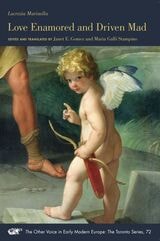
Love Enamored and Driven Mad
Lucrezia Marinella
Iter Press, 2020
The Other Voice in Early Modern Europe - The Toronto Series, volume 72
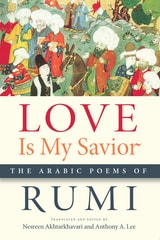
Love Is My Savior
The Arabic Poems of RumiNesreen Rumi
Michigan State University Press, 2016
This dual-language volume opens a treasury of Rumi’s mystic thought and startling poetry. His verses pulsate with desire and longing, with sensuality, and with ecstatic celebration. Rumi found in his mystic poetry a vehicle for the expression of the endless spiritual bounties of love. He placed love at the center of his faith and doctrine, and he pronounced it to be the goal of his life and the only form of true worship. This collection is stunningly rendered in English by an award-winning poet and a distinguished translator of Arabic poetry.
Love Known
Theology and Experience in George Herbert's PoetryRichard Strier
University of Chicago Press, 1983

Love Letter To Who Owns The Heavens
Corey Van Landingham
Tupelo Press, 2021
“What love poem / could be written when men can no longer / look up?” this book asks, always in a state of flux between doubt and belief—in wars, in gods, in fathers, in love. Through epistolary addresses to these figures of power and others, these poems attempt to make bodies concrete and dangerous, immediate and addressable, once again.
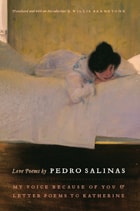
Love Poems by Pedro Salinas
My Voice Because of You and Letter Poems to KatherinePedro Salinas
University of Chicago Press, 2010
Now in paperback, a bilingual edition of one of the greatest sequences of love poems ever written.
When Pedro Salinas’s 1933 collection of love poems, La voz a ti debida, was introduced to American audiences in Willis Barnstone’s 1975 English translation, it was widely regarded as the greatest sequence of love poems written by a man or a woman, in any language, in the twentieth century. Now, seventy-five years after its publication, the reputation of the poems and its multifaceted writer remains untarnished. A portrait of their era, the poems, from a writer in exile from his native civil war-torn Spain, now reemerge in our time.
In this new, facing-page bilingual edition, Barnstone has added thirty-six poems written in the form of letters from Salinas to his great love, Katherine Whitmore. Discovered years later, these poems were written during and after the composition of La voz and, though disguised as prose, have all the rhythms and sounds of lineated lyric poetry. Taken together, the poems and letters are a history, a dramatic monologue, and a crushing and inevitable ending to the story of a man consumed by his love and his art.
Bolstered by an elegant foreword by Salinas’s contemporary, the poet Jorge Guillén, and a masterly afterword by the Salinas scholar, Enric Bou, that considers the poet and his legacy for twenty-first century world poetry, Love Poems by Pedro Salinas will be cause for celebration throughout the world of verse and beyond.
Love Song to the Demon-Possessed Pigs of Gadara
William Fargason
University of Iowa Press, 2020
In his debut collection, William Fargason inspects the pain of memory alongside the pain of the physical body. Fargason takes language to its limits to demonstrate how grief is given a voice. His speaker confronts illness, grapples with grief, and heals after loss in its most crushing forms. These poems attempt to make sense of trauma in a time of belligerent fathers and unacceptable answers. Fargason necessarily confronts toxic masculinity while navigating spiritual and emotional vulnerability.
Love among the Poets
The Victorian Poetics of IntimacyPearl Chaozon Bauer; Erik Gray
Ohio University Press, 2024
Love and Devotion
From Persia and BeyondEdited by Susan Scollay
Bodleian Library Publishing, 2012
Yusuf and Zulaykha. Khusrau and Shirin. Layla and Majnun. For hundreds of years, Persian poets have captivated audiences with recitations and reinterpretations of timeless tales of earthly and spiritual love. These tales were treasured not only in Iran, but also across the neighboring Mughal and Ottoman Empires.
In Love and Devotion, leading specialists in literature, art history, and philosophy reveal new perspectives on these evocative stories and the exquisite illustrated manuscripts that convey them. Particularly in courtly settings, poetry was a key component of Persian cultural life from the fourteenth through the eighteenth century, and elite patrons commissioned copies of lyrical poems and epics told in verse. Beautifully presented here in full-page reproductions are more than one hundred folios from these illustrated manuscripts, representing masterful works from Hafiz, Rumi, and many others. Echoes of works by Persian poets are manifest across European literature from Dante and Shakespeare to the present, and this lavishly illustrated book reveals new perspectives on the universal theme of love.
Love and Scorn
New and Selected PoemsCarol Frost
Northwestern University Press, 2000

Love and the Soul
Alan Williamson
University of Chicago Press, 1995
Love's Answer
Michael Heffernan
University of Iowa Press, 1994
Love, Like Pronouns
Rosmarie Waldrop
Omnidawn, 2003
Lovely Asunder
PoemsDanielle Cadena Deulen
University of Arkansas Press, 2011

Love’s Austere and Lonely Offices
Street Portraits and PoemsMarcus Jackson
Northwestern University Press, 2026
An astounding collection of photographs from a renowned poet
Created during the tumultuous years of 2020 and 2021, Love’s Austere and Lonely Offices: Street Portraits and Poems intersects the lens of accomplished poet and photographer Marcus Jackson with his words. The focus: the Black experience and existence. Amid isolation, protest, and survival, Jackson is the aperture and scribe giving visual consciousness and breath to these human portraits. His camera strips the view of endless cycles of social and moral injustices, presenting a resonant collection of photographs that make space for the moments and the people whose beings represent the ongoing interplay between history, society, and the individual soul.
Loving Mountains, Loving Men
Memoirs of a Gay AppalachianJeff Mann
Ohio University Press, 2023
Lucky Fish
Aimee Nezhukumatathil
Tupelo Press, 2011
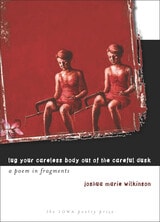
Lug Your Careless Body out of the Careful Dusk
A Poem in FragmentsJoshua Marie Wilkinson
University of Iowa Press, 2006
Drawing from the paintings of Susan Rothenberg, Gwyneth Scally, and Eric Fischl as well as from the photography of Allison Maletz, Joshua Marie Wilkinson’s Lug Your Careless Body out of the Careful Dusk is a book-length poem written in small fragments. Comprised of seven sections, the poem is formed as much by the poet’s travels through Turkey, the Baltics, and Eastern Europe as it is by the movies of Rainer Werner Fassbinder, Krzysztof Kieslowski, and Bill Morrison. The painters Francis Bacon and Lucian Freud are here alongside whispers of Emily Dickinson and Wallace Stevens. Lug Your Careless Body out of the Careful Dusk is a book of cinematic images and fragments, of small stories overheard and quickly abandoned, of hidden letters and phone booths, and of ghosts who return with questions.
Born and raised in Seattle’s Haller Lake neighborhood, Joshua Marie Wilkinson is the author of one other book of poetry, Suspension of a Secret in Abandoned Rooms, and the chapbook A Ghost as King of the Rabbits. He holds an MFA from the University of Arizona and an MA in film studies from University College Dublin. Presently he lives in Denver, Colorado, where he is pursuing his doctorate in English and creative writing and completing his first film.
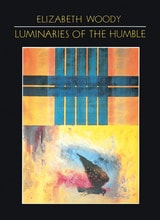
Luminaries of the Humble
Elizabeth Woody
University of Arizona Press, 1994
In opening remarks, Woody shares anecdotes of her youth that contributed to her sense of personal history and her development as a poet. "The petroglyphs on rock in the Columbia River Gorge are part of my literary heritage," she writes. Now through the medium of the printed word, Luminaries of the Humble marks an important continuation of that tradition.
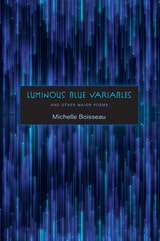
Luminous Blue Variables
and Other Major PoemsMichelle Boisseau
BkMk Press, 2021
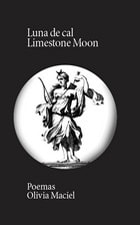
Luna de cal / Limestone Moon
Poemas / PoemsOlivia Maciel
Swan Isle Press, 2000

Lunacy of Light
Emily Dickinson and the Experience of MetaphorWendy Barker
Southern Illinois University Press, 0
"Are you afraid of the sun?" Emily Dickinson asked a friend in 1859.
Wendy Barker states here that that apparently casual query reveals a major theme of Dickinson’s poetry, a theme she shares with women writers ranging from Anne Finch to Anne Sexton. It is a tradition based upon the inversion of the traditional male-centered metaphors of light and dark. Through time the light-giving sun has represented vitality, order, God; the light-swallowing night death, chaos, Satan. These metaphors are reinforced in the writing of Emerson, Thoreau, Hawthorne, and Keats,but Eliot, Brontë, Browning, and Dickinson use the sun and images of light quite differently.
Barker argues that since light was a masculine tradition, ithad come to represent male power, energy, sexuality—not only to Dickinson but to other women writing during the era. To these writers the inversion of the light/darkness metaphor became a countertradition used as a means to express their energies in a society that was hostile to their intelligence. Dickinson, who read avidly, could not have been insensitive to this usage of light as a masculine symbol—of her Calvinist God, of her father, of all that was male—and of darkness as a feminine symbol.
Emily Dickinson thought in a richly symbolic manner. Her most frequently used metaphor is one of light in contrast to darkness, employing single-word references to light more than one thousand times in her 1,775 poems. Barker offers close readings and new interpretations of some previously overlooked or misunderstood poems and demonstrates that "Many of her most ecstatic images are oflittle lights created from darkness." Inanswer to those critics who have characterized her poems as being piecemeal, Barker argues that Dickinson’s consistent use of light as a metaphor unifies her poetry.
In her final chapter, Barker explores the ways in which twentieth-century female writers have carried on the countertradition of the light/darkness metaphor. "That Dickinson was able so brilliantly to transform and transcend the normative metaphoric patterning of her culture, creating, in effect, a metaphor of her own, has much to do with the genius of her art."
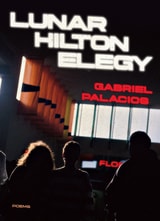
Lunar Hilton Elegy
Palacios, Gabriel
University of Iowa Press, 2026
Defining what Gabriel Palacios terms the “vaporpoem,” Lunar Hilton Elegy moves through the artifacts of a boyhood suspended in the neon-noir dusk of 1989—home-taped Video Soul broadcasts, dead-mall architecture, late-night cable access—treating the past not as a home to return to, but as an improvised shelter against the present’s digital weather.
Lunar Hilton Elegy asks what remains of the American myth when its “freshly planted tracts” resolve into blue photonic mist. At once darkly comic and urgently elegiac, Palacios offers a report from the threshold of the still-buffering all-at-once—or, more precisely, a lost-and-found sunbaked cassette of that report, still playing.
This collection is in conversation with the soundpoem project, Spanish Trail Motel. You can listen here.
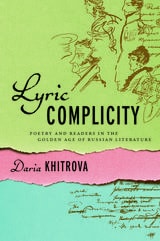
Lyric Complicity
Poetry and Readers in the Golden Age of Russian LiteratureDaria Khitrova
University of Wisconsin Press, 2019
Lyric Complicity helps modern readers recover Russian poetry’s former uses and functions—life situations that moved people to quote or perform a specific passage from a poem or a forgotten occasion that created unforgettable verse.
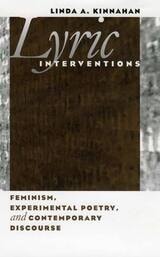
Lyric Interventions
Feminism, Experimental Poetry, DiscourseLinda A. Kinnahan
University of Iowa Press, 1998
Lyric Interventions explores linguistically innovative poetry by contemporary women in North America and Britain whose experiments give rise to fresh feminist readings of the lyric subject. The works discussed by Linda Kinnahan explore the lyric subject in relation to the social: an “I” as a product of social discourse and as a conduit for change.
Contributing to discussions of language-oriented poetries through its focus on women writers and feminist perspectives, this study of lyric experimentation brings attention to the cultural contexts of nation, gender, and race as they significantly shift the terms by which the “experimental” is produced, defined, and understood.
This study focuses upon lyric intervention in distinct but related spheres as they link public and ideological norms of identity. Firstly, lyric innovations with visual and spatial realms of cultural practice and meaning, particularly as they naturalize ideologies of gender and race in North America and the post-colonial legacies of the Caribbean, are investigated in the works of Barbara Guest, Kathleen Fraser, Erica Hunt, and M. Nourbese Philip. Secondly, experimental engagements with nationalist rhetorics of identity, marking the works of Carol Ann Duffy, Denise Riley, Wendy Mulford, and Geraldine Monk, are explored in relation to contemporary evocations of “self” in Britain. And thirdly, in discussions of all of the poets, but particularly accenuated in regard to Guest, Fraser, Riley, Mulford, and Monk, formal experimentation with the lyric “I” is considered through gendered encounters with critical and avant-garde discourses of poetics.
This fresh, energetic study will be of great interest to literary critics and womens studies scholars, as well as poets on both sides of the Atlantic.
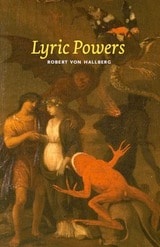
Lyric Powers
Robert von Hallberg
University of Chicago Press, 2008
To explain why a reader might prefer one kind of poem to another, von Hallberg analyzes—beyond the political and intellectual significance of poems—the musicality of both lyric poetry and popular song, including that of Tin Pan Alley and doo-wop. He shows that poets have distinctive intellectual resources—not just rhetorical resources—for examining their subjects, and that the power of poetic language to generalize, not particularize, is what justly deserves a critic’s attention.
The first book in more than a decade from this respected critic, Lyric Powers will be celebrated as a genuine event by readers of poetry and literary criticism.
Lyric Trade
Reading the Subject in the Postwar Long PoemJulia Bloch
University of Iowa Press, 2024
Engaging with poets such as Gwendolyn Brooks, H.D., Lorine Niedecker, Alice Notley, and Myung Mi Kim, this book asks: What does lyric mean, and why should it matter to poets and readers? Lyric Trade argues that lyric in the postwar long poem not only registers the ideological contradictions of modernism’s insistence on new forms, but that it also maps spaces for formal reimaginings of the subject.
Lyrical Liberators
The American Antislavery Movement in Verse, 1831–1865Monica Pelaez
Ohio University Press, 2018
Before Black Lives Matter and Hamilton, there were abolitionist poets, who put pen to paper during an era when speaking out against slavery could mean risking your life. Indeed, William Lloyd Garrison was dragged through the streets by a Boston mob before a planned lecture, and publisher Elijah P. Lovejoy was fatally shot while defending his press from rioters. Since poetry formed a part of the cultural, political, and emotional lives of readers, it held remarkable persuasive power. Yet antislavery poems have been less studied than the activist editorials and novels of the time.
In Lyrical Liberators, Monica Pelaez draws on unprecedented archival research to recover these poems from the periodicals—Garrison’s Liberator, Frederick Douglass’s North Star, and six others—in which they originally appeared. The poems are arranged by theme over thirteen chapters, a number that represents the amendment that finally abolished slavery in 1865. The book collects and annotates works by critically acclaimed writers, commercially successful scribes, and minority voices including those of African Americans and women.
There is no other book like this. Sweeping in scope and passionate in its execution, Lyrical Liberators is indispensable for scholars and teachers of American literature and history, and stands as a testimony to the power of a free press in the face of injustice.
Lyrical Strategies
The Poetics of the Twentieth-Century American NovelKatie Owens-Murphy
Northwestern University Press, 2018
Owens-Murphy surveys a broad array of writers: poets from the lyrical transatlantic tradition, as well as American novelists including Gertrude Stein, Jean Toomer, William Faulkner, Toni Morrison, Louise Erdrich, and Cormac McCarthy. Through a masterful reexamination of canonical works of twentieth-century American fiction through the lens of lyric poetry, she reveals how many elements in these novels can be better understood as poetic and rhetorical figures (metaphysical conceit, polysyndeton, dramatic monologue, apostrophe, and so on) than as narrative ones.
Making fresh contributions to literary theory and American fiction, Lyrical Strategies will fascinate readers and scholars of the American novel, fiction, poetry, and poetics alike.
Lyrics of the French Renaissance
Marot, Du Bellay, RonsardEdited by Norman R. Shapiro
University of Chicago Press, 2006
Hope Glidden’s accessible introduction, along with the notes she and Shapiro provide on specific poems, will increase readers’ enjoyment and illuminate the historical and linguistic issues relating to this wealth of more than 150 lyric poems.
“A marvelous micro-anthology of sixteenth-century French letters. Representing the pinnacle of French Renaissance verse, the poems singled out here are sensitively interpreted in rhymed English versions. . . . There is a pleasant and inspiring craftsmanship in these interpretations.”—Virginia Quarterly Review
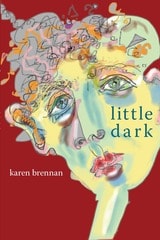
little dark
Karen Brennan
Four Way Books, 2014
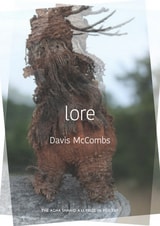
lore
Davis McCombs
University of Utah Press, 2016
Winner of the Agha Shahid Ali Poetry Prize
Drawn from the rich folk traditions of his native Mammoth Cave region in Kentucky as well as the folklore of his adopted Ozark Mountains of Arkansas, the poems in Davis McCombs’s third collection exist along the fraught lines where nature and agriculture collide or in those charged moments where modernity intrudes on an archaic world. These poems celebrate out-of-the-way places, the lore of plants, wild animals and their unknowable lives, and nearly forgotten ways of being and talking and doing. Rendered in a language of great lexical juxtapositions, here are days of soil and labor, nights lit only by firelight, and the beings, possibly not of this world, lured like moths to its flames. McCombs, always a poet of place and of rootedness, writes poems teetering between two locales, one familiar but achingly distant, one bewildering but alluringly present.