Results by title
8642 books match the query '20th century' and 251 start with l
Line Drives
100 Contemporary Baseball PoemsEdited by Brooke Horvath and Tim Wiles. Foreword by Elinor Nauen
Southern Illinois University Press, 2002
“We wait for baseball all winter long,” Bill Littlefield wrote in Boston Magazine a decade ago, “or rather, we remember it and anticipate it at the same time. We re-create what we have known and we imagine what we are going to do next. Maybe that’s what poets do, too.”
Poetry and baseball are occasions for well-put passion and expressive pondering, and just as passionate attention transforms the prose of everyday life into poetry, it also transforms this game we write about, play, or watch. Editors Brooke Horvath and Tim Wiles unite their own passion for baseball and poetry in this collection, Line Drives: 100 Contemporary Baseball Poems, providing a forum for ninety-two poets. Line after line, like baseball itself game after game and season after season, these poems manage to make the old and the familiar new and surprising.
The poems in these pages invite interrogation, and the reader—like the true baseball fan—must be willing to play the game, for these poems are fun, fresh, angry, nostalgic, meditative, and meant to be read aloud. They are keen on taking us deeply into baseball as sport and intent on offering countless metaphors for exploring history, religion, love, family, and self-identity. Each poem delivers images of pure beauty as the poets speak of murder and ghost runners and old ball gloves, of baseball as a tie that binds families—and indeed the nation—together, of the game as a stage upon which no-nonsense grit and skill are routinely displayed, and of the delight experienced in being one amid a mindlessly happy crowd. This book is true to the game’s long season and to the lives of those the game engages.
Lineages of the Global City
Occult Modernism and the Spiritualization of DemocracyShiben Banerji
University of Texas Press, 2025
2026 PROSE Award in Architecture & Urban Planning, Association of American Publishers (AAP)
2026 Book Prize Shortlist, Modernist Studies Association (MSA)
The forgotten history of the occult foundations of the early twentieth-century global city.
War, revolution, genocide, rebellion, slump. The economic and political turmoil of the early twentieth century seemed destined to rip asunder the ties that bound colonizers and the colonized to one another. The upheaval represented an opportunity, and not just to nationalists who imagined new homelands or to socialists who dreamed of international brotherhood. For modernists in the orbit of various occultisms, the crisis of empire also represented an opportunity to reveal humanity’s fundamental unity and common fate.
Lineages of the Global City recounts a continuous, if also contentious, transnational exchange among modernists and occultists across the Americas, Europe, South Asia, and Australia between 1905 and 1949. At stake were the feelings and affect of a new global subject who would perceive themselves as belonging to humanity as a unified whole, and the urban environment that would foster their subjectivity. The interventions in this debate, which drew in the period’s most renowned modernists, took the form of a succession of plans for cities, suburbs, and communes, as well as experiments in building, drawing, printmaking, filmmaking, and writing. Weaving together postcolonial, feminist, and Marxist insight on subject formation, Shiben Banerji advances a new way of understanding modernist urban space as the design of subjective effects.
Linked Labor Histories
New England, Colombia, and the Making of a Global Working ClassAviva Chomsky
Duke University Press, 2008
Chomsky examines labor and management at two early-twentieth-century Massachusetts factories: one that transformed the global textile industry by exporting looms around the world, and another that was the site of a model program of labor-management collaboration in the 1920s. She follows the path of the textile industry from New England, first to the U.S. South, and then to Puerto Rico, Japan, Mexico, Central America, the Caribbean, and Colombia. She considers how towns in Rhode Island and Massachusetts began to import Colombian workers as they struggled to keep their remaining textile factories going. Most of the workers eventually landed in service jobs: cleaning houses, caring for elders, washing dishes.
Focusing on Colombia between the 1960s and the present, Chomsky looks at the Urabá banana export region, where violence against organized labor has been particularly acute, and, through a discussion of the AFL-CIO’s activities in Colombia, she explores the thorny question of U.S. union involvement in foreign policy. In the 1980s, two U.S. coal mining companies began to shift their operations to Colombia, where they opened two of the largest open-pit coal mines in the world. Chomsky assesses how different groups, especially labor unions in both countries, were affected. Linked Labor Histories suggests that economic integration among regions often exacerbates regional inequalities rather than ameliorating them.
Listening to Workers
Oral Histories of Metro Detroit Autoworkers in the 1950sDaniel J. Clark
University of Illinois Press, 2024
Historians and readers alike often overlook the everyday experiences of workers. Drawing on years of interviews and archival research, Daniel J. Clark presents the rich, interesting, and sometimes confounding lives of men and women who worked in Detroit-area automotive plants in the 1950s.
In their own words, the interviewees frankly discuss personal matters like divorce and poverty alongside recollections of childhood and first jobs, marriage and working women, church and hobbies, and support systems and workplace dangers. Their frequent struggles with unstable jobs and economic insecurity upend notions of the 1950s as a golden age of prosperity while stories of domestic violence and infidelity open a door to intimate aspects of their lives. Taken together, the narratives offer seldom-seen accounts of autoworkers as complex and multidimensional human beings.
Compelling and surprising, Listening to Workers foregoes the union-focused strain of labor history to provide ground-level snapshots of a blue-collar world.
Lister Hill
Statesman from the SouthVirginia Van der Veer Hamilton
University of Alabama Press, 2004
Literary Alchemist
The Writing Life of Evan S. ConnellSteve Paul
University of Missouri Press, 2021
Winner, 2022 Society of Midland Authors award for Biography/Memoir
Evan S. Connell (1924–2013) emerged from the American Midwest determined to become a writer. He eventually made his mark with attention-getting fiction and deep explorations into history. His linked novels Mrs. Bridge (1959) and Mr. Bridge (1969) paint a devastating portrait of the lives of a prosperous suburban family not unlike his own that, more than a half century later, continue to haunt readers with their minimalist elegance and muted satire. As an essayist and historian, Connell produced a wide range of work, including a sumptuous body of travel writing, a bestselling epic account of Custer at the Little Bighorn, and a singular series of meditations on history and the human tragedy.
This first portrait and appraisal of an under-recognized American writer is based on personal accounts by friends, relatives, writers, and others who knew him; extensive correspondence in library archives; and insightful literary and cultural analysis of Connell’s work and its context. It also illuminates aspects of American publishing, Hollywood, male anxieties, and the power of place.
Literary Authority and the Modern Chinese Writer
Ambivalence and AutobiographyWendy Larson
Duke University Press, 1991
Larson focuses on the most famous writers associated with the May Fourth Movement, a group most active in the 1920s and 1930s, and their fundamental ambivalence about writing. She analyzes how their writing paradoxically characterized textual labor as passive, negative, and inferior to material labor and the more physical political work of social progress, and she describes the ways they used textual means to devalue literary labor.
The impact of China’s increasing contact with the West—particularly the ways in which Western notions of “individualism” and “democracy” influenced Chinese ideologies of self and work—is considered. Larson also studies the changes in China’s social structure, notably those linked to the abolition in 1905 of the educational exam system, which subsequently broke the link between the mastery of certain texts and the attainment of political power, further denigrating the cultural role of the writer.

Literary Intellectuals and the Dissolution of the State
Professionalism and Conformity in the GDREdited by Robert von Hallberg
University of Chicago Press, 1996
What drove leading thinkers, including those of the avant-garde who publicly embraced intellectual freedom, to serve as government informants? Why were they content to work within a repressive system rather than challenging it outright? This collection of interviews with more than two dozen writers and literary scholars, including several Stasi informants, provides a gripping, often dismaying picture of the motivations, compromises, and illusions of East German intellectual life.
In conversations with Robert von Hallberg, writers such as best-selling novelist Hermann Kant, playwright Christoph Hein, and avant-garde poet-publisher Sascha Anderson talk about their lives and work before the fall of the wall in 1989—about the constraints and privileges of Communist Party membership, experiences of government censorship and self-censorship, and relations with their readers. They reflect on why the possibilities of opposition to the state seemed so limited, and on how they might have found ways to resist more aggressively. Turning to the controversies that have emerged since reunification, including the Stasi scandals involving Anderson and Christa Wolf, they discuss their feelings of complicity and the need for further self-examination. Two interviews with Anderson—one conducted before he was exposed as a Stasi collaborator and one conducted afterward—offer unique insight into the double life led by many writers and scholars in the German Democratic Republic.
Literary Journalism in the Twentieth Century
Norman Sims
Northwestern University Press, 2008
This wide-ranging collection of critical essays on literary journalism addresses the shifting border between fiction and non-fiction, literature and journalism.
Literary Journalism in the Twentieth Century addresses general and historical issues, explores questions of authorial intent and the status of the territory between literature and journalism, and offers a case study of Mary McCarthy’s 1953 piece, "Artists in Uniform," a classic of literary journalism.
Sims offers a thought-provoking study of the nature of perception and the truth, as well as issues facing journalism today.
Literary Journalism on Trial
Masson v. New Yorker and the First AmendmentKathy Roberts Forde
University of Massachusetts Press, 2008
In November 1984, Jeffrey Masson filed a libel suit against writer Janet Malcolm and the New Yorker, claiming that Malcolm had intentionally misquoted him in a profile she wrote for the magazine about his former career as a Freud scholar and administrator of the Freud archives. Over the next twelve years the case moved up and down the federal judicial ladder, at one point reaching the U.S. Supreme Court, as lawyers and judges wrestled with questions about the representation of “truth” in journalism and, by extension, the limits of First Amendment protections of free speech. Had a successful Freudian scholar actually called himself an “intellectual gigolo” and “the greatest analyst who ever lived?" Or had a respected writer for the New Yorker knowingly placed false, self-damning words in her subject's mouth?
In Literary Journalism on Trial, Kathy Roberts Forde explores the implications of Masson v. New Yorker in the context of the history of American journalism. She shows how the case represents a watershed moment in a long debate between the advocates of traditional and literary journalism and explains how it reflects a significant intellectual project of the period: the postmodern critique of objectivity, with its insistence on the instability of language and rejection of unitary truth in human affairs. The case, Forde argues, helped widen the perceived divide between ideas of literary and traditional journalism and forced the resolution of these conflicting conceptions of truth in the constitutional arena of libel law. By embracing traditional journalism's emphasis on fact and objectivity and rejecting a broader understanding of truth, the Supreme Court turned away from the First Amendment theory articulated in previous rulings, opting to value less the free, uninhibited interchange of ideas necessary to democracy and more the “trustworthiness” of public expression. The Court's decision in this case thus had implications that reached beyond the legal realm to the values and norms expressed in the triangular relationship between American democracy, First Amendment principles, and the press.
Literary Luxuries
American Writing at the End of the MillenniumJoe David Bellamy
University of Missouri Press, 1995
From the Iowa Writers Workshop to the halls of Congress and the National Endowment for the Arts, from the world of literary magazines and writers' conferences to the bizarre realm of the late-twentieth-century American English department, Literary Luxuries takes the reader on a guided tour of American literary life in our time--and the forces threatening its existence.
Joe David Bellamy has been a significant figure on the literary scene during the last three decades; as a "literary Everyman," he offers in Literary Luxuries a distinctive and valuable perspective on the culture wars, on education and the imagination, on particular writers and major literary and aesthetic movements, on the role of government in fostering cultural development, and on the day-to-day strife of the writer's life in the United States.
As director of the literature program of the National Endowment for the Arts, Bellamy had the unenviable task of trying to persuade Congress and ordinary citizens that American literature is worthy of support, and in Literary Luxuries he continues that debate and helps us to understand its implications: "Literature is our national treasury of language and style and our best reckoning about human life, as it is lived in this time and place."
Part memoir, part critique, part impassioned defense of American literary culture and the values it espouses and struggles to uphold, Literary Luxuries offers unforgettable commentary on the literary life in the United States during the last decades of the twentieth century as described from the perspective of one of its key participants.

Literary Politics in the Soviet Ukraine, 1917-1934
George S. N. Luckyj
Duke University Press, 1990
The new edition reissues Luckyj’s critical work in light of current political developments and reflects the revision of previous findings. Luckyj originally drew on published Soviet sources and the important unpublished papers of a Soviet Ukrainian writer who defected to the West to describe how the brief literary revival in the Soviet Ukraine in the 1920s was abruptly halted by Communist Party controls. The present volume features a new preface, an additional chapter covering recent Soviet attitudes toward the literature of the 1920s and 1930s, and an updated bibliography.
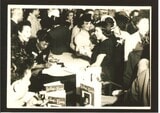
Literary Sisters
Dorothy West and Her Circle, A Biography of the Harlem RenaissanceMitchell, Verner D
Rutgers University Press, 2012
Harlem Renaissance writer Dorothy West led a charmed life in many respects. Born into a distinguished Boston family, she appeared in Gershwin’s Porgy and Bess, then lived in the Soviet Union with a group that included Langston Hughes, to whom she proposed marriage. She later became friends with Jacqueline Kennedy Onassis, who encouraged her to finish her second novel, The Wedding, which became the octogenarian author’s first bestseller.
Literary Sisters reveals a different side of West’s personal and professional lives—her struggles for recognition outside of the traditional literary establishment, and her collaborations with talented African American women writers, artists, and performers who faced these same problems. West and her “literary sisters”—women like Zora Neale Hurston and West’s cousin, poet Helene Johnson—created an emotional support network that also aided in promoting, publishing, and performing their respective works. Integrating rare photos, letters, and archival materials from West’s life, Literary Sisters is not only a groundbreaking biography of an increasingly important author but also a vivid portrait of a pivotal moment for African American women in the arts.
Literary Theory
An IntroductionTerry Eagleton
University of Minnesota Press, 1996
Literature and Liminality
Festive Readings in the Hispanic TraditionGustavo Pérez Firmat
Duke University Press, 1986
Gustavo Perez Firmat examines three of these marginal or liminal phenomena—paying particular attention to the distinction between "center" and "periphery"—as they appear in Hispanic literature. Carnival (the traditional festival in which normal behavior is overturned), choteo (an insulting form of humor), and disease are three liminal entities discussed. Less an attempt to frame a general theory of such "liminalities" than an effort to demonstrate the interpretive power of the liminality concept, this work challenges conventional boundaries of critical sense and offers new insights into a variety of questions, among them the notion of convertability in psychoanalysis and the relation of New World culture to its European forebears.
Literature and Politics in the Central American Revolutions
By John Beverley and Marc Zimmerman
University of Texas Press, 1990
“This book began in what seemed like a counterfactual intuition . . . that what had been happening in Nicaraguan poetry was essential to the victory of the Nicaraguan Revolution,” write John Beverley and Marc Zimmerman. “In our own postmodern North American culture, we are long past thinking of literature as mattering much at all in the ‘real’ world, so how could this be?” This study sets out to answer that question by showing how literature has been an agent of the revolutionary process in Nicaragua, El Salvador, and Guatemala.
The book begins by discussing theory about the relationship between literature, ideology, and politics, and charts the development of a regional system of political poetry beginning in the late nineteenth century and culminating in late twentieth-century writers. In this context, Ernesto Cardenal of Nicaragua, Roque Dalton of El Salvador, and Otto René Castillo of Guatemala are among the poets who receive detailed attention.
Literature and Resistance in Guatemala
Textual Modes and Cultural Politics from El Señor Presidente to Rigoberta MenchúMarc Zimmerman
Ohio University Press, 1994
Literature at the Barricades
The American Writer in the 1930sEdited by Ralph F. Bogardus and Fred Hobson
University of Alabama Press, 1982
This collection captures the sense—at times the ordeal—of the 1930s literary experience in America. Fourteen essayists deal with the experience of being a writer in a time of overwhelming economic depression and political ferment, and thereby illuminate the social, political, intellectual, and aesthetic problems and pressures that characterized the experience of American writers and influenced their works.
The essays, as a group, constitute a reevaluation of the American literature of the 1930s. At the same time they support and reinforce certain assumptions about the decade of the Great Depression—that it was grim, desperate, a time when dreams died and poverty became something other than genteel—they challenge other assumptions, chief among them in the notion that 1930s literature was uniform in content, drab in style, anti-formalist, and always political or sociological in nature. They leave us with an impression that there was variety in American writing of the 1930s and a convincing argument that the decade was not a retreat from the modernism of the 1920s. Rather it was a transitional period in which literary modernism was very much an issue and a force that bore imaginative fruit.
Literature in Exile
John Glad, ed.
Duke University Press, 1990
The volume includes writers whose origins lie in Central Europe, South Africa, Israel, Cuba, Chile, Somalia, and Turkey. Through their testimony of the creative process in exile, we gain insight into the forces which affect the creative process as a whole.
Contributors. William Gass, Yury Miloslavsky, Jan Vladislav, Jiri Grusa, Guillermo Cabrera Infante, Horst Bienek, Edward Limonov, Nedim Gursel, Nuruddin Farah, Jaroslav Vejvoda, Anton Shammas, Joseph Brodsky, Wojciech Karpinski, Thomas Venclova, Yuri Druzhnikov
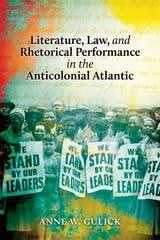
Literature, Law, and Rhetorical Performance in the Anticolonial Atlantic
Anne W. Gulick
The Ohio State University Press, 2016
Responses to this question take shape across the black Atlantic from Haiti to South Africa, in texts ranging from Haiti’s Declaration of Independence and work by C. L. R. James to South Africa’s Freedom Charter, Aimé Césaire’s poem Notebook of a Return to the Native Land, and Ngugi wa Thiong’o’s A Grain of Wheat. These texts constitute a robust transatlantic tradition of challenging colonial and imperial authority through rhetorical performance. Drawing on the cosmopolitan aspirations and emancipatory energies of the political declaration, this tradition aims to radically reinvent the possibilities for law and political belonging in the postcolonial future.
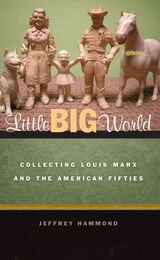
Little Big World
Collecting Louis Marx and the American FiftiesJeffrey Hammond
University of Iowa Press, 2010
Jeffrey Hammond’s Little Big World: Collecting Louis Marx and the American Fifties is the story of a middle-aged man’s sudden compulsion to collect the toys of his childhood: specifically themed playsets produced by the Louis Marx Toy Company. Hammond never made a conscious decision to become a collector of any kind, so he was surprised when his occasional visits to web sites turned into hours spent gazing at, and then impulsively purchasing, the tiny plastic people and animals in the Civil War set, the Fort Apache set, Roy Rogers Ranch, and Happi-Time Farm—just a few of the dozens of playsets the Marx Company produced.
Hammond interweaves childhood memories with reflections on what they reveal about the culture and values of cold war America, offering an extended meditation on toys as powerful catalysts for the imagination of both children and adults. Never sentimentalizing his childhood in an effort to get his old toys back, Hammond exposes the dangers of nostalgia by casting an unsettling light on the culture of the fifties and the era’s lasting impact on those who grew up in it.
Writing in a lovably quirky voice, Hammond not only attempts to understand his personal connection to the Marx toys but also examines the psychology of his fellow eBay denizens. In this warm, funny, and contemplative work, the reader encounters an online community of serious adult collectors who, as the author suspects, are driven to obsession by middle-aged nostalgia. When Hammond questions this preoccupation with the past, he comes to realize that his own collecting has prevented him from moving forward. With this insight, he offers an insider’s take on the culture and psychology of collecting.
Little Hawk and the Lone Wolf
A MemoirRaymond Kaquatosh
Wisconsin Historical Society Press, 2022
After his father’s death, eight-year-old Ray was sent to an Indian boarding school in Keshena. There he experienced isolation and despair, but also comfort and kindness. Upon his return home, Ray remained a lonely boy in a full house until he met and befriended a lone timber wolf. The unusual bond they formed would last through both their lifetimes. As Ray grew into a young man, he left the reservation more frequently. Yet whenever he returned—from school and work, from service in the Marines, and finally from postwar Wausau with his future wife—the wolf waited.
In this rare first-person narrative of a Menominee Indian’s coming of age, Raymond Kaquatosh shares a story that is wise and irreverent, often funny, and in the end, deeply moving.
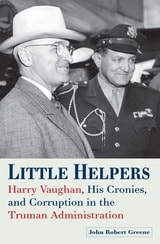
Little Helpers
Harry Vaughan, His Cronies, and Corruption in the Truman AdministrationJohn Robert Greene
University of Missouri Press, 2024
Greene begins with the story of how Truman and Vaughan met during World War I, then examines Vaughan’s support for Truman for the Senate and later as President. The majority of the book, however, considers the various cronies that surrounded Vaughan and illustrates the significance of his relationship with Truman—and the president’s inability to rein him in.
Drawing from primary and archival sources, many never before published, Little Helpers is further distinguished by its use of the correspondence between Vaughan and Truman. Greene also provides a dramatic narrative account of the inner workings of the Truman administration, making the book accessible to the general reader as well as the specialist.
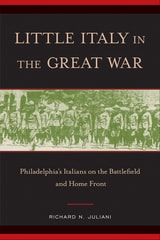
Little Italy in the Great War
Philadelphia's Italians on the Battlefield and Home FrontRichard N. Juliani
Temple University Press, 2020
The Great War challenged all who were touched by it. Italian immigrants, torn between their country of origin and country of relocation, confronted political allegiances that forced them to consider the meaning and relevance of Americanization. In his engrossing study, Little Italy in the Great War, Richard Juliani focuses on Philadelphia’s Italian community to understand how this vibrant immigrant population reacted to the war as they were adjusting to life in an American city that was ambivalent toward them.
Juliani explores the impact of the Great War on many immigrant soldiers who were called to duty as reservists and returned to Italy, while other draftees served in the U.S. Army on the Western Front. He also studies the impact of journalists and newspapers reporting the war in English and Italian, and reactions from civilians who defended the nation in industrial and civic roles on the home front.
Within the broader context of the American experience, Little Italy in the Great War examines how the war affected the identity and cohesion of Italians as a population still passing through the assimilation process.
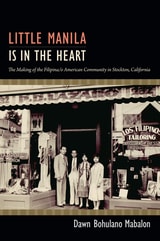
Little Manila Is in the Heart
The Making of the Filipina/o American Community in Stockton, CaliforniaDawn Bohulano Mabalon
Duke University Press, 2013
Mabalon draws on oral histories, newspapers, photographs, personal archives, and her own family's history in Stockton. She reveals how Filipina/o immigrants created a community and ethnic culture shaped by their identities as colonial subjects of the United States, their racialization in Stockton as brown people, and their collective experiences in the fields and in the Little Manila neighborhood. In the process, Mabalon places Filipinas/os at the center of the development of California agriculture and the urban West.

Little White Houses
How the Postwar Home Constructed Race in AmericaDianne Harris
University of Minnesota Press, 2013
A rare exploration of the racial and class politics of architecture, Little White Houses examines how postwar media representations associated the ordinary single-family house with middle-class whites to the exclusion of others, creating a powerful and invidious cultural iconography that continues to resonate today. Drawing from popular and trade magazines, floor plans and architectural drawings, television programs, advertisements, and beyond, Dianne Harris shows how the depiction of houses and their interiors, furnishings, and landscapes shaped and reinforced the ways in which Americans perceived white, middle-class identities and helped support a housing market already defined by racial segregation and deep economic inequalities.
After describing the ordinary postwar house and its orderly, prescribed layout, Harris analyzes how cultural iconography associated these houses with middle-class whites and an ideal of white domesticity. She traces how homeowners were urged to buy specific kinds of furniture and other domestic objects and how the appropriate storage and display of these possessions was linked to race and class by designers, tastemakers, and publishers. Harris also investigates lawns, fences, indoor-outdoor spaces, and other aspects of the postwar home and analyzes their contribution to the assumption that the rightful owners of ordinary houses were white.
Richly detailed, Little White Houses adds a new dimension to our understanding of race in America and the inequalities that persist in the U.S. housing market.
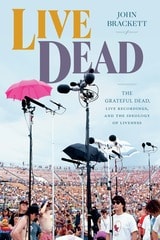
Live Dead
The Grateful Dead, Live Recordings, and the Ideology of LivenessJohn Brackett
Duke University Press, 2023

Lives and Legends of the Christmas Tree Ships
Fred Neuschel
University of Michigan Press, 2007
Lives and Legends of the Christmas Tree Ships brings the maritime heritage of the Great Lakes to life, using the tragic story of the schooner Rouse Simmons as a porthole into the robust but often forgotten communities that thrived along Lake Michigan from the Civil War to World War I.
Memorialized in songs, poems, fiction, and even a musical, the infamous ship that went down in a Thanksgiving storm while delivering Christmas trees to Chicago has long been shrouded in myth and legend. As a result, the larger story of the captain, crew, and affected communities has often been overlooked. Fred Neuschel delves into this everyday life of camaraderie, drudgery, ambition, and adventure—with tales of the Midwest’s burgeoning immigrant groups and rapid industrialization—to create a true story that is even more fascinating than the celebrated legends.
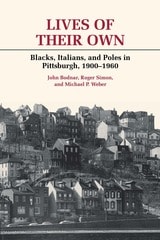
Lives of Their Own
Blacks, Italians, and Poles in Pittsburgh, 1900-1960John Bodnar, Roger Simon, and Michael P. Weber
University of Illinois Press, 1982
Lives of the Imaginary Artists in Cold War California
Monica Steinberg
University of Chicago Press, 2025
This book explores how a group of real California artists created imaginary artists, engaging with the political climate of the Cold War era and frustrating the discipline of art history. They employed pseudonymity, obfuscation, anonymity, (auto)biografiction, imaginary portraiture, heteronymity, role-playing, doubling, and alter ego. Often laced with humor, these exploits facilitated stylistic experimentation, provoking reactions from art viewers and governing authorities alike, and disrupting reliance on documentation and attribution within art history.
In the 1950s and early 1960s, Ed Kienholz, Walter Hopps, Robert Alexander, Wally Hedrick, George Herms, and Wallace Berman activated imagined and secret identities, provoking reactions within a conservative environment gripped by communist paranoia. As political concerns shifted in the 1960s and 1970s to movements for peace and equality, artists including Billy Al Bengston, Ed Ruscha, Joe Goode, Lynda Benglis, Larry Bell, Judy Chicago, Lowell Darling, and Eleanor Antin redirected these tactics to probe the rise of celebrity culture and the administrative state. These practices also became the precursor for later interventions by Bruce Conner, Asco, Allen Ruppersberg, Senga Nengudi, and others.
Considering a compelling range of visual material, including paintings, sculptures, and performed intrusions as well as publications, postcards, and advertisements, Monica Steinberg examines why these imaginary artists appeared when and where they did—and to what ends.
Living At The Edge
Biography Of D H Lawrence & Frieda Von RichthofenMichael Squires
University of Wisconsin Press, 2002
Living at the Edge follows the separate lives of Lawrence and Frieda up to their first meeting in 1912. Tracing their new life together, it depicts their grateful escape from the English Midlands; their discovery of exotic places where they made temporary homes—Italy, Cornwall, Australia, New Mexico, and Mexico; Lawrence’s courageous battle against illness; and, after his death in 1930, Frieda’s success in recreating the simple life on ranches near Taos, New Mexico, where she died in 1956.
At the center of their story is Lawrence’s literary career. Biographers Squires and Talbot see Lawrence’s major novels—The Rainbow, Women in Love, Lady Chatterley’s Lover—as a fresh way to understand his turbulent and conflicted life. They reveal the extreme care with which he rewrote his personal experience to satisfy his deepest needs, and they introduce the many influential people who entered the Lawrences’ lives and work. The rich materials from Frieda’s letters reveal a different Lawrence—more difficult as a man but more interesting as an artist; they also reveal a different Frieda—more vibrant as a woman, more substantial as a companion. This superb biography gives both Lawrence and Frieda striking new dimensions.
Living Labor
Fiction, Film, and Precarious WorkJoseph B. Entin
University of Michigan Press, 2023
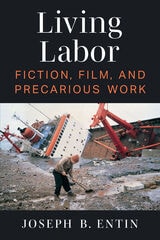
Cover attribution: Allan Sekula, Shipwreck and worker, Istanbul, from TITANIC’s wake, 1998/2000. Courtesy of the Allan Sekula Studio.
Living Matter
The Preservation of Biological Materials in Contemporary Art: An International Conference Held in Mexico City, June 3–5, 2019Rachel Rivenc
J. Paul Getty Trust, The, 2022
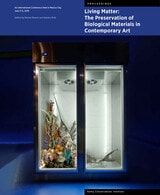
Eggshells, flowers, onion peels, sponge cake, dried bread, breast milk, bacteria, living organisms—these are just a few of the biological materials that contemporary artists are using to make art. But how can works made from such perishable ingredients be preserved? And what logistical, ethical, and conceptual dilemmas might be posed by doing so?
Because they are prone to rapid decay, even complete disappearance, biological materials used in art pose a range of unique conservation challenges. This groundbreaking book probes the issues associated with displaying, collecting, and preserving these unique works of art. The twenty-four papers from the conference present a range of case studies, prominently featuring artists’ perspectives, as well as conceptual discussions, thereby affording a comprehensive and richly detailed overview of current thinking and practices on this topic. Living Matter is the first publication to explore broadly the role of biological materials in the creative process and present a variety of possible approaches to their preservation.
The free online edition of this open-access publication is available at www.getty.edu/publications/living-matter/ and includes videos and zoomable illustrations. Also available are free PDF, EPUB, and Kindle/MOBI downloads of the book.
Living Off the Country
Essays on Poetry and PlaceJohn Haines
University of Michigan Press, 1981
We live on the surface, he discovered. It is the land that makes people. If a poet will see, will feel, will interpret his place and then relate that experience to what he knows of the world at large, he will have a life in imagination, a vitality beyond appearances.
John Haines is author of At the End of Summer: Poems 1948-1954; Fables and Distances: New and Selected Essays; and The Owl in the Mask of the Dreamer. He received the Lenore Marshall Poetry Prize in 1991.
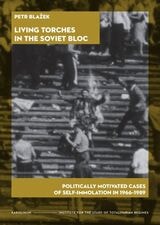
Living Torches in the Soviet Bloc
Politically Motivated Cases of Self-Immolation, 1966–1989Petr Blažek
Karolinum Press, 2025
Living Torches in the Soviet Bloc presents the lives of those who chose self-immolation as a radical form of protest against the political oppression of Communist regimes in the Soviet Bloc between 1966–1989. While more than fifty such cases were identified during the relevant period, Petr Blažek focuses here on the twenty-one cases in which at least partial political motivation is apparent from historical sources.
Many of the cases of the “living torches” were a radical response to the August 1968 occupation of Czechoslovakia by the armies of five Warsaw Pact member states and the suppression of the Prague Spring. After January 1969, the self-immolation of Jan Palach evoked a large wave of followers not only in Czechoslovakia, but also abroad, and greatly influenced other cases of “living torches” which continued to appear in the Soviet Bloc until the end of the 1980s.
Although the conditions in the Soviet Bloc states were sometimes fundamentally different, these cases of self-immolation across states share a common disapproval of the totalitarian form of rule. They were often drastic responses from members of occupied nations, most of whom were Czechs, Lithuanians, Ukrainians, and Poles, who rejected the enforced Communist regime and Soviet military presence. Some decided to sacrifice their lives to wake others from indifference and resignation. Even several decades later, their shocking acts not only provoke, but also lead us to reflect on fundamental questions of human life.
Living Up to the Ads
Gender Fictions of the 1920sSimone Weil Davis
Duke University Press, 2000
Materials from advertising firms—including memos, manuals, meeting minutes, and newsletters—are considered alongside the fiction of Sinclair Lewis, Nella Larsen, Bruce Barton, F. Scott Fitzgerald, and Zelda Fitzgerald. Davis engages such books as Babbitt, Quicksand, and Save Me the Waltz in original and imaginative ways, asking each to participate in her discussion of commodity culture, gender, and identity. To illuminate the subjective, day-to-day experiences of 1920s consumerism in the United States, Davis juxtaposes print ads and industry manuals with works of fiction. Capturing the maverick voices of some of the decade’s most influential advertisers and writers, Davis reveals the lines that were drawn between truths and lies, seduction and selling, white and black, and men and women.
Davis’s methodology challenges disciplinary borders by employing historical, sociological, and literary practices to discuss the enduring links between commodity culture, gender, and identity construction. Living Up to the Ads will appeal to students and scholars of advertising, American studies, women’s studies, cultural studies, and early-twentieth-century American history.
Living a Country Year
Wit and Wisdom from the Good Old DaysJerry Apps
Wisconsin Historical Society Press, 2018
“Even with the all the hard work, we had more time (perhaps we took more time) to enjoy what was all around us: nights filled with starlight, days with clear blue skies and puffy clouds. Wonderful smells everywhere—fresh mown hay, wildflowers, and apple blossoms. Interesting sounds—the rumble of distant thunder, an owl calling in the woods, a flock of Canada geese winging over in the fall.”
In this paperback edition of a beloved Jerry Apps classic, the rural historian tells stories from his childhood days on a small central Wisconsin dairy farm in the 1930s and 1950s. From a January morning memory of pancakes piled high after chores, to a June day spent learning to ride a pony named Ginger, Jerry moves through the turn of the seasons and teaches gentle lessons about life on the farm. With recipes associated with each month and a new introduction exclusive to this 2nd edition, Living a Country Year celebrates the rhythms of rural life with warmth and humor.
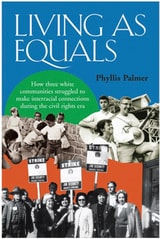
Living as Equals
How Three White Communities Struggled to Make Interracial Connections During the Civil Rights EraPhyllis Palmer
Vanderbilt University Press, 2008
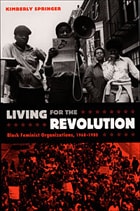
Living for the Revolution
Black Feminist Organizations, 1968–1980Kimberly Springer
Duke University Press, 2005
The organizations that Springer examines were the first to explicitly use feminist theory to further the work of previous black women’s organizations. As she describes, they emerged in response to marginalization in the civil rights and women’s movements, stereotyping in popular culture, and misrepresentation in public policy. Springer compares the organizations’ ideologies, goals, activities, memberships, leadership styles, finances, and communication strategies. Reflecting on the conflicts, lack of resources, and burnout that led to the demise of these groups, she considers the future of black feminist organizing, particularly at the national level. Living for the Revolution is an essential reference: it provides the history of a movement that influenced black feminist theory and civil rights activism for decades to come.

Living in the Shadow of a Hell Ship
The Survival Story of U.S. Marine George Burlage, a WWII Prisoner-of-War of the JapaneseGeorgianne Burlage
University of North Texas Press, 2020
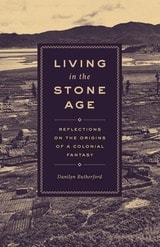
Living in the Stone Age
Reflections on the Origins of a Colonial FantasyDanilyn Rutherford
University of Chicago Press, 2018
Living in the Stone Age answers this question by following the adventures of officials sent to the New Guinea highlands in the 1930s to establish a foothold for Dutch colonialism. These officials became deeply dependent on the good graces of their would-be Papuan subjects, who were their hosts, guides, and, in some cases, friends. Danilyn Rutherford shows how, to preserve their sense of racial superiority, these officials imagined that they were traveling in the Stone Age—a parallel reality where their own impotence was a reasonable response to otherworldly conditions rather than a sign of ignorance or weakness. Thus, Rutherford shows, was born a colonialist ideology.
Living in the Stone Age is a call to write the history of colonialism differently, as a tale of weakness not strength. It will change the way readers think about cultural contact, colonial fantasies of domination, and the role of anthropology in the postcolonial world.
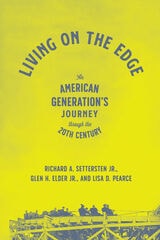
Living on the Edge
An American Generation’s Journey through the Twentieth CenturyRichard A. Settersten Jr., Glen H. Elder Jr., and Lisa D. Pearce
University of Chicago Press, 2021
Drawing from the iconic longitudinal Berkeley Guidance Study, Living on the Edge reveals the hopes, struggles, and daily lives of the 1900 generation. Most surprising is how relevant and relatable the lives and experiences of this generation are today, despite the gap of a century. From the reorganization of marriage and family roles and relationships to strategies for adapting to a dramatically changing economy, the challenges faced by this earlier generation echo our own time. Living on the Edge offers an intimate glimpse into not just the history of our country, but the feelings, dreams, and fears of a generation remarkably kindred to the present day.
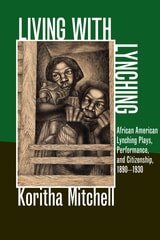
Living with Lynching
African American Lynching Plays, Performance, and Citizenship, 1890-1930Koritha Mitchell
University of Illinois Press, 2012
In closely analyzing the political and spiritual uses of black theatre during the Progressive Era, Mitchell demonstrates that audiences were shown affective ties in black families, a subject often erased in mainstream images of African Americans. Examining lynching plays as archival texts that embody and reflect broad networks of sociocultural activism and exchange in the lives of black Americans, Mitchell finds that audiences were rehearsing and improvising new ways of enduring in the face of widespread racial terrorism. Images of the black soldier, lawyer, mother, and wife helped readers assure each other that they were upstanding individuals who deserved the right to participate in national culture and politics. These powerful community coping efforts helped African Americans band together and withstand the nation's rejection of them as viable citizens.
The Left of Black interview with author Koritha Mitchell begins at 14:00.
An interview with Koritha Mitchell at The Ohio Channel.
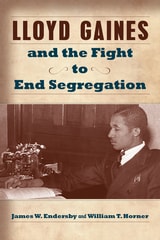
Lloyd Gaines and the Fight to End Segregation
James W. Endersby and William T. Horner
University of Missouri Press, 2016
Winner, 2017 Missouri Conference on History Book Award
In 1936, Lloyd Gaines’s application to the University of Missouri law school was denied based on his race. Gaines and the NAACP challenged the university’s decision. Missouri ex rel. Gaines v. Canada (1938) was the first in a long line of decisions by the U.S. Supreme Court regarding race, higher education, and equal opportunity. The court case drew national headlines, and the NAACP moved Gaines to Chicago after he received death threats. Before he could attend law school, he vanished.
This is the first book to focus entirely on the Gaines case and the vital role played by the NAACP and its lawyers—including Charles Houston, known as “the man who killed Jim Crow”—who advanced a concerted strategy to produce political change. Horner and Endersby also discuss the African American newspaper journalists and editors who mobilized popular support for the NAACP’s strategy. This book uncovers an important step toward the broad acceptance of racial segregation as inherently unequal.
This is the inaugural volume in the series Studies in Constitutional Democracy, edited by Justin Dyer and Jeffrey Pasley of the Kinder Institute on Constitutional Democracy.
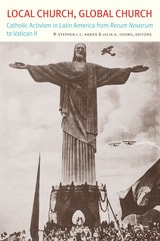
Local Church, Global Church
Stephen J.C. Andes
Catholic University of America Press, 2016
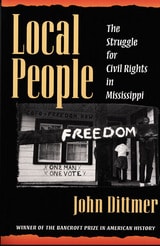
Local People
The Struggle for Civil Rights in MississippiJohn Dittmer
University of Illinois Press, 1994
Publication of this book was supported by a grant from DePauw University, Greencastle, Indiana.
Local Transcendence
Essays on Postmodern Historicism and the DatabaseAlan Liu
University of Chicago Press, 2008
In the essays collected in Local Transcendence, Alan Liu takes the pulse of such postmodern historicism by tracking two leading indicators of its acceleration in the late twentieth and early twenty-first centuries: postmodern cultural criticism—including the new historicism, the new cultural history, cultural anthropology, the new pragmatism, and postmodern and postindustrial theory—and digital information technology. What is the relation between the new historicist anecdote and the database field, Liu asks, and can either have a critical function in the age of postmodern historicism? Local Transcendence includes two previously unpublished essays and a synthetic introduction in which Liu traverses from his earlier work on the theory of historicism to his recent studies of information culture to propose a theory of contingent method incorporating a special inflection of history: media history.
Logic and Sin in the Writings of Ludwig Wittgenstein
Philip R. Shields
University of Chicago Press, 1992
"Shields argues that the appearance throughout Wittgenstein's writings of such concepts as ritual, limit, transgression, a change of will, pride, temptation, and judgment implies a relation between religion and the logical aspects of Wittgenstein's philosophy."—Choice
"Of the many recent books about Wittgenstein, Logic and Sin is one of the very few that are well worth having"—Fergus Kerr, Modern Theology
"What Shields has uncovered in Wittgenstein's religious sensibility is something genuine and profound. . . . Shields has not just written an important book on Wittgenstein but an enlightening work that invites further reflection."—Eric O. Springsted, Cross Currents
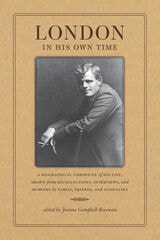
London in His Own Time
A Biographical Chronicle of His Life, Drawn from Recollections, Interviews, and Memoirs by Family, Friends, and AssociatesJeanne Reesman
University of Iowa Press, 2020
Everyone knows Jack London for his tales of adventure in Alaska and the Canadian Yukon. With his work translated into more than 100 languages, London is one of the most popular American writers in the world, alongside Mark Twain. Yet for the reader tackling The Call of the Wild or White Fang, or perhaps his most often-anthologized short story “To Build a Fire,” many misconceptions about his life confuse his legacy.
London in His Own Time is based on Jeanne Reesman’s nearly thirty-five years of archival research. The book offers surprising perspectives on Jack London’s many sides by family, friends, fellow struggling young writers, business associates, high school and college classmates, interviewers, editors, coauthors, visitors to his Sonoma Valley Beauty Ranch in Glen Ellen, California, and more.
People who have commented on and discussed the mercurial genius include Joseph Conrad, Theodore Dreiser, Upton Sinclair, Sinclair Lewis, Ambrose Bierce, and Mary Austin, as well as his half-sister, Eliza London Shepard, and his first wife, Elizabeth Bess “Bessie” Maddern London. There are a few Klondike pals he kept in touch with, and some fellow writers such as Cloudesley Johns, but many of those closest to him truly demonstrate his wide range of friends: barman Johnny Heinold; his second wife, Charmian, whom he called “Mate Woman”; his daughters, Joan and Becky; his lover, Anna Strunsky; his closest friends, especially the poet George Sterling; his former crewmate on the Snark, Martin Johnson; and his valet/memoirist, Yoshimatsu Nakata. Reesman also includes dozens of entries from Bay-area socialists, friends in Hawai’i and the South Seas, fellow war correspondents, neighbors like Luther Burbank, and his long-time editor at Macmillan, George Brett.
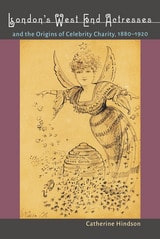
London's West End Actresses and the Origins of Celebrity Charity, 1880-1920
Catherine Hindson
University of Iowa Press, 2016
In the late nineteenth century, theatre’s fundraising for charitable causes shifted from male-dominated and private to female-directed and public. Although elite women had long been involved in such enterprises, they took on more authority in this period. At the same time, regular, high-profile public charity events became more important and much more visible than private philanthropy. Actresses became key figures in making the growing number of large and heavily publicized fundraisers successful. By 1920, the attitude was “Get an actress first. If you can’t get an actress, then get a duchess.” Actresses’ star power, their ability to orchestrate large events quickly, and their skill at performing a kind of genteel extortion made them essential to this model of charity. Actresses also benefited from this new role. Taking a prominent, public, offstage position was crucial in making them, individually and collectively, respectable professionals.
Author Catherine Hindson reveals this history by examining the major types of charity events at the turn of the twentieth century, including fundraising matinees, charity bazaars and costume parties, theatrical tea and garden parties, and benefit performances. Her study concludes with a look at the involvement of actresses in raising funds for British soldiers serving in the Anglo-Boer War and the First World War.