Results by title
8642 books match the query '20th century' and 251 start with l

Lone Stars III
A Legacy of Texas Quilts, 1986-2011By Karoline Patterson Bresenhan and Nancy O'Bryant Puentes
University of Texas Press, 2011
From frontier times in the Republic of Texas until today, Texans have been making gorgeous quilts. Karoline Patterson Bresenhan and Nancy O'Bryant Puentes documented the first 150 years of the state's rich heritage of quilt art in Lone Stars: A Legacy of Texas Quilts, 1836–1936 and Lone Stars II: A Legacy of Texas Quilts, 1936–1986. Now in Lone Stars III, they bring the Texas quilt story into the twenty-first century, presenting two hundred traditional and art quilts that represent "the best of the best" quilts created since 1986.
The quilts in Lone Stars III display the explosion of creativity that has transformed quilting over the last quarter century. Some of the quilts tell stories, create landscapes, record events, and memorialize people. Others present abstract designs that celebrate form and color. Their makers have embraced machine quilting, as well as hand sewing, and they often embellish their quilts with buttons, beads, lace, ribbon, and even more exotic items. Each quilt is pictured in its entirely, and some entries also include photographs of quilt details. The accompanying text describes the quilt's creation, its maker, and its physical details.
With 16.3 million American quilters who spend $3.6 billion annually on their pastime, the quilting community has truly become a force to reckon with both artistically and socially. Lone Stars III is the perfect introduction to this world of creativity.

Lonesome Cowgirls and Honky-Tonk Angels
The Women of Barn Dance RadioKristine M. McCusker
University of Illinois Press, 2007
Drawing on personal interviews and rich archival material from the Grand Ole Opry, Kristine M. McCusker examines the gendered politics of the images through the lives and careers of six women performers: Linda Parker, the Girls of the Golden West (Milly and Dolly Good), Lily May Ledford, Minnie Pearl, and Rose Lee Maphis.
Lonesome Roads and Streets of Dreams
Place, Mobility, and Race in Jazz of the 1930s and '40sAndrew S. Berish
University of Chicago Press, 2012
Long Is the Way and Hard
One Hundred Years of the NAACPKevern Verney
University of Arkansas Press, 2009
Long Live the Counter-Revolution
Hawa Hawa' and Other StoriesNabarun Bhattacharya
Seagull Books, 2022
In this wildly inventive collection of Nabarun Bhattacharya’s stories, we meet characters such as a trigger-happy cop in an authoritarian police state, a man who holds on to a piece of rope from a deadly noose, a retired revolutionary thrilled by delusions of grandeur, and people working for a corporation that arranges lavish suicides for a price. Ranging from scathing satires of society to surreal investigations of violence and love, these stories are also a window onto the political and social climate in Bengal, tracing both pan-Indian developments like the 1975 Emergency and local ones like militant-leftist Naxalism and the decades-long Communist reign in the state. Expertly translated from the Bengali, Hawa Hawa and Other Stories is a journey through the mind of one of the most daring countercultural writers of India, one with particular resonance in these chaotic times.
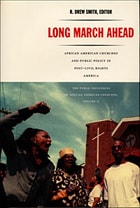
Long March Ahead
African American Churches and Public Policy in Post-Civil Rights AmericaR. Drew Smith ed.
Duke University Press, 2004
Long March Ahead emphasizes the need for African American churches to complement the excellent work they do in implementing policies set by others by getting more involved in shaping public policy. The contributors explore the efficacy of different means of public policy advocacy and social service delivery, including faith-based initiatives. At the same time, they draw attention to trends that have constrained political involvement by African American churches: the increased professionalization of policy advocacy and lobbying, the underdevelopment of church organizational structures devoted to policy work, and tensions between religious imperatives and political activism. Long March Ahead takes an important look at the political role of African American churches after the great policy achievements of the civil rights era.
Contributors
Cathy J. Cohen
Megan McLaughlin
Columba Aham Nnorum
Michael Leo Owens
Desiree Pedescleaux
Barbara D. Savage
R. Drew Smith
Emilie Townes
Christopher Winship
Long Shadows
The Second World War in British Fiction and FilmEdited by Petra Rau
Northwestern University Press, 2016
Looking Back on the Vietnam War
Twenty-first-Century PerspectivesBoyle, Brenda M
Rutgers University Press, 2016
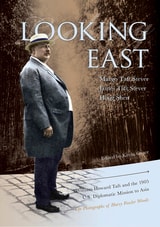
Looking East
William Howard Taft and the 1905 U.S. Diplomatic Mission to Asia: the Photographs of Harry Fowler WoodsMargo Taft Stever, James Taft Stever, and Hong Shen
University of Minnesota Press, 2015
Since the mid-19th century, relations between the United States in the West and Asian countries in the East have been an aggregate of diplomatic miscues and achievements, of trade policy successes and failures, and of cultural chasms and bridges. From the Treaty of Wangxia in 1844 that provided America with trading rights in China on a par with European countries to the contemporary political debates and educational partnerships in nations like Japan, Vietnam, India, and China, the element of understanding and appreciating differences has been paramount.
A singular event in this heritage of almost 150 years in the 1905 mission that sent William Howard Taft on a combination trade and culture junket to Asian countries. Occurring just a few years after U.S. Secretary of State's John Hay's 1899 Open Door Note that sought to keep China open to equitable trade with all countries, the Taft delegation primarily visited China, Japan, and the Philippines to shore up America's interests and to learn more about their emerging partners in the new century.
In Looking East, authors Margo Taft Stever, James Taft Stever, and Hong Shen explore this journey not only by an assiduous use of archives and historical analyses, but especially through the extraordinary images captured by photographer Harry Fowler Woods. Both Taft and Woods are ancestors of two of the authors so there is a particular interest on their part. With scholar Shen, they uncovered these photos and created exhibitions and published the initial Chinese-language edition of this volume by Zhejiang University Press in 2012. In this new, English-language edition, William Howard Taft's 1905 endeavors in Asia are freshly accorded the insight and appreciation they deserve in American diplomatic history.
Looking Forward
Prediction and Uncertainty in Modern AmericaJamie L. Pietruska
University of Chicago Press, 2017
Pietruska argues that this late nineteenth-century quest for future certainty had an especially ironic consequence: it led Americans to accept uncertainty as an inescapable part of both forecasting and twentieth-century economic and cultural life. Drawing together histories of science, technology, capitalism, environment, and culture, Looking Forward explores how forecasts functioned as new forms of knowledge and risk management tools that sometimes mitigated, but at other times exacerbated, the very uncertainties they were designed to conquer. Ultimately Pietruska shows how Americans came to understand the future itself as predictable, yet still uncertain.

Looking Like the Enemy
Japanese Mexicans, the Mexican State, and US Hegemony, 1897–1945Jerry García
University of Arizona Press, 2014
Japanese citizens were initially lured to Mexico with promises of cheap and productive land in Chiapas. Many of the promises were false, and the immigrants were forced to fan out across the country, especially to the lands along the US border. As Jerry García reveals, they were victims of discrimination based on “difference,” but they also displayed “markers of whiteness” that linked them positively to Europeans and Americans, who were perceived as powerful and socially advanced. And, García reports, many Mexicans looked favorably on the Japanese as hardworking and family-centered.
The book delves deeply into the experiences of the Japanese on both sides of the border during World War II, illuminating the similarities and differences in their treatment. Although some Japanese Mexicans were eventually interned (at the urging of the US government), in general the fear and vitriol that Japanese Americans encountered never reached the same levels in Mexico.
Looking Like the Enemy is an ambitious study of a tumultuous half-century in Mexico. It is a significant contribution to our understanding of the immigrant experience in the Western Hemisphere and to the burgeoning field of borderlands studies.
Looking South
The Evolution of Latin Americanist Scholarship in the United States, 1850-1975Helen Delpar
University of Alabama Press, 2007
The definitive history of how Latin American studies became a major field in American scholarship.
Looking South: The Evolution of Latin Americanist Scholarship in the United States, 1850-1975 is the first comprehensive history of the development of Latin American studies as a field of academic inquiry in the United States. In this ambitious and insightful work, historian Helen Delpar traces more than a century of intellectual engagement with Latin America, revealing how generations of historians, anthropologists, geographers, economists, sociologists, and political scientists shaped American understandings of the region and transformed Latin American studies into a recognized academic discipline.
A central contribution of the book lies in its exploration of the relationship between scholarship and historical context. Delpar demonstrates that academic interest in Latin America was never isolated from larger political, economic, and cultural developments in the United States. The expansion of hemispheric trade, the Good Neighbor era, World War II, the Cold War, and the Cuban Revolution all influenced how American scholars approached the region and what questions they considered important. By examining these intersections, she reveals how academic knowledge is shaped by changing national priorities, international events, and institutional support networks.
Beyond its contributions to Latin American history, Looking South is a major work of intellectual and academic history. It offers a compelling account of how scholarly fields are created, how academic communities develop, and how knowledge about world regions is produced, organized, and disseminated. Delpar's careful attention to both individual scholars and larger institutional structures makes the book an essential resource for understanding the history of area studies, the social sciences, and higher education in the United States.
Looking South remains an indispensable guide to the origins and evolution of Latin Americanist scholarship. It is essential reading for historians, Latin Americanists, anthropologists, political scientists, educators, and anyone interested in the intellectual history of the Americas and the development of knowledge across national and cultural boundaries.
Looking for God in the Suburbs
The Religion of the American Dream and its Critics, 1945-1965Hudnut-Beumler, James
Rutgers University Press, 1994
In the 1950s, 99 percent of adult Americans said they believed in God. How, James Hudnut-Beumler asks, did this consensus about religion turn into the confrontational debates over religion in the 1960s? He argues that post-World War II suburban conformity made church-going so much a part of middle-class values and life that religion and culture became virtually synonymous. Secular critics like David Riesman, William Whyte, C. Wright Mills, and Dwight Macdonald, who blamed American culture for its conformism and lack of class consciousness, and religious critics like Will Herberg, Gibson Winter, and Peter Berger, who argued that religion had lost its true roots by incorporating only the middle class, converged in their attacks on popular religion.
Although most Americans continued to live and worship as before, a significant number of young people followed the critics' call for a faith that led to social action, but they turned away from organized religion and toward the counterculture of the sixties. The critics of the 1950s deserve credit for asking questions about the value of religion as it was being practiced and the responsibilities of the affluent to the poor—and for putting these issues on the social and cultural agenda of the next generation.

Lord, Please Don't Take Me in August
African-Americans in Newport and Saratoga Springs, 1870-1930Myra B. Young Armstead
University of Illinois Press, 1999
The lives built by Black Americans in a pair of summer resort towns
In the late nineteenth and early twentieth centuries, northern resort towns were in their heyday as celebrated retreats for America's wealthy. Lord, Please Don't Take Me in August documents the experiences of African Americans in Saratoga Springs, New York, and Newport, Rhode Island--towns that provided a recurring season of expanded employment opportunities, enhanced social life, cosmopolitan experience, and, in a good year, enough money to last through the winter.
Affirming that the decision to live in their tiny resort communities was conscious and deliberate, Myra B. Young Armstead shows how Afro-Saratogians and Afro-Newporters organized their rhythms, their routines, and their communities to create meaningful identities for themselves. Living on streets close to their churches, developing social organizations that promoted their standards of gentility and respectability, and lobbying for wider opportunities, these African Americans actively shaped their lives within the structures and limitations imposed on them.
Armstead situates the resort town between the poles of the rural South and the large industrial cities of the North. She shows how these small northern towns, with their seasonal economic rhythms and domestic wage work, permitted an important continuity between rural and urban lifestyles and a path from rural South to urban North besides the jarring, disruptive journey that often ended in the ghetto.
"Lord, Please Don't Take Me in August" tells a story that is at once American and uniquely African American: a story of economic imperatives and enlarged social aspirations culminating in a season--June, July, and August--that brought Blacks as close as they could get to the American Dream.
Lords of the Ring
The Triumph and Tragedy of College Boxing's Greatest TeamDoug Moe
University of Wisconsin Press, 2005
Under legendary and beloved coach John Walsh, the most successful coach in the history of American collegiate boxing, University of Wisconsin boxers won eight NCAA team championships and thirty-eight individual titles from 1933 to 1960. Badger boxers included heroes like Woody Swancutt, who later helped initiate the Strategic Air Command, and rogues like Sidney Korshak, later the most feared mob attorney in the United States. A young fighter from Louisville named Cassius Clay also boxed in the Wisconsin Field House during this dazzling era.
But in April 1960, collegiate boxing was forever changed when Charlie Mohr— Wisconsin’s finest and most popular boxer, an Olympic team prospect—slipped into a coma after an NCAA tournament bout in Madison. Suddenly, not just Mohr’s life but the entire sport of college boxing was in peril. It was to be the last NCAA boxing tournament ever held. Lords of the Ring tells the whole extraordinary story of boxing at the University of Wisconsin, based on dozens of interviews and extensive examination of newspaper microfilm, boxing records and memorabilia.

Lorine Niedecker
A Poet’s LifeMargot Peters
University of Wisconsin Press, 2011
Lorine Niedecker (1903–70) was a poet of extraordinary talent whose life and work were long enveloped in obscurity. After her death in 1970, poet Basil Bunting wrote that she was “the most interesting woman poet America has yet produced . . . only beginning to be appreciated when she died.” Her poverty and arduous family life, the isolated home in Wisconsin that provided rich imagery for her work, and her unusual acquaintances have all contributed to Niedecker’s enigmatic reputation.
Margot Peters brings Lorine Niedecker’s life out of the shadows in this first full biography of the poet. She depicts Niedecker’s watery world on Blackhawk Island (near Fort Atkinson, Wisconsin), where she was born and spent most of her life. A brief college career cut short by family obligations and an equally brief marriage were followed in 1931 by the start of a life-changing correspondence and complicated thirty-five-year friendship with modernist poet Louis Zukofsky, who connected Niedecker to a literary lifeline of distant poets and magazines. Supporting herself by turns as a hospital scrubwoman and proofreader for a dairy journal, Niedecker made a late marriage to an industrial painter, which gave her time to write and publish her work in the final decades of her life.
During her lifetime, Niedecker’s poetry was praised by a relatively small literary circle, including Zukofsky, William Carlos Williams, Robert Creeley, Denise Levetov, and Allen Ginsberg. Since her death much more of her surviving writings have been published, including a comprehensive edition of collected works and two volumes of correspondence. Through Margot Peters’s compelling biography, readers will discover Lorine Niedecker as a poet of spare and brilliant verse and a woman whose talent and grit carried her through periods of desperation and despair.
Best Special Interest Books, selected by the American Association of School Librarians

Losing Control
Global Security in the 21st CenturyPaul Rogers
Pluto Press, 2010
When Losing Control was first published a decade ago it was years ahead of its time. Its argument was simple - the real causes of global insecurity were the widening socio-economic divide, global marginalisation and environmental limitations, especially climate change and conflict over energy resources.
Paul Rogers, one of the most original thinkers on international security, pointed to a world in which irregular warfare from the margins would prevent powerful states from maintaining their position. He even predicted accurately how the United States would respond to a catastrophic attack.
The new edition brings the whole analysis right up to date, arguing persuasively that the world’s elite cannot maintain control and that a far more emancipatory and sustainable approach to global security has to be developed.
Losing the Plot
Film and Feeling in the Modern NovelPardis Dabashi
University of Chicago Press, 2023
The modernist novel sought to escape what Virginia Woolf called the “tyranny” of plot. Yet even as twentieth-century writers pushed against the constraints of plot-driven Victorian novels, plot kept its hold on them through the influence of another medium: the cinema. Focusing on the novels of Nella Larsen, Djuna Barnes, and William Faulkner—writers known for their affinities and connections to classical Hollywood—Pardis Dabashi links the moviegoing practices of these writers to the tensions between the formal properties of their novels and the characters in them. Even when they did not feature outright happy endings, classical Hollywood films often provided satisfying formal resolutions and promoted normative social and political values. Watching these films, modernist authors were reminded of what they were leaving behind—both formally and in the name of aesthetic experimentalism—by losing the plot.
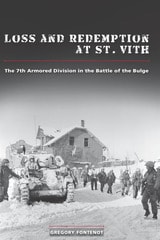
Loss and Redemption at St. Vith
The 7th Armored Division in the Battle of the BulgeGregory Fontenot, Colonel, US Army, Retired
University of Missouri Press, 2020
Loss within Loss
Artists in the Age of AIDSEdited by Edmund White; In Cooperation with the Estate Project for Artists with AIDS, a project of the Alliance for the Arts
University of Wisconsin Press, 2002
This landmark book is published in association with the Estate Project for Artists with AIDS, a national organization that preserves art works created by artists living with HIV or lost to AIDS. Loss within Loss stands as a powerful reminder of the devastating impact of the AIDS epidemic on the arts community and as the first real survey of that devastation. Though these accounts are often intensely sad, Loss within Loss is an invigorating, sometimes even exuberant, testimony to the sheer joy of being an artist . . . and being alive.
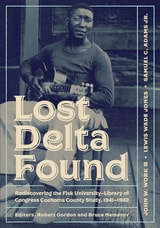
Lost Delta Found
Rediscovering the Fisk University-Library of Congress Coahoma County Study, 1941-1942John W. Work
Vanderbilt University Press, 2005
This remarkable book recovers three invaluable perspectives, long thought to have been lost, on the culture and music of the Mississippi Delta.
In 1941 and ’42 African American schol-ars from Fisk University—among them the noted composer and musicologist John W. Work III, sociologist Lewis Wade Jones, and graduate student Samuel C. Adams Jr.—joined folklorist Alan Lomax of the Library of Congress on research trips to Coahoma County, Mississippi. Their mission was “to document adequately the cultural and social backgrounds for music in the community.” Among the fruits of the project were the earliest recordings by the legendary blues singer and guitarist Muddy Waters.
The hallmark of the study was to have been a joint publication of its findings by Fisk and the Library of Congress. While this publication was never completed, Lost Delta Found is composed of the writings, interviews, notes, and musical transcriptions produced by Work, Jones, and Adams in the Coahoma County study. Their work captures, with compelling immediacy, a place, a people, a way of life, and a set of rich musical traditions as they existed in the 1940s.
Illustrated with photos and more than 160 musical transcriptions.

Lost Eagles
One Man's Mission to Find Missing Airmen in Two World WarsBlaine Pardoe
University of Michigan Press, 2010
Praise for Lost Eagles
"The pilot and observer stories selected have not previously seen much exposure. Not only are they interesting, but I found myself relishing getting to the next chapter to find out what Frederick Zinn was doing during the next stage of his life."
---Alan Roesler, founding member, League of World War I Aviation Historians, and former Managing Editor, Over the Front
Praise for Blaine Pardoe's previous military histories (which average 4.5-star customer reviews on Amazon.com):
Terror of the Autumn Skies: The True Story of Frank Luke, America's Rogue Ace of World War I
"This painstaking biography of World War I ace Frank Luke will earn Pardoe kudos . . . Pardoe has flown a very straight course in researching and recounting Luke's myth-ridden life. . . . Thorough annotation makes the book that much more valuable to WWI aviation scholars as well as for more casual air-combat buffs."
---Booklist
The Cruise of the Sea Eagle: The Amazing True Story of Imperial Germany's Gentleman Pirate
"This is a gem of a story, well told, and nicely laid out with photos, maps, and charts that cleverly illuminate the lost era of ‘gentlemen pirates' at sea . . . [German commerce raider Felix von Luckner's] legend lives on in this lively and readable biography."
---Admiral James Stavridis, U.S. Navy, Naval History
Few people have ever heard of Frederick Zinn, yet even today airmen's families are touched by this man and the work he performed in both world wars. Zinn created the techniques still in use to determine the final fate of airmen missing in action. The last line of the Air Force Creed reads, "We will leave no airman behind." Zinn made that promise possible.
Blaine Pardoe weaves together the complex story of a man who brought peace and closure to countless families who lost airmen during both world wars. His lasting contribution to warfare was a combination of his methodology for locating the remains of missing pilots (known as the Zinn system) and his innovation of imprinting all aircraft parts with the same serial number so that if a wreck was located, the crewman could be identified. The tradition he established for seeking and recovering airmen is carried on to this day.
Blaine Pardoe is an accomplished author who has published dozens of military fiction novels and other books, including the widely acclaimed Cubicle Warfare: Self-Defense Tactics for Today's Hypercompetitive Workplace; Terror of the Autumn Skies: The True Story of Frank Luke, America's Rogue Ace of World War I; and The Cruise of the Sea Eagle: The Amazing True Story of Imperial Germany's Gentleman Pirate.
Jacket photo: Frederick Zinn's Sopwith aircraft, which crashed during World War I. National Museum of the United States Air Force Archives.
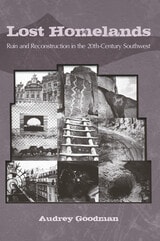
Lost Homelands
Ruin and Reconstruction in the 20th-Century SouthwestAudrey Goodman
University of Arizona Press, 2010
Through analyzing a variety of texts and images, Goodman illuminates the ways that modern forces such as militarization, environmental degradation, internal migration, and an increased border patrol presence have shattered the perception of a secure homeland in the Southwest. The deceptive natural beauty of the Southwest deserts shields a dark history of trauma and decimation that has remained as a shadow on the region’s psyche. The first to really synthesize such wide-ranging material about the effects of the atomic age in the Southwest, Goodman realizes the value of combined visual and verbal art and uses it to put forth her own original ideas about reconstructing a new sense of homeland.
Lost Homelands reminds us of the adversity and dislocation suffered by people of the Southwest by looking at the ways that artists, photographers, filmmakers, and writers have grappled with these problems for decades. In assessing the ruination of the region, however, Goodman argues that those same artists and writers have begun to reassemble a new sense of homeland from these fragments.
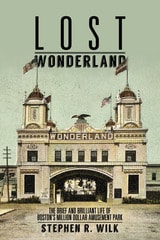
Lost Wonderland
The Brief and Brilliant Life of Boston's Million Dollar Amusement ParkStephen R. Wilk
University of Massachusetts Press, 2020
If you take Boston's Blue Line to its northern end, you'll reach the Wonderland stop. Few realize that a twenty-three-acre amusement park once sat nearby—the largest in New England, and grander than any of the Coney Island parks that inspired it. Opened in Revere on Memorial Day in 1906 to great fanfare, Wonderland offered hundreds of thousands of visitors recreation by the sea, just a short distance from downtown Boston.
The story of the park's creation and wild, but brief, success is full of larger-than-life characters who hoped to thrill attendees and rake in profits. Stephen R. Wilk describes the planning and history of the park, which featured early roller coasters, a scenic railway, a central lagoon in which a Shoot-the-Chutes boat plunged, an aerial swing, a funhouse, and more. Performances ran throughout the day, including a daring Fires and Flames show; a Wild West show; a children's theater; and numerous circus acts. While nothing remains of what was once called “Boston's Regal Home of Pleasure” and the park would close in 1910, this book resurrects Wonderland by transporting readers through its magical gates.
Lost in Time
Locating the Stranger in German ModernityJune J. Hwang
Northwestern University Press, 2014
Lost in the Shadow of the Word
Space, Time, and Freedom in Interwar Eastern EuropeBenjamin Paloff
Northwestern University Press, 2016
Scholars of modernism have long addressed how literature, painting, and music reflected the radical reconceptualization of space and time in the early twentieth century—a veritable revolution in both physics and philosophy that has been characterized as precipitating an “epistemic trauma” around the world. In this wide-ranging study, Benjamin Paloff contends that writers in Central and Eastern Europe felt this impact quite distinctly from their counterparts in Western Europe. For the latter, the destabilization of traditional notions of space and time inspired works that saw in it a new kind of freedom. However, for many Central and Eastern European authors, who were writing from within public discourses about how to construct new social realities, the need for escape met the realization that there was both nowhere to escape to and no stable delineation of what to escape from. In reading the prose and poetry of Czech, Polish, and Russian writers, Paloff imbues the term “Kafkaesque” with a complexity so far missing from our understanding of this moment in literary history.
Lost in the USA
American Identity from the Promise Keepers to the Million Mom MarchDeborah Gray White
University of Illinois Press, 2017
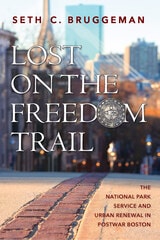
Lost on the Freedom Trail
The National Park Service and Urban Renewal in Postwar BostonSeth C. Bruggeman
University of Massachusetts Press, 2022
Boston National Historical Park is one of America's most popular heritage destinations, drawing in millions of visitors annually. Tourists flock there to see the site of the Boston Massacre, to relive Paul Revere's midnight ride, and to board Old Ironsides—all of these bound together by the iconic Freedom Trail, which traces the city's revolutionary saga.
Making sense of the Revolution, however, was never the primary aim for the planners who reimagined Boston's heritage landscape after the Second World War. Seth C. Bruggeman demonstrates that the Freedom Trail was always largely a tourist gimmick, devised to lure affluent white Americans into downtown revival schemes, its success hinging on a narrow vision of the city's history run through with old stories about heroic white men. When Congress pressured the National Park Service to create this historical park for the nation's bicentennial celebration in 1976, these ideas seeped into its organizational logic, precluding the possibility that history might prevail over gentrification and profit.
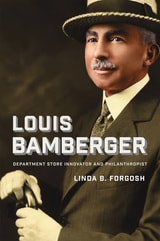
Louis Bamberger
Department Store Innovator and PhilanthropistLinda B. Forgosh
Brandeis University Press, 2016
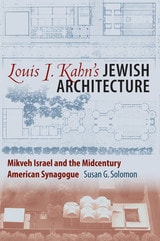
Louis I. Kahn’s Jewish Architecture
Mikveh Israel and the Midcentury American SynagogueSusan G. Solomon
University Press of New England, 2009
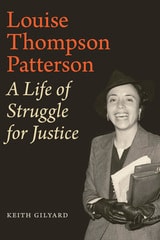
Louise Thompson Patterson
A Life of Struggle for JusticeKeith Gilyard
Duke University Press, 2017
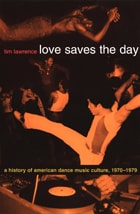
Love Saves the Day
A History of American Dance Music Culture, 1970-1979Tim Lawrence
Duke University Press, 2003
Tales of nocturnal journeys, radical music making, and polymorphous sexuality flow through the arteries of Love Saves the Day like hot liquid vinyl. They are interspersed with a detailed examination of the era’s most powerful djs, the venues in which they played, and the records they loved to spin—as well as the labels, musicians, vocalists, producers, remixers, party promoters, journalists, and dance crowds that fueled dance music’s tireless engine.
Love Saves the Day includes material from over three hundred original interviews with the scene's most influential players, including David Mancuso, Nicky Siano, Tom Moulton, Loleatta Holloway, Giorgio Moroder, Francis Grasso, Frankie Knuckles, and Earl Young. It incorporates more than twenty special dj discographies—listing the favorite records of the most important spinners of the disco decade—and a more general discography cataloging some six hundred releases. Love Saves the Day also contains a unique collection of more than seventy rare photos.

Love Valley
An American UtopiaConrad Ostwalt
University of Wisconsin Press, 1998
The town boasts a saloon, general store, hitching posts, and rodeos. Yet, above all of this stands a little church—the heart of what Barker conceived as his Christian utopia. This unique combination has led to more than forty years of philanthropic ventures, controversial events such as the Love Valley Rock Festival, stories and legends, and political ambition. Love Valley: An American Utopia captures the history of this town in narrative form while arguing that Love Valley’s founders were motivated by utopian goals.
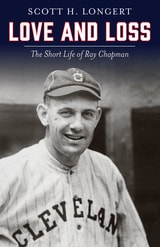
Love and Loss
The Short Life of Ray ChapmanScott H. Longert
Ohio University Press, 2024
The son of a coal miner from a small Illinois town, Cleveland Indians shortstop Ray Chapman lived the American dream until his untimely death at age twenty-nine. In his brief life, he reached the pinnacle of baseball success as the best shortstop in the American League. While many professional ballplayers struggled with meager salaries, the handsome Chapman had married heiress Kathleen Daly, one of Cleveland’s wealthiest women. With a child on the way and an executive job in the offseason, Chapman was moving toward a privileged place in society until an errant fastball fractured his skull and ended his life the next day. Late in the 1920 pennant race, the Indians were in New York for a key series against the Yankees. New York pitcher Carl Mays threw a high hard one that Chapman could not evade. He was taken to a nearby hospital, where doctors tried in vain to save his life. The tragedy did not end there. His widow took her own life eight years later, and their daughter, Rae, subsequently died from meningitis. Today, people visit Chapman’s impressive grave in Cleveland’s Lake View Cemetery, leaving baseballs and gloves in his memory. Though gone over a hundred years, he is well remembered as a Cleveland icon. This book goes far beyond the well-worn accounts of Chapman’s untimely death to illustrate the fullness of his short life.

Love and Politics in the Contemporary Spanish American Novel
By Aníbal González
University of Texas Press, 2010
The Latin American Literary Boom was marked by complex novels steeped in magical realism and questions of nationalism, often with themes of surreal violence. In recent years, however, those revolutionary projects of the sixties and seventies have given way to quite a different narrative vision and ideology. Dubbed the new sentimentalism, this trend is now keenly elucidated in Love and Politics in the Contemporary Spanish American Novel.
Offering a rich account of the rise of this new mode, as well as its political and cultural implications, Aníbal González delivers a close reading of novels by Miguel Barnet, Elena Poniatowska, Isabel Allende, Alfredo Bryce Echenique, Gabriel García Márquez, Antonio Skármeta, Luis Rafael Sánchez, and others. González proposes that new sentimental novels are inspired principally by a desire to heal the division, rancor, and fear produced by decades of social and political upheaval. Valuing pop culture above the avant-garde, such works also tend to celebrate agape—the love of one's neighbor—while denouncing the negative effects of passion (eros). Illuminating these and other aspects of post-Boom prose, Love and Politics in the Contemporary Spanish American Novel takes a fresh look at contemporary works.

Love in the Lav
A Social Biography of Same-Sex Desire in Ireland, 1922-1972Averill Earls
Temple University Press, 2025
Earls uses courtroom testimonies, police records, and family history archives as well as “educated speculation” to show how structures governing male same-sex desire in Ireland played out on the bodies of the men who desired men, the teen boys who sold sex to men, and the way the Catholic-nationalist ethos shaped the Gardaí who policed them.
Love in the Lav examines the experiences of people such as cabbie James Hand, who was put on trial for gross indecency, to provide a window into the queer working-class subculture of 1930s Dublin. Earls also focuses on issues of consent, especially with teens, and the unregulated queer Irish world of public figures, including Micheál Mac Liammóir, Hilton Edwards, Ronald Brown, and John Broderick.
By examining twentieth-century Ireland through the lived experiences of ordinary same-sex-desiring Irish men who were relegated to obscurity by Irish society, Earls reveals the contradictions, possibilities, and magnitude of postcolonial Irish Catholic nationalism.
In the series Sexuality Studies
Love, Anarchy, & Emma Goldman
A BiographyFalk, Candace
Rutgers University Press, 1990
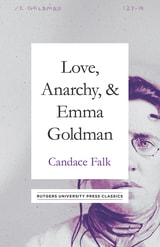
Love, Anarchy, & Emma Goldman
A BiographyCandace Serena Falk
Rutgers University Press, 2019
“Fascinating …With marvelous clarity and depth, Candace Falk illuminates for us an Emma Goldman shaped by her time yet presaging in her life the situation and conflicts of women in our time.” —Tillie Olsen
One of the most famous political activists of all time, Emma Goldman was also infamous for her radical anarchist views and her “scandalous” personal life. In public, Goldman was a firebrand, confidently agitating for labor reform, anarchism, birth control, and women’s independence. But behind closed doors she was more vulnerable, especially when it came to the love of her life.
Love, Anarchy, & Emma Goldman is an account of Goldman’s legendary career as a political activist. But it is more than that—it is a biography that offers an intimate look at how Goldman’s passion for social reform dovetailed with her passion for one man: Chicago activist, hobo king, and red-light district gynecologist Ben Reitman. Candace Falk takes us into the heart of their tumultuous love affair, finding that even as Goldman lectured on free love, she confronted her own intense jealousy.
As director of the Emma Goldman papers, Falk had access to over 40,000 writings by Goldman—including her private letters and notes—and she draws upon these archives to give us a rare insight into this brilliant, complex woman’s thoughts. The result is both a riveting love story and a primer on an exciting, explosive era in American politics and intellectual life.
Love, H
The Letters of Helene Dorn and Hettie JonesHettie Jones
Duke University Press, 2016
Loving Before Loving
A Marriage in Black and WhiteJoan Steinau Lester
University of Wisconsin Press, 2026
Braiding intellectual, personal, and political history, Lester tells the story of a writer and activist fighting for love and justice before, during, and after the Supreme Court’s 1967 decision striking down bans on interracial marriage in Loving v. Virginia. She describes her own shifts in consciousness, from an activist climbing police barricades by day and reading and writing late into the night to a woman navigating the coming-out process in midlife, before finding the publishing success she had dreamed of. Speaking candidly about every facet of her life, Lester illuminates her journey to fulfillment and healing.
Loving Faster than Light
Romance and Readers in Einstein's UniverseKaty Price
University of Chicago Press, 2012
Loving Mountains, Loving Men
Memoirs of a Gay AppalachianJeff Mann
Ohio University Press, 2005
Lowest White Boy
Greg Bottoms
West Virginia University Press, 2019
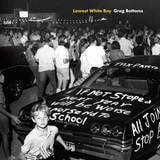
An innovative, hybrid work of literary nonfiction, Lowest White Boy takes its title from Lyndon Johnson’s observation during the civil rights era: “If you can convince the lowest white man he’s better than the best colored man, he won’t notice you’re picking his pocket.”
Greg Bottoms writes about growing up white and working class in Tidewater, Virginia, during school desegregation in the 1970s. He offers brief stories that accumulate to reveal the everyday experience of living inside complex, systematic racism that is often invisible to economically and politically disenfranchised white southerners—people who have benefitted from racism in material ways while being damaged by it, he suggests, psychologically and spiritually. Placing personal memories against a backdrop of documentary photography, social history, and cultural critique, Lowest White Boy explores normalized racial animus and reactionary white identity politics, particularly as these are collected and processed in the mind of a child.

Loyalty and Liberty
American Countersubversion from World War 1 to the McCarthy EraAlex Goodall
University of Illinois Press, 2013
Identifying varied interest groups such as business tycoons, Christian denominations, and Southern Democrats, Goodall demonstrates how countersubversive politics was far from unified: groups often pursued clashing aims while struggling to balance the competing pulls of loyalty to the nation and liberty of thought, speech, and action. Meanwhile, the federal government pursued its own course, which alternately converged with and diverged from the paths followed by private organizations. By the end of World War II, alliances on the left and right had largely consolidated into the form they would keep during the Cold War. Anticommunists on the right worked to rein in the supposedly dictatorial ambitions of the Roosevelt administration, while New Deal liberals divided into several camps: the Popular Front, civil liberties activists, and embryonic Cold Warriors who struggled with how to respond to communist espionage in Washington and communist influence in politics more broadly.
Rigorous in its scholarship yet accessible to a wide audience, Goodall's masterful study shows how opposition to radicalism became a defining ideological question of American life.
Lunch on a Beam
The Making of an American PhotographChristine Roussel
Brandeis University Press, 2026
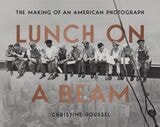
Lunch on a Beam, also known as Lunch Atop a Skyscraper, shows ironworkers eating lunch on a steel beam during the construction of Rockefeller Center’s RCA Building in 1932. It’s a photo so famous you can likely picture it in your mind: seated in a row, eleven men chat and break bread 850 feet above the ground, the dense cityscape behind them. While the scene may look spontaneous, the photo was taken during a publicity shoot to promote Rockefeller Center’s new skyscraper. And despite the image’s renown, for years, little information was available about its subjects or its photographer.
In Lunch on a Beam, Rockefeller Center archivist Christine Roussel interweaves the art, architectural, and social history behind the photograph with her personal experience as a confidante to the financiers who developed Rockefeller Center. She tells the stories of the fearless photographers, brazen publicity men, the ironworkers, and their immigrant and Indigenous communities. This portrait of eleven construction workers, she points out, is also a celebration of the nation’s richest man. She examines how, in the depths of the Great Depression, John D. Rockefeller, Jr., took it upon himself to build a monument to American industry and sell it to the public.
Featuring striking images from the Rockefeller Center Archives, Lunch on a Beam calls attention to the fascinating paradoxes contained in a single photo and celebrates the men who built an architectural marvel at great personal risk. This is a story of art and commerce, and the role of a photograph in the mythmaking of New York City.
Lured by the American Dream
Filipino Servants in the U.S. Navy and Coast Guard, 1952-1970P. James Paligutan
University of Illinois Press, 2022
Insightful and dramatic, Lured by the American Dream is the untold story of how Filipino servicepersons overcame tradition and hierarchy in their quest for dignity.
Lviv – Wroclaw, Cities in Parallel?
Myth, Memory and Migration, c. 1890-PresentJan Fellerer
Central European University Press, 2020
After World War II, Europe witnessed the massive redrawing of national borders and the efforts to make the population fit those new borders. As a consequence of these forced changes, both Lviv and Wrocław went through cataclysmic changes in population and culture. Assertively Polish prewar Lwów became Soviet Lvov, and then, after 1991, it became assertively Ukrainian Lviv. Breslau, the third largest city in Germany before 1945, was in turn "recovered" by communist Poland as Wrocław. Practically the entire population of Breslau was replaced, and Lwów's demography too was dramatically restructured: many Polish inhabitants migrated to Wrocław and most Jews perished or went into exile. The forced migration of these groups incorporated new myths and the construction of official memory projects.
The chapters in this edited book compare the two cities by focusing on lived experiences and "bottom-up" historical processes. Their sources and methods are those of micro-history and include oral testimonies, memoirs, direct observation and questionnaires, examples of popular culture, and media pieces. The essays explore many manifestations of the two sides of the same coin—loss on the one hand, gain on the other—in two cities that, as a result of the political reality of the time, are complementary.
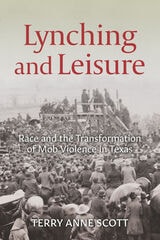
Lynching and Leisure
Race and the Transformation of Mob Violence in TexasTerry Anne Scott
University of Arkansas Press, 2022
Winner, 2022 Ottis Lock Endowment “Best Book” Award from the East Texas Historical Association
In Lynching and Leisure, Terry Anne Scott examines how white Texans transformed lynching from a largely clandestine strategy of extralegal punishment into a form of racialized recreation in which crowd involvement was integral to the mode and methods of the violence. Scott powerfully documents how lynchings came to function not only as tools for debasing the status of Black people but also as highly anticipated occasions for entertainment, making memories with friends and neighbors, and reifying whiteness. In focusing on the sense of pleasure and normality that prevailed among the white spectatorship, this comprehensive study of Texas lynchings sheds new light on the practice understood as one of the chief strategies of racial domination in the nineteenth- and twentieth-century South.
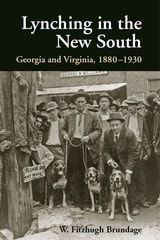
Lynching in the New South
Georgia and Virginia, 1880-1930W. Fitzhugh Brundage
University of Illinois Press, 1993
A groundbreaking study, Lynching in the New South is a classic portrait of the tradition of violence that poisoned American life.
Lyric Trade
Reading the Subject in the Postwar Long PoemJulia Bloch
University of Iowa Press, 2024
Engaging with poets such as Gwendolyn Brooks, H.D., Lorine Niedecker, Alice Notley, and Myung Mi Kim, this book asks: What does lyric mean, and why should it matter to poets and readers? Lyric Trade argues that lyric in the postwar long poem not only registers the ideological contradictions of modernism’s insistence on new forms, but that it also maps spaces for formal reimaginings of the subject.