93 books match the query '1946-' and 6 start with m
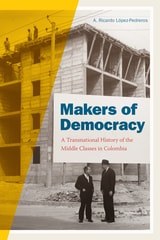
cover of Makers of Democracy: A Transnational History of the Middle Classes in Colombia

Makers of Democracy

A Transnational History of the Middle Classes in Colombia

A. Ricardo López-Pedreros

Duke University Press, 2019
In Makers of Democracy A. Ricardo López-Pedreros traces the ways in which a thriving middle class was understood to be a foundational marker of democracy in Colombia during the second half of the twentieth century. Drawing on a wide array of sources ranging from training manuals and oral histories to school and business archives, López-Pedreros shows how the Colombian middle class created a model of democracy based on free-market ideologies, private property rights, material inequality, and an emphasis on a masculine work culture. This model, which naturalized class and gender hierarchies, provided the groundwork for Colombia's later adoption of neoliberalism and inspired the emergence of alternate models of democracy and social hierarchies in the 1960s and 1970s that helped foment political radicalization. By highlighting the contested relationships between class, gender, economics, and politics, López-Pedreros theorizes democracy as a historically unstable practice that exacerbated multiple forms of domination, thereby prompting a rethinking of the formation of democracies throughout the Americas.
[more]
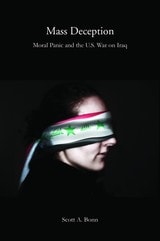
cover of Mass Deception: Moral Panic and the U.S. War on Iraq

Mass Deception

Moral Panic and the U.S. War on Iraq

Scott A. Bonn

Rutgers University Press, 2010

The attacks of 9/11 led to a war on Iraq, although there was neither tangible evidence that the nation's leader, Saddam Hussein, was linked to Osama bin Laden nor proof of weapons of mass destruction. Why, then, did the Iraq war garner so much acceptance in the United States during its primary stages?


Mass Deception argues that the George W. Bush administration manufactured public support for the war on Iraq. Scott A. Bonn introduces a unique, integrated, and interdisciplinary theory called "critical communication" to explain how and why political elites and the news media periodically create public panics that benefit both parties. Using quantitative analysis of public opinion polls and presidential rhetoric pre- and post-9/11 in the news media, Bonn applies the moral panic concept to the Iraq war. He critiques the war and occupation of Iraq as violations of domestic and international law. Finally, Mass Deception connects propaganda and distortion efforts by the Bush administration to more general theories of elite deviance and state crime.

[more]
cover of Me, Governor?: My Life in the Rough-and-Tumble World of New Jersey Politics

Me, Governor?

My Life in the Rough-and-Tumble World of New Jersey Politics

Richard J. Codey

Rutgers University Press, 2011
And so, a new chapter in the life of Richard J. Codey, an undertaker's son born and bred in the Garden State, began on the night of August 12, 2004--he knew from that point his life would never be the same . . . and it hasn't been. His memoir is a breezy, humorous, perceptive, and candid chronicle of local and state government from a man who lived among political movers and shakers for more than three decades. Codey became governor of New Jersey, succeeding James McGreevey, who resigned following a homosexual affair--a shattering scandal and set of circumstances that were bizarre, even for the home state of the Sopranos. At once a political autobiography, filled with lively, incisive anecdotes that record how Codey restored respectability and set a record for good politics and good government in a state so often tarnished, this is also the story about a man and his family.
[more]
cover of Melodrama as Provocateur

Melodrama as Provocateur

Linda Williams. Edited by Christine Gledhill, Laura Horak, and Elisabeth R. Anker

Duke University Press, 2026
As one of the most influential contemporary film scholars, Linda Williams brought her critical feminist lens to some of society’s most maligned and underappreciated film genres. Melodrama as Provocateur showcases what was to be Williams's last project in which, insisting on melodrama as a cross-generic, cross-media mode, she investigates the divergence between French and American attitudes to film melodrama. A diverse group of scholars respond to her provocations, rethinking melodrama’s transnational, transmedia histories and potential futures. Their contributions examine how melodrama became, as Williams argues, the default mode of contemporary media, and demonstrate how it plays an increasingly powerful role in public discourse and political rhetoric today.
[more]
cover of Memory and Identity in Ancient Judaism and Early Christianity: A Conversation with Barry Schwartz

Memory and Identity in Ancient Judaism and Early Christianity

A Conversation with Barry Schwartz

Tom Thatcher

SBL Press, 2014

Essential reading for scholars and students interested in sociology and biblical studies

In this collection scholars of biblical texts and rabbinics engage the work of Barry Schwartz, Professor Emeritus in the Department of Sociology at the University of Georgia. Schwartz provides an introductory essay on the study of collective memory. Articles that follow integrate his work into the study of early Jewish and Christian texts. The volume concludes with a response from Schwartz that continues this warm and fruitful dialogue between fields.

Features:

  • Articles that integrate the study of collective memory and social psychology into religious studies
  • Essays from Barry Schwartz
  • Theories applied rather than left as abstract principles
[more]
cover of Missed Connections

Missed Connections

Barbara Stenross

Temple University Press, 1999

"Why doesn't she just open up her ears and listen?" Few physical problems are as poorly understood as hearing loss. In Missed Connections, a new kind of  self-help book that combines sociological reporting with personal reflection, sociologist Barbara Stenross examines what hearing loss feels like to those who have it and which technologies and strategies can improve communication at home and in public.

Based on seven  years of research, Stenross's book tells of how -- as she sought information and solutions to help her hard-of-hearing father -- she came  to join a community group called Village Self Help for Hard of Hearing People. Taking us along to group meetings and into the homes of members, Stenross shows us -- through the personal accounts of these individuals -- the exhaustion that comes from constantly straining to listen, the frustration of missing critical comments or the or the punchlines of jokes, and the pain that hard-of-hearing family members experience when loved ones accuse them of hearing "when they want to." Full of scenes, dialogues, and conversations, Missed Connections also discusses such practical issues as how people with impaired hearing can continues to use the phone, how assistive technologies can help in public and private, why hearing aids can't always do enough, and how bluffing and silence can hurt more than help. Understanding that when one family member is hard of hearing, the whole family can suffer from "missed connections," Stenross offers in this book a useful family resource with a broad range of practical guidance.

With chapters on belonging and acceptance, do's and don'ts in public, lip-reading, hearing aids, and television, Missed Connections will interest a range of readers including deaf and hard-of-hearing people -- as well as their families, teachers, friends, employers, and counselors -- healthcare professionals, scholars, and others interested in the experience of and solutions for disability and hearing loss.
[more]