Results by title
168 books match the query '1989-' and 5 start with m
Metaphorical World Politics
Francis A. Beer
Michigan State University Press, 2004
Metaphorical World Politics argues that language and metaphor are important parts of international political reality. Metaphors and world politics have appeared together many times in recent history. The blended space that results is metaphorical world politics, a real- world game for political and scientific actors. This collection picks up the challenge to unravel the game, to examine its rules, to clarify the mixture of images and facts that is so real in politics but so exceptional in science. Scholars have studied metaphor mostly from a linguistic or a literary point of view. This work forces those primarily interested in metaphors to think about applications and implications beyond the text. Others concerned mainly with world politics may consider how metaphors may help to energize and structure international political thought and action.
Scholars have most often studied world politics embedded in so-called "facts." Metaphorical World Politics shows that facts are misleading in their compactness, that facts are often meaningless, that metaphors in contrast are energetic processors of meaning, and that facts in world politics are nothing more than weak emulsions of metaphor. This work outlines the general place of metaphor on the map of politics and highlights the location of specific metaphors on the political terrain.
Moral Issues
How Public Opinion on Abortion and Gay Rights Affects American Religion and PoliticsPaul Goren and Christopher Chapp
University of Chicago Press, 2024
A new perspective on how beliefs about abortion and gay rights reshaped American politics.
Many believe that religious and partisan identities undergird American public opinion. However, when it comes to abortion and gay rights, the reverse may be closer to the truth.
Drawing on wide-ranging evidence, Paul Goren and Christopher Chapp show that views on abortion and gay rights are just as durable and politically impactful—and often more so—than political and religious identities. Goren and Chapp locate the lasting strength of stances on abortion and gay rights in the automatic, visceral emotions that the media has primed since the late 1980s. Moral Issues examines how attitudes toward these moralized issues affect, and can sometimes even disrupt, religious and partisan identities. Indeed, over the last thirty years, these attitudes have accelerated the rise of the religious “nones,” who have no religious affiliation, and promoted moral sorting into the Democratic and Republican parties.
My African Horse Problem
William F. S. Miles
University of Massachusetts Press, 2008
My African Horse Problem recounts the intricacies of this unusual father-son expedition, a sometimes harrowing two-week trip that Samuel joined as "true heir" to the disputed stallion. It relates the circumstances leading up to the dispute and describes the intimacy of a relationship spanning a quarter century between William Miles and the custodians of his family horse—Islamic village friends eking out a precarious existence along the remote sub-Saharan borderline between Nigeria and Niger.
My African Horse Problem is a multi-layered narrative—part memoir, part ethnography—reaching back to Miles's days as a Peace Corps volunteer in Niger in the 1970s and a Fulbright scholar in the 1980s. At a deeper level, the story juxtaposes the idealistic and sometimes irresponsible tendencies of a young university graduate with the parental concerns of a middle-aged, tenured professor. Miles wonders if he was justified in exposing Sam to some of the worst health risks on earth, mainly to restore tenuous ties with long-ago friends in the African bush. Was it reckless to make his son illegally cross international boundaries, in a quixotic quest for justice and family honor? My African Horse Problem is more than an adventurer's tale with a unique story line: it is a father-son travel rumination, leavened by Sam's journal entries that help his father see Africa anew through a child's fresh eyes. In this era of religious and racial tensions, it is also a reaffirmation—within a black Muslim context—of the basic human imperative of trust.
My Heart Became a Bomb
Poems by Ramy al-Asheq; translated by Levi Thompson
University of Texas Press, 2021
My Heart Became a Bomb is the first collection of poetry by Syrian-Palestinian poet Ramy al-Asheq to be translated into English. Poignant and raw, these poems take the reader along a path of forced emigration from Bashar al-Assad’s prisons in Syria to Amsterdam to Auschwitz to Berlin, Germany, where Al-Asheq is now creating a new home. By turns melancholy and reflective, celebratory and hopeful, Al-Asheq’s newly translated poems offer the English-reading audience a contemporary perspective on the experience of exile in a world facing the phenomeno of mass migration, whether for political or environmental reasons. The translations are the result of a long collaboration between Al-Asheq and Thompson (who also edited this collection). Raising questions about the nature of love, identity, and the role of poetry in the face of constant flux and great uncertainty, My Heart Became a Bomb introduces an important new voice to the world of contemporary poetry.
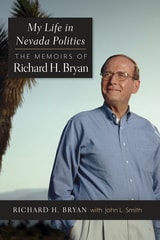
My Life in Nevada Politics
The Memoirs of Senator Richard H. BryanRichard H. Bryan
University of Nevada Press, 2024
Born in Washington, D.C. in 1937, Bryan grew up in Las Vegas. His interest in politics started early, winning school-class elections and expressing a personal goal of one day becoming Governor of Nevada. He was elected student body president at the University of Nevada.
His career in public service began as a deputy district attorney in Clark County. In 1966, he became the first county public defender in state history. Bryan served in the Nevada Legislature in both the Assembly and Senate before winning the statewide office of Attorney General in 1978. He was elected Nevada Governor in 1982, winning re-election in 1986. Bryan was elected to the U.S. Senate in 1988, reelected in 1994, and served on the committees on Commerce, Banking, Taxation, and Intelligence, and chaired the Ethics Committee. He retired from the Senate in 2001 and returned to Nevada.
Bryan’s list of accomplishments is extensive. He was largely responsible for the early call-to-arms in the fight against the Department of Energy’s attempt to create a nuclear waste repository at Yucca Mountain. As governor, he reorganized state economic development programs, improved environmental protections for Lake Tahoe and other threatened areas, and made unprecedented appointments of women. In the Senate, Bryan authored the Southern Nevada Public Lands Management Act and the National Conservation Area for the High Rock Desert country. He had a front-row seat to the historic buildup to the Iraq War and the impeachment of President Bill Clinton. In retirement, Bryan continues to serve the state through his participation on a wide range of committees.
Throughout his political career, Bryan, with wife Bonnie at his side, traversed Nevada from its tiniest hamlets to the metro areas of Reno and Las Vegas with unrivaled zeal in his efforts to represent the state’s citizens. He is famous for knowing thousands of his constituents not only by their first names, but also recalling details of their lives. The simple fact is, while in service to Nevada, Bryan was in his element in the place he loves best.